Loading...
Done
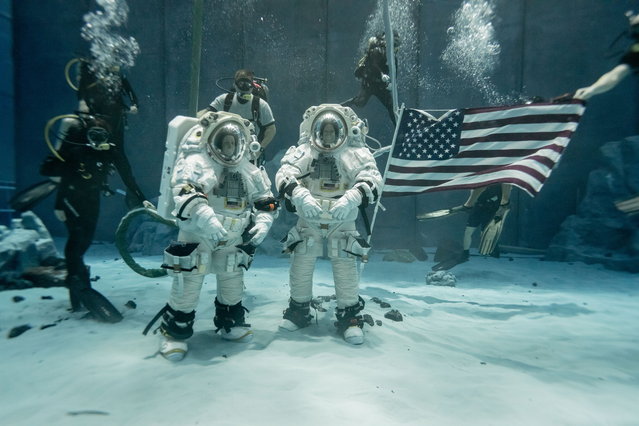
NASA astronauts Stan Love and Loral O’Hara test Axiom Space’s lunar spacesuits underwater on October 1, 2025. The AxEMU suit is designed for the Artemis III mission to the moon’s south pole, due to lift off no earlier than mid-2027. (Photo by NBL/NASA via South West News Service)

NASA astronauts Stan Love and Loral O’Hara test Axiom Space’s lunar spacesuits underwater on October 1, 2025. The AxEMU suit is designed for the Artemis III mission to the moon’s south pole, due to lift off no earlier than mid-2027. (Photo by NBL/NASA via South West News Service)
Details
08 Oct 2025 03:56:00
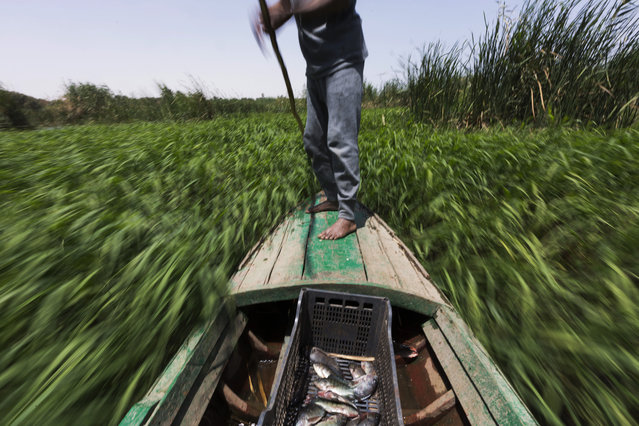
In this April 12, 2015 photo, Sayed Ahmed Abdoh poles his boat to check his fish traps in the Nile River, near Abu al-Nasr village, about 770 kilometers (480 miles) south of Cairo, Egypt. Abdoh caught some 20 fish this day and gave them to his friend, Salama Osman, a migrant worker in a Cairo apartment building, to celebrate his biannual return to their village. (Photo by Hiro Komae/AP Photo)

In this April 12, 2015 photo, Sayed Ahmed Abdoh poles his boat to check his fish traps in the Nile River, near Abu al-Nasr village, about 770 kilometers (480 miles) south of Cairo, Egypt. Abdoh caught some 20 fish this day and gave them to his friend, Salama Osman, a migrant worker in a Cairo apartment building, to celebrate his biannual return to their village. (Photo by Hiro Komae/AP Photo)
Details
06 May 2015 13:11:00
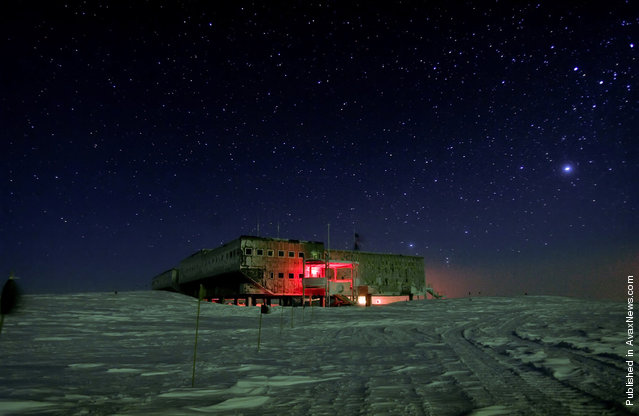
Amundsen-Scott South Pole Station experiences months of darkness. The sun dips below the horizon on March 21, after which follows several weeks of twilight before complete darkness results

Amundsen-Scott South Pole Station experiences months of darkness. The sun dips below the horizon on March 21, after which follows several weeks of twilight before complete darkness results. Photo taken on June 25, 2009. (National Science Foundation/Jeremy Johnson)
Details
08 Apr 2012 13:07:00
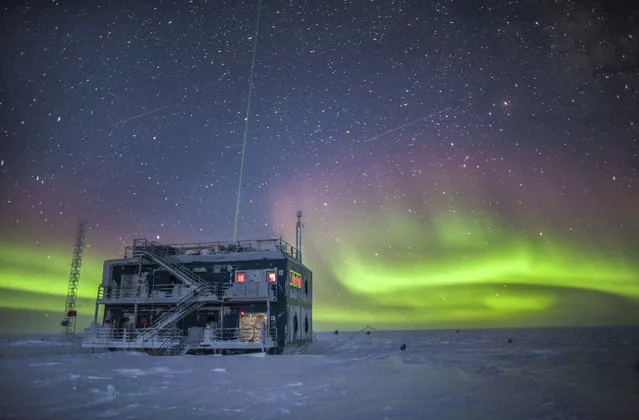
This undated photo provided by NOAA in May 2018 shows aurora australis near the South Pole Atmospheric Research Observatory in Antarctica. When a hole in the ozone formed over Antarctica, countries around the world in 1987 agreed to phase out several types of ozone-depleting chemicals called chlorofluorocarbons (CFCs). Production was banned, emissions fell and the hole shriveled. But according to a study released on Wednesday, May 16, 2018, scientists say since 2013, there’s more of a banned CFC going into the atmosphere. (Photo by Patrick Cullis/NOAA via AP Photo)

This undated photo provided by NOAA in May 2018 shows aurora australis near the South Pole Atmospheric Research Observatory in Antarctica. When a hole in the ozone formed over Antarctica, countries around the world in 1987 agreed to phase out several types of ozone-depleting chemicals called chlorofluorocarbons (CFCs). Production was banned, emissions fell and the hole shriveled. But according to a study released on Wednesday, May 16, 2018, scientists say since 2013, there’s more of a banned CFC going into the atmosphere. (Photo by Patrick Cullis/NOAA via AP Photo)
Details
15 Aug 2018 00:05:00
Elodie Katze, co-owner of Wild Pole Studio, performs a trick on a pole as students look on during a class at the  pole dancing studio Wild Pole in Paris, France, on March 26, 2024. (Photo by Benoit Tessier/Reuters)

Elodie Katze, co-owner of Wild Pole Studio, performs a trick on a pole as students look on during a class at the pole dancing studio Wild Pole in Paris, France, on March 26, 2024. (Photo by Benoit Tessier/Reuters)
Details
21 Apr 2024 03:08:00
Antarctic World Record Attempt

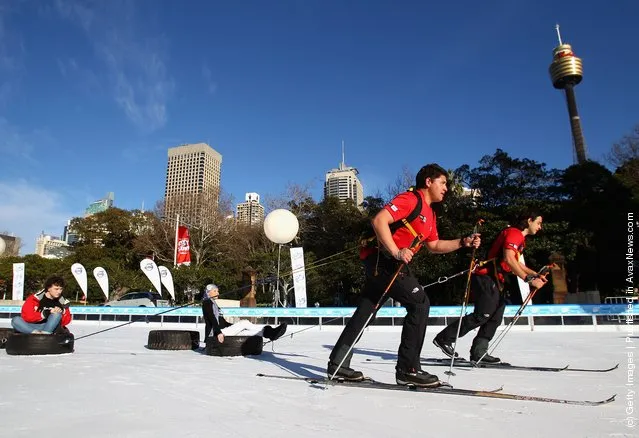
James Castrission, “Cas” and Justin Jones “Jonesy” ski across an ice staking rink with two “You Can” patients on August 2, 2011 in Sydney, Australia. In 75 days, the Aussie adventure pair will attempt to cross 2,200 kilometres of Antarctic ice to the South Pole and back on foot to raise money for youth with cancer. The journey will require the two to trek with all the supplies for approximately three months of walking. Cas and Jonesy became the first to kayak unassisted over 3,300 kilometres from New Zealand to Australia in 2008. (Photo by Ryan Pierse/Getty Images)
Details
02 Aug 2011 14:00:00
McMurdo Station Antarctic

McMurdo Station is a U.S. Antarctic research centre located on the southern tip of Ross Island, which is in the New Zealand-claimed Ross Dependency on the shore of McMurdo Sound in Antarctica. It is operated by the United States through the United States Antarctic Program, a branch of the National Science Foundation. The station is the largest community in Antarctica, capable of supporting up to 1,258 residents, and serves as the United States Antarctic science facility. All personnel and cargo going to or coming from Amundsen–Scott South Pole Station first pass through McMurdo.
Details
05 Sep 2013 10:18:00
Assimilation By Dillon Marsh

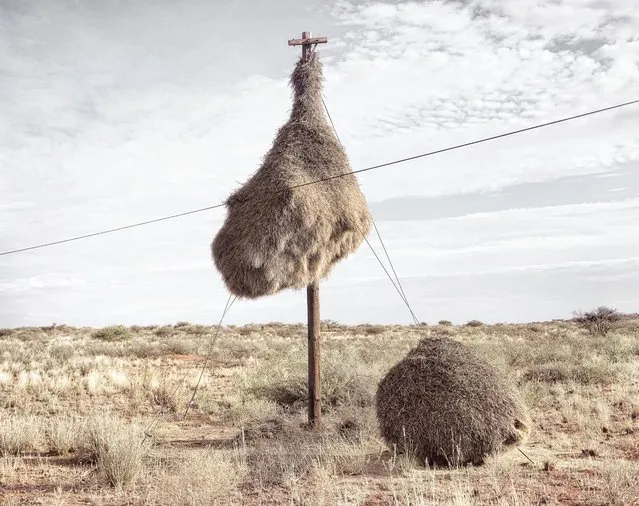
Captured by South African photographer Dillon Marsh, these fantastic photographs depict the many designs employed by sociable weavers to build sturdy nests that are safe from intruders such as cobras and tree snakes. They are also nice cool during the day, and stay warm during cold desert nights. A University of Stellenbosch graduate, Marsh is currently interested in landscape photographer who seeks out anomalies that can be arranged in a photographic series. Assimilation depicts scores of intricate weaver’s nests atop utility poles in Southern Africa. Colonies of sociable weavers have been known to stay attached to one particular nest for up to 100 years, according to The San Diego Zoo.
Details
15 Feb 2014 14:47:00