Loading...
Done
Adrienne Yip takes a picture of her Burmese mountain dog named “Walter”, beneath the cherry blossoms in peak bloom at the Tidal Basin with the Washington Monument seen behind, in Washington, DC, USA, 18 March 2024. Peak bloom, as defined when seventy percent of the cherry blossoms are open, is occuring this week. This year's peak bloom, beginning the 17th of March, is tied for the second earliest in history and is seen as a reflection of warming temperatures. (Photo by Michael Reynolds/EPA/EFE/Rex Features/Shutterstock)

Adrienne Yip takes a picture of her Burmese mountain dog named “Walter”, beneath the cherry blossoms in peak bloom at the Tidal Basin with the Washington Monument seen behind, in Washington, DC, USA, 18 March 2024. Peak bloom, as defined when seventy percent of the cherry blossoms are open, is occuring this week. This year's peak bloom, beginning the 17th of March, is tied for the second earliest in history and is seen as a reflection of warming temperatures. (Photo by Michael Reynolds/EPA/EFE/Rex Features/Shutterstock)
Details
31 Mar 2024 05:48:00
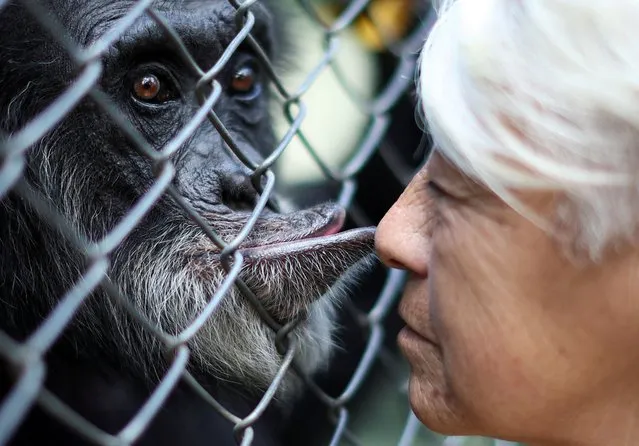
Keeper Silvia Salvatierra, 59, is kissed by a chimp named “Jony”, 54, who was rescued from a circus, at the Lujan Zoo from where felines, including tigers and lions, will be transferred to a wildlife sanctuary in India, in Lujan, on the outskirts of Buenos Aires, Argentina on April 8, 2024. (Photo by Agustin Marcarian/Reuters)

Keeper Silvia Salvatierra, 59, is kissed by a chimp named “Jony”, 54, who was rescued from a circus, at the Lujan Zoo from where felines, including tigers and lions, will be transferred to a wildlife sanctuary in India, in Lujan, on the outskirts of Buenos Aires, Argentina on April 8, 2024. (Photo by Agustin Marcarian/Reuters)
Details
14 Apr 2024 03:59:00
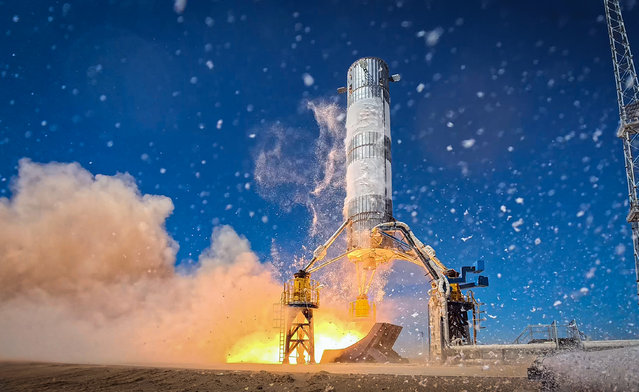
China's independently developed Zhuque-3 reusable test rocket conducts a flight test at Jiuquan Satellite Launch Center on September 11, 2024 in Jiuquan, Gansu Province of China. China's private space company LandSpace successfully conducted a 10-kilometer vertical takeoff and vertical landing (VTVL) test on September 11. (Photo by Ni Yanqiang, Zeng Yangxi/Zhejiang Daily Press Group/VCG via Getty Images)

China's independently developed Zhuque-3 reusable test rocket conducts a flight test at Jiuquan Satellite Launch Center on September 11, 2024 in Jiuquan, Gansu Province of China. China's private space company LandSpace successfully conducted a 10-kilometer vertical takeoff and vertical landing (VTVL) test on September 11. (Photo by Ni Yanqiang, Zeng Yangxi/Zhejiang Daily Press Group/VCG via Getty Images)
Details
05 Jan 2026 12:04:00
A man assists two young hostages who managed to escape from the school building after special forces entered the school in Beslan, North Ossetia, Friday 03 September 2004. Streams of hostages fled the besieged school in Beslan in southern Russia Friday amid intensive shooting and a series of powerful explosions that signalled a bloody end to the three-day stand-off with terrorists. (Photo by Yuri Kochetkov/EPA)

On September 1, 2004, Chechen militants stormed an elementary school in the town of Beslan in the Russian republic of North Ossetia. They took 1,100 teachers, children, and their relatives hostage, demanding the withdrawal of federal forces from Chechnya as a condition for their release. On September 3, 2004, Russian security forces stormed the building, resulting in a battle in which more than 330 hostages died, including 186 children. Here: A man assists two young hostages who managed to escape from the school building after special forces entered the school in Beslan, North Ossetia, Friday 03 September 2004. (Photo by Yuri Kochetkov/EPA)
Details
25 Sep 2017 06:41:00
A Hindu devotee performs a stunt with fire during a rehearsal for the annual Rath Yatra, or chariot procession, which commemorates a journey by Hindu god Jagannath, his brother Balabhadra and sister Subhadra, in specially made chariots, in Ahmedabad, India, June 26, 2016. (Photo by Amit Dave/Reuters)

A Hindu devotee performs a stunt with fire during a rehearsal for the annual Rath Yatra, or chariot procession, which commemorates a journey by Hindu god Jagannath, his brother Balabhadra and sister Subhadra, in specially made chariots, in Ahmedabad, India, June 26, 2016. (Photo by Amit Dave/Reuters)
Details
04 Jul 2016 08:20:00
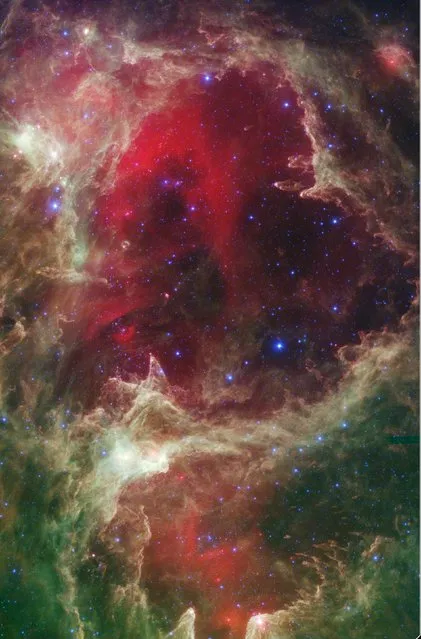
An infrared portrait from NASA's Spitzer Space Telescope which shows generations of stars is seen in this undated NASA handout image released February 14, 2013. In this wispy star-forming region, called W5, the oldest stars can be seen as blue dots in the centers of the two hollow cavities (other blue dots are background and foreground stars not associated with the region). Red shows heated dust that pervades the region's cavities, while green highlights dense clouds. (Photo by NASA/Reuters/JPL-Caltech/Harvard-Smithsonian/Handout)

An infrared portrait from NASA's Spitzer Space Telescope which shows generations of stars is seen in this undated NASA handout image released February 14, 2013. In this wispy star-forming region, called W5, the oldest stars can be seen as blue dots in the centers of the two hollow cavities (other blue dots are background and foreground stars not associated with the region). Red shows heated dust that pervades the region's cavities, while green highlights dense clouds. (Photo by NASA/Reuters/JPL-Caltech/Harvard-Smithsonian/Handout)
Details
03 Mar 2013 08:44:00
Iraqi teenagers swim in waste water from the nearby Tuweitha nuclear facility near Baghdad, Iraq on May 28, 2003. Iraqis are consuming contaminated water unaware of the dangerous pollutants that can cause severe ill health. (Photo by Damir Sagolj/Reuters)

Iraqi teenagers swim in waste water from the nearby Tuweitha nuclear facility near Baghdad, Iraq on May 28, 2003. Iraqis are consuming contaminated water unaware of the dangerous pollutants that can cause severe ill health. (Photo by Damir Sagolj/Reuters)
Details
24 Jun 2019 00:05:00
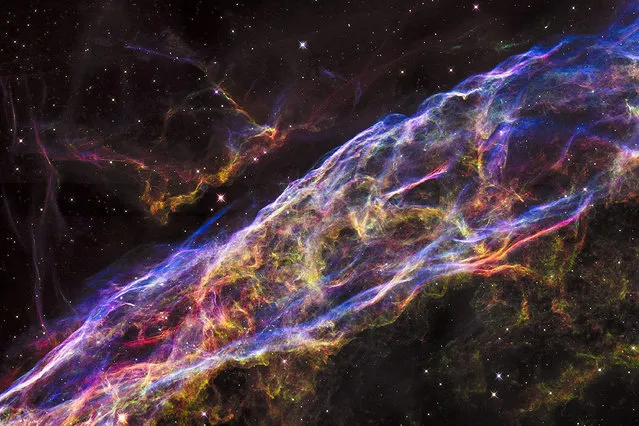
A small section of the expanding remains of the Veil Nebula, a massive star that exploded about 8,000 years ago. The entire nebula is 110 light-years across, covering six full moons on the sky as seen from Earth, and resides about 2,100 light-years away in the constellation Cygnus, the Swan. (Photo by Reuters/NASA/ESA/Hubble)

A small section of the expanding remains of the Veil Nebula, a massive star that exploded about 8,000 years ago. The entire nebula is 110 light-years across, covering six full moons on the sky as seen from Earth, and resides about 2,100 light-years away in the constellation Cygnus, the Swan. (Photo by Reuters/NASA/ESA/Hubble)
Details
29 Feb 2016 11:30:00