Loading...
Done
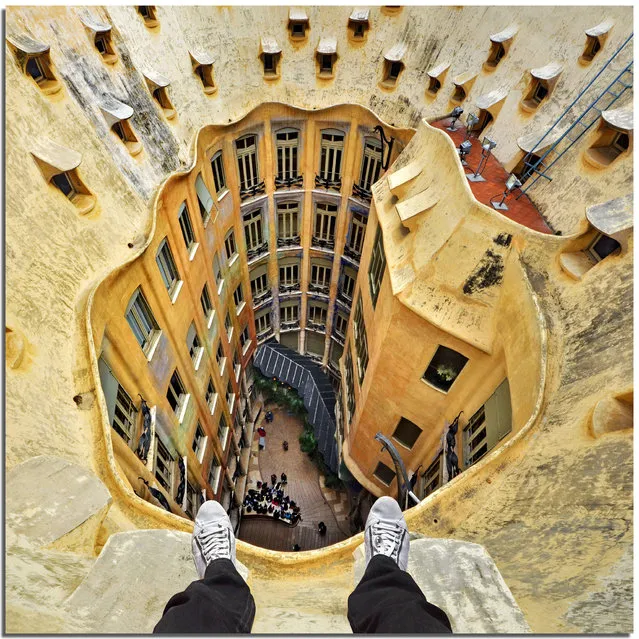
“Not for the faint of heart”. Casa Milà, better known as La Pedrera, is a building designed by the Catalan architect Antoni Gaudí and built during the years 1905–1910, being considered officially completed in 1912. It is located at 92, Passeig de Gràcia in the Eixample district of Barcelona, Catalonia, Spain. (Stefano Scarselli)

“Not for the faint of heart”. Casa Milà, better known as La Pedrera, is a building designed by the Catalan architect Antoni Gaudí and built during the years 1905–1910, being considered officially completed in 1912. It is located at 92, Passeig de Gràcia in the Eixample district of Barcelona, Catalonia, Spain. (Photo by Stefano Scarselli)
Details
17 Jan 2013 14:17:00
Fireworks explode over the Kremlin in Red Square which was blocked by police during New Year celebrations in Moscow, Russia, Sunday, January 1, 2017. New Year's Eve is Russia's major gift-giving holiday, and big Russian cities were awash in festive lights and decorations. (Photo by Alexander Zemlianichenko Jr./AP Photo)

Fireworks explode over the Kremlin in Red Square which was blocked by police during New Year celebrations in Moscow, Russia, Sunday, January 1, 2017. New Year's Eve is Russia's major gift-giving holiday, and big Russian cities were awash in festive lights and decorations. (Photo by Alexander Zemlianichenko Jr./AP Photo)
Details
02 Jan 2017 12:37:00
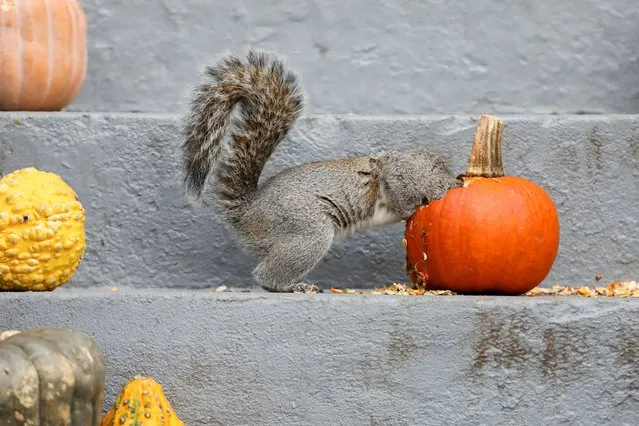
A squirrel digs into a pumpkin in Washington, U.S., November 28, 2022. (Photo by Amanda Andrade-Rhoades./Reuters)

A squirrel digs into a pumpkin in Washington, U.S., November 28, 2022. (Photo by Amanda Andrade-Rhoades./Reuters)
Details
05 Dec 2022 04:15:00
“Mr Big Dipper”, Nicholas Roemmelt (Denmark). A stargazer observes the constellation of the Big Dipper perfectly aligned with the window of the entrance to a large glacier cave in Engadin, Switzerland. This is a panorama of two pictures, and each is a stack of another two pictures: one for the stars and another one for the foreground, but with no composing or time blending. (Photo by Nicholas Roemmelt/National Maritime Museum/The Guardian)

“Mr Big Dipper”, Nicholas Roemmelt (Denmark). A stargazer observes the constellation of the Big Dipper perfectly aligned with the window of the entrance to a large glacier cave in Engadin, Switzerland. This is a panorama of two pictures, and each is a stack of another two pictures: one for the stars and another one for the foreground, but with no composing or time blending. (Photo by Nicholas Roemmelt/National Maritime Museum/The Guardian)
Details
27 Jul 2017 06:50:00
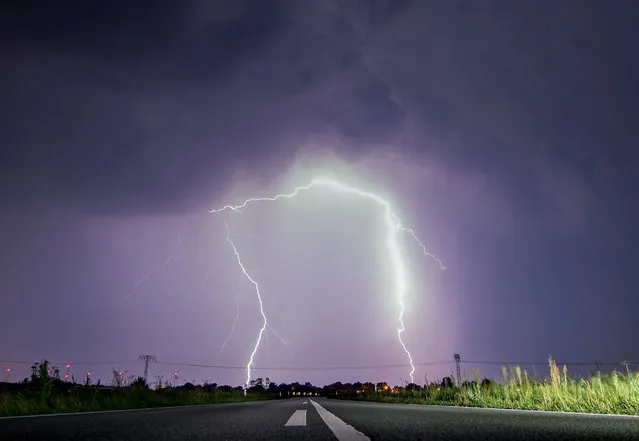
Lightning strikes near Jacobsdorf at the Oder-Spree district in eastern Germany, September 1, 2015. (Photo by Patrick Pleul/AFP Photo)

Lightning strikes near Jacobsdorf at the Oder-Spree district in eastern Germany, September 1, 2015. (Photo by Patrick Pleul/AFP Photo)
Details
02 Dec 2015 08:06:00
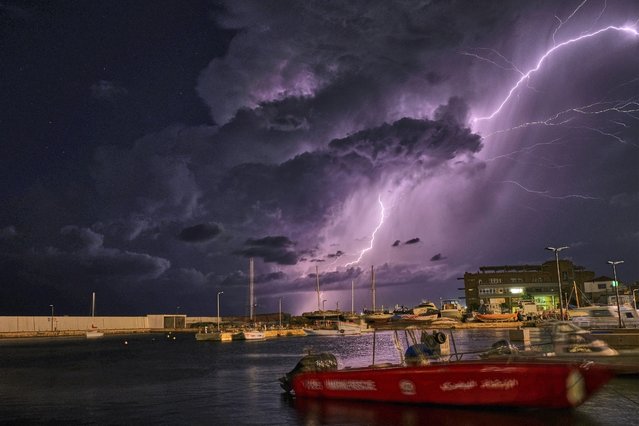
Lightning streaks across the skies over the coastal port city of Batroun, some 43km north of the Lebanese capital Beirut on December 6, 2023. (Photo by Ibrahim Chalhoub/AFP Photo)

Lightning streaks across the skies over the coastal port city of Batroun, some 43km north of the Lebanese capital Beirut on December 6, 2023. (Photo by Ibrahim Chalhoub/AFP Photo)
Details
05 Aug 2024 04:36:00
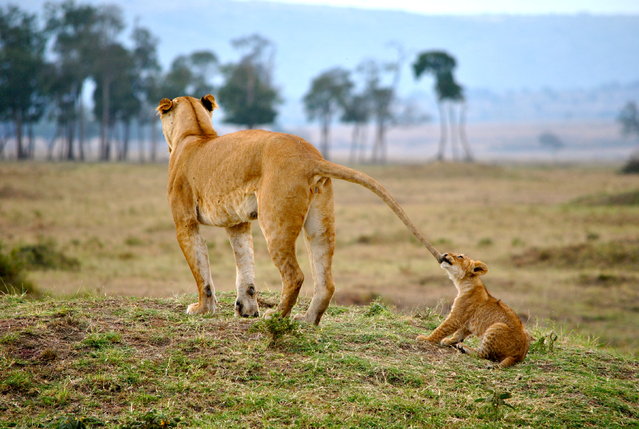
“A Mothers Tail”. A baby cub pulls on his mother's tail to get attention. Photo location: Masai Mara, Kenya. (Photo and caption by Tori Marsh/National Geographic Photo Contest)

“A Mothers Tail”. A baby cub pulls on his mother's tail to get attention. Photo location: Masai Mara, Kenya. (Photo and caption by Tori Marsh/National Geographic Photo Contest)
Details
21 Oct 2014 12:40:00
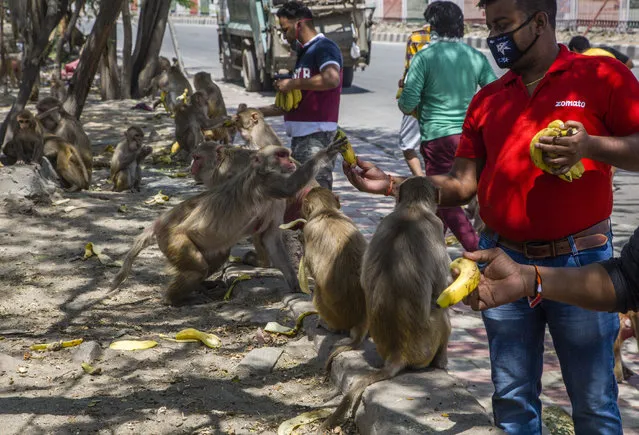
Men give bananas to monkeys gathered on the side of the road as India remains under an unprecedented lockdown over the highly contagious coronavirus (COVID-19) on April 08, 2020 in New Delhi, India. Wild animals, including monkeys, are roaming human settlements in India as people are staying indoors due to the 21-day lockdown. With India's 1.3 billion population and tens of millions of cars off the roads, wildlife is moving towards areas inhabited by humans. Wild animals in many countries have been seen roaming streets. A study says some 60 percent of the new diseases found around the globe every year are zoonotic, meaning they originate in animals and are passed on to humans. COVID-19 is a zoonotic disease that is suspected to have come from the wet markets of Wuhan, China. (Photo by Yawar Nazir/Getty Images)

Men give bananas to monkeys gathered on the side of the road as India remains under an unprecedented lockdown over the highly contagious coronavirus (COVID-19) on April 08, 2020 in New Delhi, India. Wild animals, including monkeys, are roaming human settlements in India as people are staying indoors due to the 21-day lockdown. (Photo by Yawar Nazir/Getty Images)
Details
12 Apr 2020 00:05:00