Loading...
Done
Amazing Photos by Yann Arthus-Bertrand. Part Four

Yann Arthus-Bertrand (born March 13, 1946 in Paris) is a French photographer, journalist, reporter and environmentalist.


Part One Part Two Part Three

Details
24 Sep 2012 16:52:00


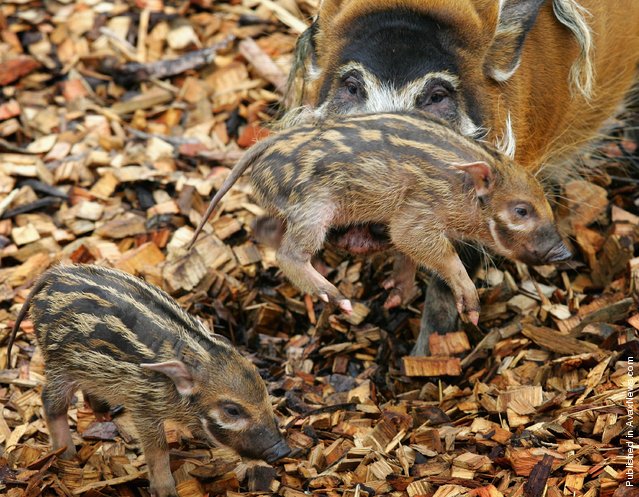
“The Red River Hog (Potamochoerus porcus), also known as the Bush Pig (but not to be confused with P. larvatus, common name “Bushpig”), is a wild member of the pig family living in Africa, with most of its distribution in the Guinean and Congolian forests. It is rarely seen away from rainforests, and generally prefers areas near rivers or swamps.

Red River Hogs eat grass, berries, roots, insects, molluscs, small vertebrates and carrion. They are capable of causing damage to plantations. Red River Hogs typically live in herds of 6-20 members led by a dominant boar. Sows rear 3-6 piglets at a time.”

Photo: Two 17 day old red river hoglet twins forage for food next to their mother Bahiti at London Zoo on August 23, 2007 in London, England. Red River hoglets inhabit the forests and swamps of West and Central Africa. The recent additions to the London Zoo pig pen have been eagerly awaited by zoo keepers. (Photo by Chris Jackson/Getty Images)
Details
18 Mar 2011 15:15:00


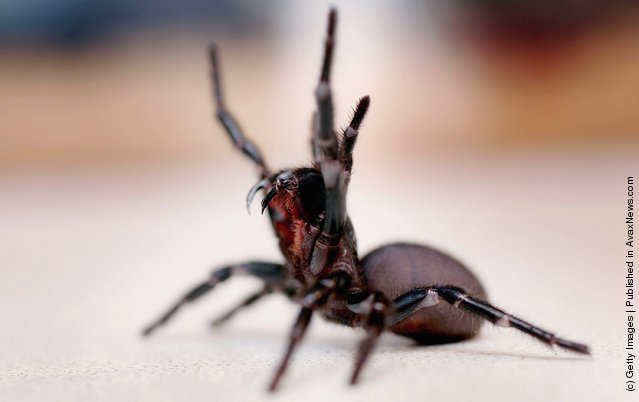
A Funnel Web spider is pictured at the Australian Reptile Park January 23, 2006 in Sydney, Australia. The Funnel Web is one of Australia's deadliest animals, with a venom that is packed with at least 40 different toxic proteins. A bite from a Funnel Web causes massive electrical over-load in the body's nervous system. Finally, fatalities occur from either heart attack or a pulmonary oedema, where the capillaries around the lungs begin to leak fluid and the patient effectively drowns. Death can come as quickly as two hours after a bite if no medical treatment is sought. Due to advances in anti-venom, there has been no death from a Funnel Web bite in Australia since 1980. Australia is home to some of the most deadly and poisonous animals on earth. (Photo by Ian Waldie/Getty Images)
Details
25 Apr 2011 07:49:00
Russians Go To The Polls In Presidential Election And The Kremlin Prepares For Protests

(Excuse me for the clumsy electronic translator) Today in Moscow presidential elections are spent. Abundantly clear that without dependence from their results the winner will be declared Vladimir Putin. It can lead to the mass protest. Therefore the authorities have deduced on streets of thousand soldiers and policemen. For example, personally I (Avax) see from the window: four buses and two trucks with RIOT police. In photos more low – Moscow on March 04, 2012. A Garden Ring, The Tverskaya street, The Mayoralty, The State Duma, and The Bolshoi theater. (Photos by: Vladimir Maltsev; Source: LiveJournal; Rustem Adagamov; Source: LiveJournal).
Details
04 Mar 2012 13:22:00
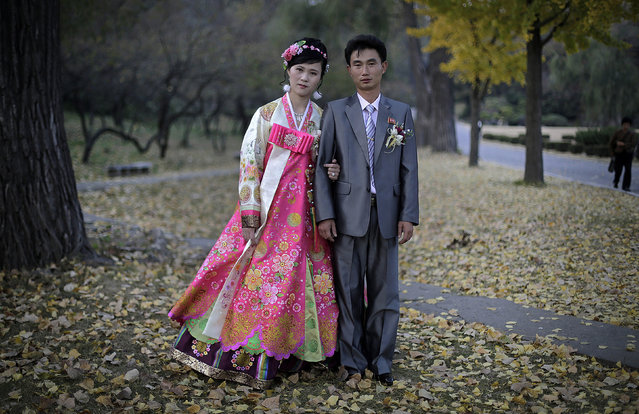
In this October 25, 2014, file photo, North Korean bride Ri Ok Ran, 28, and groom Kang Sung Jin, 32, pose for a portrait at the Moran Hill where they went to take wedding pictures, in Pyongyang, North Korea. The couple were married after dating for about two years. Their motto: “To have many children so that they can serve in the army and defend and uphold our leader and country, for many years into the future”. (Photo by Wong Maye-E/AP Photo)

Associated Press photographer Wong Maye-E tries to get her North Korean subjects to open up as much as is possible in an authoritarian country with no tolerance for dissent and great distrust of foreigners. She has taken dozens of portraits of North Koreans over the past three years, often after breaking the ice by taking photos with an instant camera and sharing them. Her question for everyone she photographs: What is your motto? Their answers reflect both their varied lives and the government that looms incessantly over all of them. (Photo by Wong Maye-E/AP Photo)
Details
16 Jun 2017 06:28:00
Surfers take to the waves at Bondi Beach on October 16, 2021 in Sydney, Australia. COVID-19 restrictions eased across NSW on Monday 11 October for fully vaccinated residents after the state passed its 70 per cent double vaccination target. Under the state government's Reopening NSW Roadmap, hospitality, retail stores, gyms and hairdressers can reopen, along with indoor entertainment venues, cinemas, theatres, museums and galleries. Restrictions will ease further in NSW once the state reaches its next vaccination milestone of 80 per cent of people having received two doses of a COVID-19 vaccine. (Photo by Brook Mitchell/Getty Images)

Surfers take to the waves at Bondi Beach on October 16, 2021 in Sydney, Australia. COVID-19 restrictions eased across NSW on Monday 11 October for fully vaccinated residents after the state passed its 70 per cent double vaccination target. (Photo by Brook Mitchell/Getty Images)
Details
17 Dec 2021 10:24:00
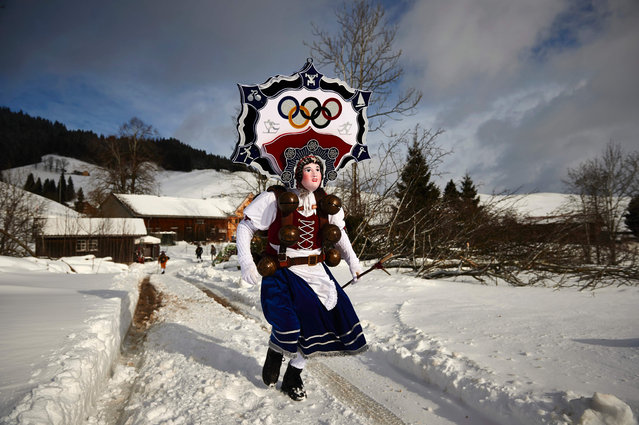
A leader “Rolli” of a yodel group “Schuppel” runs in the snow in front of a farmstead during the “Silvesterchlausen” in the early morning in Urnaesch in the Swiss canton Appenzell Ausserroden on January 13, 2017. The “Silvesterchlausen” is a tradition of the Swiss canton Appenzell, where colorfull characters organized in groups called “Schuppel”, chase out the old year and welcome the new one. They run all day long from farmstead to farmstead, gather together to sing a jodel and great the farmers. A “Schuppel” consists of some “Schelli” and two “Rolli”, sometimes with female dresses and nice scenes over the head, despite the dress all participants are males. The Silversterchlausen run twice a year, first for the new Silvester on December 31, and then again on January 13, for the old Silvester following the Julian calendar. (Photo by Michael Buholzer/AFP Photo)

A leader “Rolli” of a yodel group “Schuppel” runs in the snow in front of a farmstead during the “Silvesterchlausen” in the early morning in Urnaesch in the Swiss canton Appenzell Ausserroden on January 13, 2017. (Photo by Michael Buholzer/AFP Photo)
Details
14 Jan 2017 12:41:00
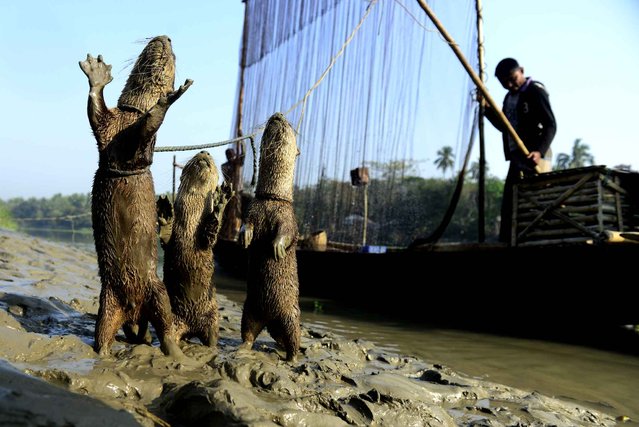
Bangladeshi fisherman feed their otters as they catch fish in Narail some 208 kms from Dhaka on March 11, 2014. The fishermen are using a rare technique that relies on coordination between man and trained otters, a centuries-old fishing partnership that has already long died out in other parts of Asia. (Photo by Munir Uz Zaman/AFP Photo)

Bangladeshi fisherman feed their otters as they catch fish in Narail some 208 kms from Dhaka on March 11, 2014. The fishermen are using a rare technique that relies on coordination between man and trained otters, a centuries-old fishing partnership that has already long died out in other parts of Asia. (Photo by Munir Uz Zaman/AFP Photo)
Details
22 Mar 2014 14:22:00