Loading...
Done
Two scavengers collect plastics in the Citarum river in Bandung, West Java on March 28, 2023. (Photo by Timur Matahari/AFP Photo)

Two scavengers collect plastics in the Citarum river in Bandung, West Java on March 28, 2023. (Photo by Timur Matahari/AFP Photo)
Details
04 Apr 2023 04:12:00
A woman wears glasses in support of late Venezuelan President Hugo Chavez during a caravan to carry Chavez's cadet saber and his dagger to the mausoleum where the politician's remains are laid to rest, in Caracas on March 15, 2023. The caravan traveled some 9 kilometers through the streets of Caracas to the Cuartel de la Montaña, also known as the Cuartel 4 de Febrero, as a reminder of the date of the failed coup led by Chavez on February 4, 1992. (Photo by Miguel Zambrano/AFP Photo)

A woman wears glasses in support of late Venezuelan President Hugo Chavez during a caravan to carry Chavez's cadet saber and his dagger to the mausoleum where the politician's remains are laid to rest, in Caracas on March 15, 2023. The caravan traveled some 9 kilometers through the streets of Caracas to the Cuartel de la Montaña, also known as the Cuartel 4 de Febrero, as a reminder of the date of the failed coup led by Chavez on February 4, 1992. (Photo by Miguel Zambrano/AFP Photo)
Details
06 Apr 2023 03:34:00
A participant rides a bicycle carrying an orangutan mascot costume as he attends an awareness action calling for the protection of orangutans, organised by local environmental NGO Satya Bumi to mark World Orangutan Day, observed on August 19, during Car Free Day in Jakarta on August 24, 2025. (Photo by Yasuyoshi Chiba/AFP Photo)

A participant rides a bicycle carrying an orangutan mascot costume as he attends an awareness action calling for the protection of orangutans, organised by local environmental NGO Satya Bumi to mark World Orangutan Day, observed on August 19, during Car Free Day in Jakarta on August 24, 2025. (Photo by Yasuyoshi Chiba/AFP Photo)
Details
16 Sep 2025 03:42:00
Four hundred buyers from around the world join 260 diamond manufacturing and trading firms on International Diamond Week as some 1,500 people are expected to trade more than  billion of polished diamonds this week in Ramat Gan, Israel on February 16, 2016. The Israel Diamond Exchange is considered the most secure in the world, covering an area of 100,000 square meters with 3,500 bourse members. Israeli diamonds are sold for over $2,000 per carat. Israel's 2015 annual export of diamonds exceeded .1 billion, comprising about 15% of the nation's industrial exports. (Photo by Nir Alon via ZUMA Wire)

Four hundred buyers from around the world join 260 diamond manufacturing and trading firms on International Diamond Week as some 1,500 people are expected to trade more than billion of polished diamonds this week in Ramat Gan, Israel on February 16, 2016. The Israel Diamond Exchange is considered the most secure in the world, covering an area of 100,000 square meters with 3,500 bourse members. (Photo by Nir Alon via ZUMA Wire)
Details
17 Feb 2016 10:38:00
Ebiowei, 48, carries an empty oil container on his head to a place where it would be filled with refined fuel at an illegal refinery site near river Nun in Nigeria's oil state of Bayelsa November 27, 2012. (Photo by Akintunde Akinleye/Reuters)

Ebiowei, 48, carries an empty oil container on his head to a place where it would be filled with refined fuel at an illegal refinery site near river Nun in Nigeria's oil state of Bayelsa November 27, 2012. Locals in the industry say workers can earn $50 to $60 a day. Thousands of people in Nigeria engage in a practice known locally as “oil bunkering” – hacking into pipelines to steal crude then refining it or selling it abroad. The practice, which leaves oil spewing from pipelines for miles around, managed to lift around a fifth of Nigeria's two million barrel a day production last year according to the finance ministry. (Photo by Akintunde Akinleye/Reuters)
Details
18 Jan 2013 14:29:00
Nasar, an Arabian horse, stands in the office of doctor Stephanie Arndt at her home on February 19, 2014 in Holt, Germany. Fearing for the horse's safety, Mrs. Arndt brought the horse into her house during the Xaver heavy storm back in December, and the horse now wanders through the house daily, inspecting details and looking for snacks. Mrs. Arndt says she doesn't mind, and though the horse never spends the night, it does occasionally take a nap in the house. (Photo by Patrick Lux/Getty Images)


Nasar, an Arabian horse, stands in the office of doctor Stephanie Arndt at her home on February 19, 2014 in Holt, Germany. Fearing for the horse's safety, Mrs. Arndt brought the horse into her house during the Xaver heavy storm back in December, and the horse now wanders through the house daily, inspecting details and looking for snacks. Mrs. Arndt says she doesn't mind, and though the horse never spends the night, it does occasionally take a nap in the house. (Photo by Patrick Lux/Getty Images)

Details
23 Feb 2014 09:44:00
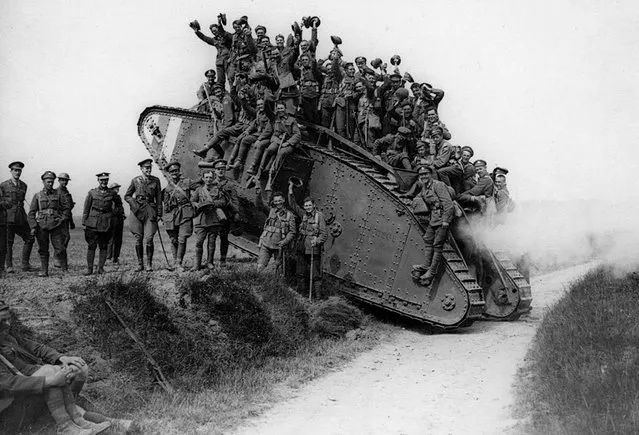
These black-and-white photos are taken from the new book “Armoured Warfare in the First World War 1916 – 1918” by Anthony Tucker-Jones and published by Pen & Sword Military. “Interestingly the British, French and Germans took completely different approaches with varying results”. The British military produced “Little Willie” in Autumn 1915 weighing 18 tonnes, which had a crew of two plus four gunners. “Inspired by a tracked artillery tractor “Little Willie” was referred to as a water tank – hence the name tank – to ensure secrecy”, said Anthony. “This led to the strange looking Mark I with its peculiar rhomboid shape, designed to cross trenches with guns in sponsons on either side. The Germans saw the tank as unchivalrous and were slow to grasp its utility. They favoured the Stormtrooper (specialist soldiers used to infiltrate enemy trenches) and artillery, not the tank”, said Anthony. “However, they didn’t hesitate to make use of captured British tanks. Although the tank helped secure victory and German soldiers dubbed it “Germany’s Downfall” the country was ultimately brought to its knees by the Allies blockade”. Here: British troops hitch a ride on a Mark IV after the massed tank fleet spearheading attack at Cambrai on November 20, 1917. (Photo by Anthony Tucker-Jones/Mediadrumworld.com)

These black-and-white photos are taken from the new book “Armoured Warfare in the First World War 1916 – 1918” by Anthony Tucker-Jones and published by Pen & Sword Military. Here: British troops hitch a ride on a Mark IV after the massed tank fleet spearheading attack at Cambrai on November 20, 1917. (Photo by Anthony Tucker-Jones/Mediadrumworld.com)
Details
23 Feb 2017 00:02:00
Fireplace for children, Trondheim, Norway, by Haugen/Zohar. The children of Trondheim come to sit around the fire and tell stories in this whimsical cone hut, made with materials recycled from a construction site. (Photo by Jason Havneraas/The Guardian)

Fireplace for children, Trondheim, Norway, by Haugen/Zohar. The children of Trondheim come to sit around the fire and tell stories in this whimsical cone hut, made with materials recycled from a construction site. (Photo by Jason Havneraas/The Guardian)
Details
17 Mar 2017 00:04:00