Loading...
Done
An empty camp is shown beneath a colourful sky in Siberia, December 2016. (Photo by Timothy Allen/Barcroft Productions)

A British photographer has captured life at the “edge of the world”. Timothy Allen, best known for his work on BBC's Human Planet, trekked through the freezing Siberian wilderness for 16 days as he joined part of an 800km migration of reindeer in the Yamal-Nenets region – a name that roughly translates to “edge of the world”. The stunning pictures feature the nomadic Nenets tribe, who drink blood to survive in -45°C temperatures. Timothy's epic journey, which will be revealed in an eight-minute documentary on Animal Planet USA, saw him travel across the bleak terrain of the frozen Ob River with the Nenets people in December last year. Here: An empty camp is shown beneath a colourful sky in Siberia, December 2016. (Photo by Timothy Allen/Barcroft Productions)
Details
19 Sep 2017 07:48:00
A fighter of Libyan forces allied with the U.N.-backed government runs for cover during a battle with Islamic State fighters in Sirte, Libya, July 31, 2016. (Photo by Goran Tomasevic/Reuters)

A fighter of Libyan forces allied with the U.N.-backed government runs for cover during a battle with Islamic State fighters in Sirte, Libya, July 31, 2016. (Photo by Goran Tomasevic/Reuters)
Details
01 Aug 2016 10:16:00
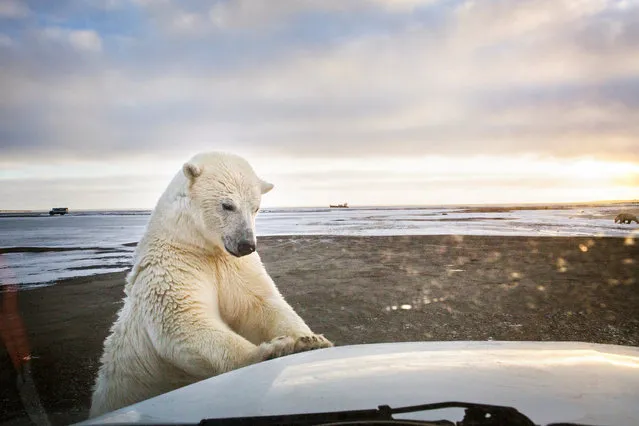
In late summer and early autumn polar bears flock to the native village of Kaktovik in the Alaskan Arctic to eat at “the boneyard” – the remains of whales annually hunted by the community. (Photo by Katie Orlinsky/Getty Images)

A selection of work by four photojournalists who have won grants of $10,000 and editorial support from the agency. Here: “Chasing Winter” by Katie Orlinksy. In late summer and early autumn polar bears flock to the native village of Kaktovik in the Alaskan Arctic to eat at “the boneyard” – the remains of whales annually hunted by the community. (Photo by Katie Orlinsky/Getty Images)
Details
02 Sep 2016 13:55:00
Miss Earth 2016 candidates wearing environmental statement sashes lineup during a press presentation in Manila, Philippines, 11 October 2016. Eighty three young women from around the globe converged in Manila for the international beauty event. Miss Earth is a pioneering beauty pageant that serves as a vehicle for environmental advocacy. (Photo by Mark R. Cristino/EPA)

Miss Earth 2016 candidates wearing environmental statement sashes lineup during a press presentation in Manila, Philippines, 11 October 2016. Eighty three young women from around the globe converged in Manila for the international beauty event. Miss Earth is a pioneering beauty pageant that serves as a vehicle for environmental advocacy. (Photo by Mark R. Cristino/EPA)
Details
12 Oct 2016 11:02:00
This image made available by the Johns Hopkins University Applied Physics Laboratory on Wednesday, May 31, 2017 depicts NASA's Solar Probe Plus spacecraft approaching the sun. On Wednesday, NASA announced it will launch the probe in summer 2018 to explore the solar atmosphere. It will be subjected to brutal heat and radiation like no other man-made structure before. (Photo by Johns Hopkins University Applied Physics Laboratory via AP Photo)

This image made available by the Johns Hopkins University Applied Physics Laboratory on Wednesday, May 31, 2017 depicts NASA's Solar Probe Plus spacecraft approaching the sun. On Wednesday, NASA announced it will launch the probe in summer 2018 to explore the solar atmosphere. It will be subjected to brutal heat and radiation like no other man-made structure before. (Photo by Johns Hopkins University Applied Physics Laboratory via AP Photo)
Details
08 Sep 2017 09:42:00
A woman poses next to a giant mining truck at the entrance of the Dakar Rally camp in Calama, Chile. The truck operates in copper mines near the city. (Photo by Victor R. Caivano/Associated Press)

A woman poses next to a giant mining truck at the entrance of the Dakar Rally camp in Calama, Chile. The truck operates in copper mines near the city. (Photo by Victor R. Caivano/Associated Press)
Details
19 Jan 2014 05:28:00
Titanoboa: Monster Snake

Titanoboa, meaning "titanic boa," is an extinct genus of snake that lived approximately 60–58 million years ago, during the Paleocene epoch, a 10-million-year period immediately following the dinosaur extinction event. The only known species is Titanoboa cerrejonensis, the largest, longest, and heaviest snake ever discovered, which supplanted the previous record holder, Gigantophis.

A full-scale model of the snake was unveiled at New York City's Grand Central station before the exhibit opens at the Smithsonian in Washington DC.
Details
06 Feb 2014 12:38:00
A baby wallaby

“Very small forest-dwelling wallabies are known as pademelons (genus Thylogale) and dorcopsises (genera Dorcopsis and Dorcopsulus). The name wallaby comes from the Eora Aboriginal tribe who were the original inhabitants of the Sydney area. Wallabies are herbivores whose diet consists of a wide range of grasses, vegetables, leaves, and other types of foliage”. – Wikipedia

Photo: A baby wallaby sits in a zoo attendant's lap at Edogawa Natural Zoo on August 4, 2009 in Tokyo, Japan. The staff of the zoo have raised the young wallaby after her mother neglected her. (Photo by Junko Kimura/Getty Images)
Details
07 Sep 2011 13:33:00