Loading...
Done
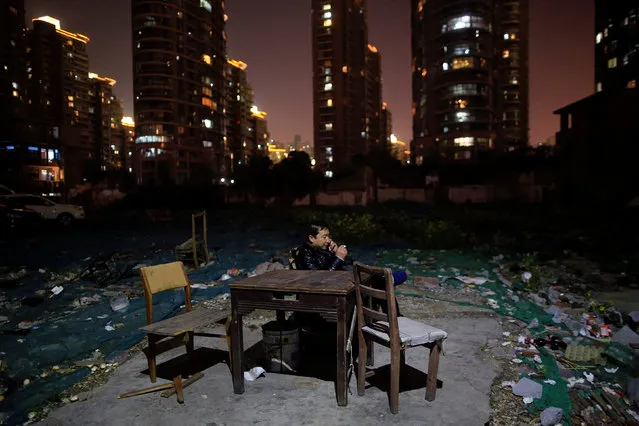
Li Guoqiang talks on his phone outside his house at Guangfuli neighbourhood, in Shanghai, China, April 1, 2016. Li, 38, is a deliveryman who rents a place at Guangfuli. (Photo by Aly Song/Reuters)

Li Guoqiang talks on his phone outside his house at Guangfuli neighbourhood, in Shanghai, China, April 1, 2016. Li, 38, is a deliveryman who rents a place at Guangfuli. In a corner of Shanghai, surrounded by a cement wall, lies one of the world's most valuable fields of debris and garbage. On paper, the Guangfuli neighbourhood is a real estate investor's dream: a plot in the middle of one of the world's most expensive and fast-rising property markets. But the reality is more like a developer's nightmare, thanks to hundreds of people living there who have refused to budge from their ramshackle homes for nearly 16 years as the local authority sought to clear the land for new construction. (Photo by Aly Song/Reuters)
Details
06 May 2016 13:54:00
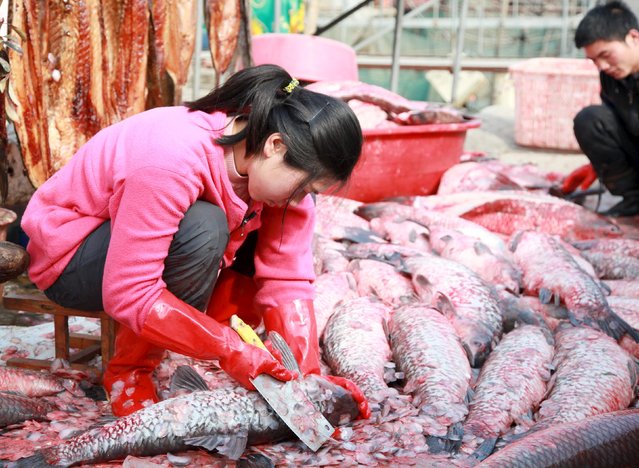
A woman scales fish by the side of a lake as she prepares for the upcoming Chinese Lunar New Year in Suqian, Jiangsu province, China, January 27, 2016. (Photo by Reuters/China Daily)

A woman scales fish by the side of a lake as she prepares for the upcoming Chinese Lunar New Year in Suqian, Jiangsu province, China, January 27, 2016. (Photo by Reuters/China Daily)
Details
04 Feb 2016 11:03:00
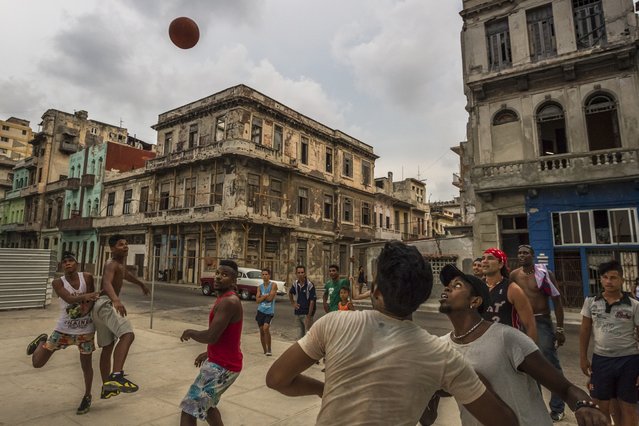
Young men play basketball on an improvised court wedged between a construction site and the shells of once grand colonial homes in Havana, July 20, 2015. As much as the young in Cuba welcome political opening and economic reform, such changes are unlikely to filter down to their lives anytime soon. (Photo by Meridith Kohut/The New York Times)

Young men play basketball on an improvised court wedged between a construction site and the shells of once grand colonial homes in Havana, July 20, 2015. As much as the young in Cuba welcome political opening and economic reform, such changes are unlikely to filter down to their lives anytime soon. (Photo by Meridith Kohut/The New York Times)
Details
07 Aug 2015 11:11:00
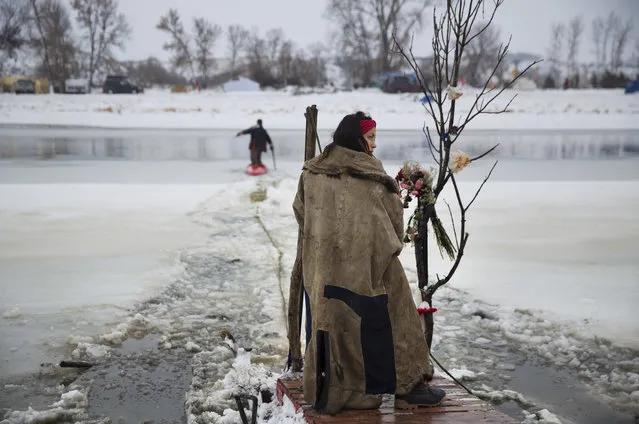
In this Thursday, December 1, 2016 photo, Cat Bigney, part of the Oglala Native American tribe, waits on the shore of the Cannonball river for travelers to arrive by canoe at the Oceti Sakowin camp where people have gathered to protest the Dakota Access oil pipeline in Cannon Ball, N.D. So far, those at the camp have shrugged off the heavy snow, icy winds and frigid temperatures. But if they defy next week's government deadline to abandon the camp, demonstrators know the real deep freeze lies ahead. Life-threatening wind chills and towering snow drifts could mean the greatest challenge is simple survival. (Photo by David Goldman/AP Photo)

In this Thursday, December 1, 2016 photo, Cat Bigney, part of the Oglala Native American tribe, waits on the shore of the Cannonball river for travelers to arrive by canoe at the Oceti Sakowin camp where people have gathered to protest the Dakota Access oil pipeline in Cannon Ball, N.D. So far, those at the camp have shrugged off the heavy snow, icy winds and frigid temperatures. But if they defy next week's government deadline to abandon the camp, demonstrators know the real deep freeze lies ahead. Life-threatening wind chills and towering snow drifts could mean the greatest challenge is simple survival. (Photo by David Goldman/AP Photo)
Details
06 Dec 2016 10:22:00
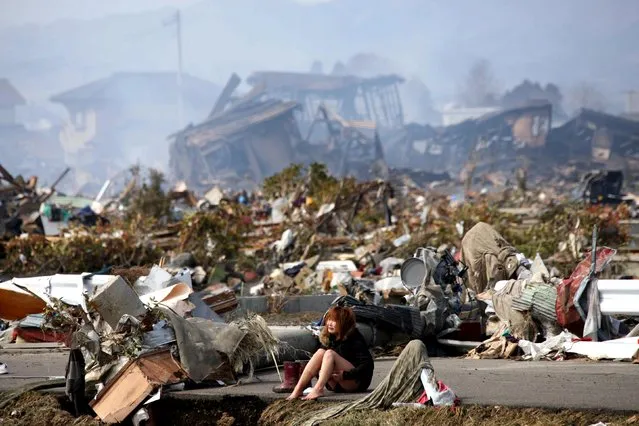
A woman cries while sitting on a road amid the destroyed city of Natori, Miyagi Prefecture in northern Japan March 13, 2011, after a massive earthquake and tsunami that are feared to have killed more than 10,000 people. (Photo by Asahi Shimbun/Reuters)

A woman cries while sitting on a road amid the destroyed city of Natori, Miyagi Prefecture in northern Japan March 13, 2011, after a massive earthquake and tsunami. Five years on from the tsunami that triggered meltdowns at Japan's Fukushima nuclear plant, the page is anything but turned. A magnitude 9 earthquake and towering tsunami on March 11, 2011 killed nearly 16,000 people along Japan's northeastern coast and left more than 2,500 missing. The 10-metre (33-foot) tsunami swept away everything in its path, including houses, ships, cars and farm buildings. (Photo by Asahi Shimbun/Reuters)
Details
09 Mar 2016 12:40:00
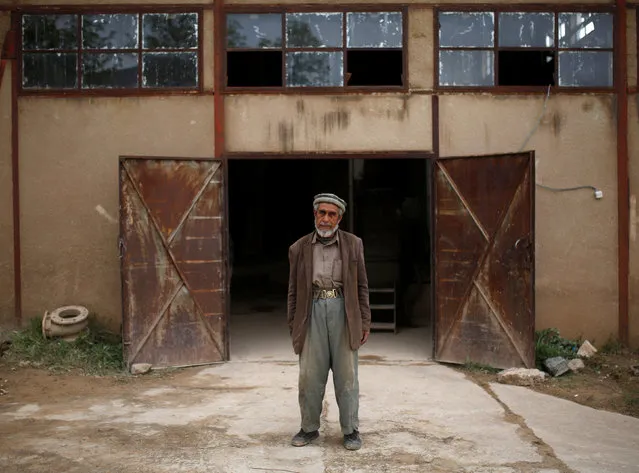
A worker at the Jabal Saraj cement factory poses for a photograph in Jabal Saraj, north of Kabul, Afghanistan April 19, 2016. (Photo by Ahmad Masood/Reuters)

A worker at the Jabal Saraj cement factory poses for a photograph in Jabal Saraj, north of Kabul, Afghanistan April 19, 2016. In an area desperately short of industry and jobs, local workers hope that the relaunch of the plant in Jabal Saraj, built by Czech engineers in 1957 and closed down by the Taliban in 1995, can show that Afghanistan's shattered industry can climb back to its feet after decades of war and destruction. But the outdated state-owned plant some 75 kilometres outside Kabul also shows how far it has to go before that promise can be achieved and there are serious questions over whether it has a viable future unless a new, modern facility is built to replace it. (Photo by Ahmad Masood/Reuters)
Details
31 May 2016 11:29:00
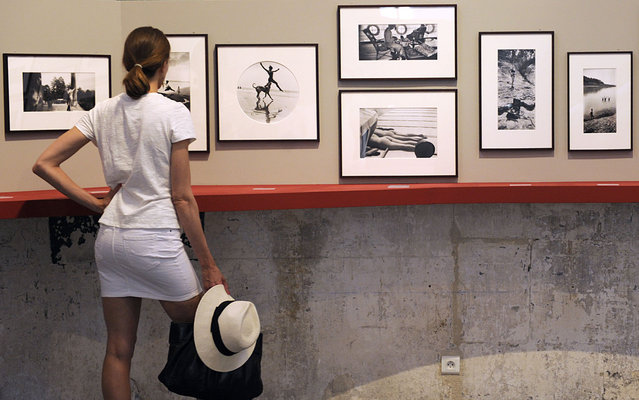
A visitor looks at pictures of French photographer Jacques-Henri Lartigue (1894-1986), on July 1, 2013 during the 44thd annual Rencontres d'Arles photography festival in Arles, southern France. The event runs until September 22. (Photo by Boris Horvat/AFP Photo)

A visitor looks at pictures of French photographer Jacques-Henri Lartigue (1894-1986), on July 1, 2013 during the 44thd annual Rencontres d'Arles photography festival in Arles, southern France. The event runs until September 22. (Photo by Boris Horvat/AFP Photo)
Details
06 Jul 2013 11:34:00
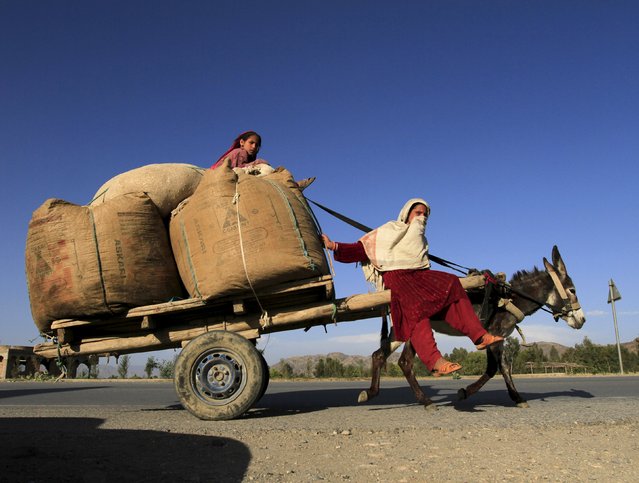
Girls ride on a donkey cart with grass for animals on the outside of Nangarhar province, Afghanistan May 19, 2015. (Photo by Reuters/Parwiz)

Girls ride on a donkey cart with grass for animals on the outside of Nangarhar province, Afghanistan May 19, 2015. (Photo by Reuters/Parwiz)
Details
28 Jul 2015 12:07:00