Loading...
Done
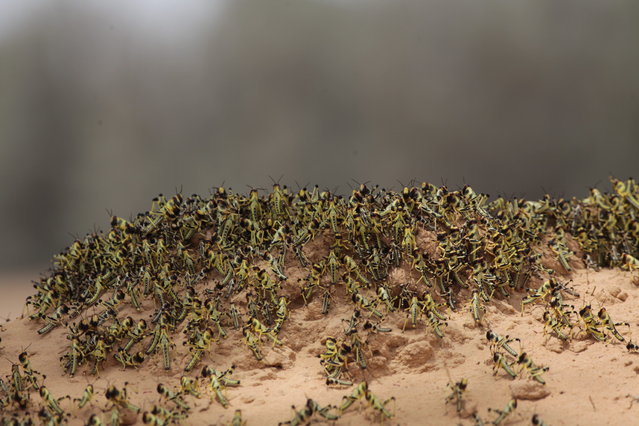
Billions of newly hatched locusts are spreading throughout Israel's South. (Photo by Eliahu Hershkovitz/Haaretz)

Billions of newly hatched locusts are spreading throughout Israel's South. The young locusts identified in the Negev Desert area are the offspring of locust swarms that entered Israel from Egypt in March. (Photo by Eliahu Hershkovitz/Haaretz)
Details
09 May 2013 07:57:00


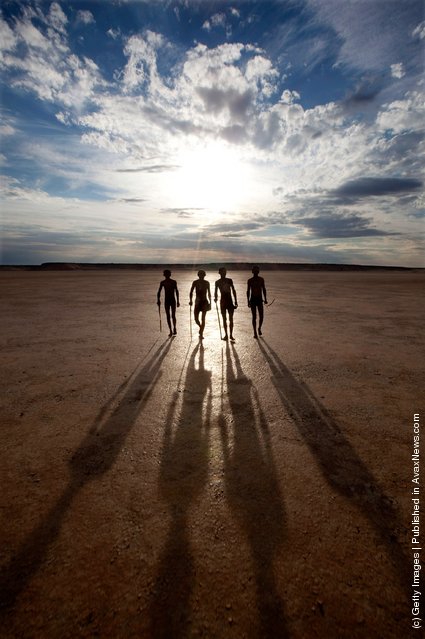
A group of San Bushmen from the Khomani San community practice their hunter-gatherer craft in the Southern Kalahari desert on October 15, 2009 in the Kalahari, South Africa. One of the largest studies of African genetics by an international team from the University of Pennsylvania, published in April 2009, revealed that the San of Southern Africa are the most genetically diverse on earth, and that the San homeland could be the spot where modern humanity began. (Photo by Dan Kitwood/Getty Images)
Details
07 May 2011 09:35:00
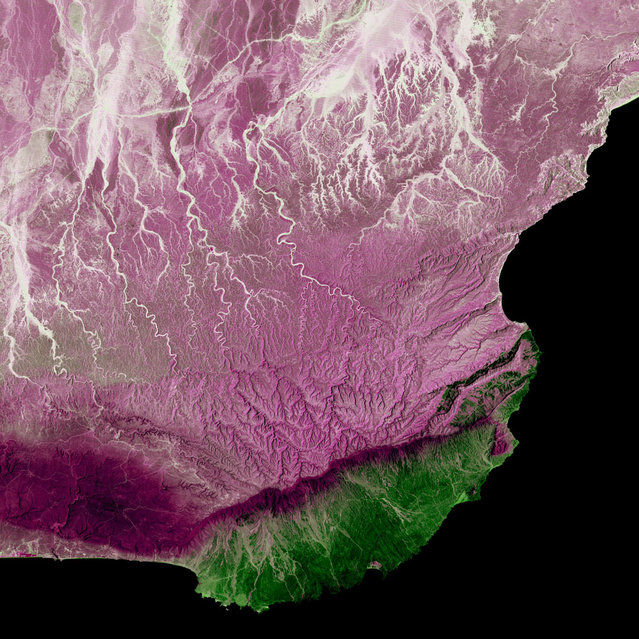
Dhofar Region, Oman. Much of Oman is desert, but the Arabian Sea coast in the Dhofar region represents a startling difference in climate. This coastal region catches the monsoon rains, or khareef, during the summer months. Drenching rains fall primarily on the mountainous ridge that separates the lush, fertile areas along the coast from the arid interior, recharging streams, waterfalls and springs that provide plentiful water supplies in the fertile lowlands for the remainder of the year. Image taken by Landsat 5 on April 2, 2005. (Photo by USGS/NASA)

Dhofar Region, Oman. Much of Oman is desert, but the Arabian Sea coast in the Dhofar region represents a startling difference in climate. This coastal region catches the monsoon rains, or khareef, during the summer months. Drenching rains fall primarily on the mountainous ridge that separates the lush, fertile areas along the coast from the arid interior, recharging streams, waterfalls and springs that provide plentiful water supplies in the fertile lowlands for the remainder of the year. Image taken by Landsat 5 on April 2, 2005. (Photo by USGS/NASA)
Details
25 Dec 2012 11:13:00
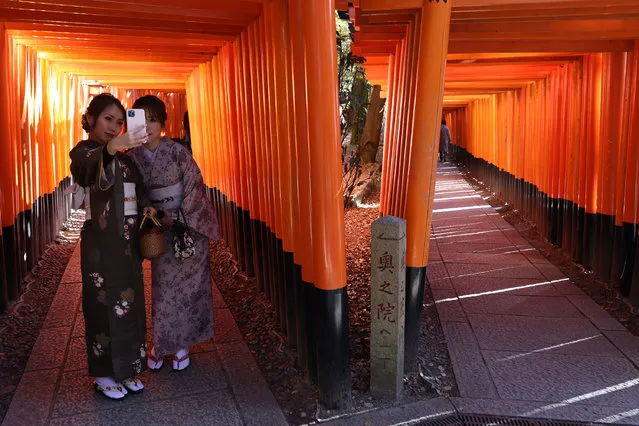
Women dressed in kimonos pose for a selfie photograph at a deserted torii path Fushimi Inari Taish shrine on January 18, 2021 in Kyoto, Japan. Kyoto, along with a Osaka and several other prefectures, was brought under a state of emergency last week by the Japanese government as they grapple to contain the third, and most virulent, wave of Covd-19 coronavirus to hit the country. (Photo by Buddhika Weerasinghe/Getty Images)

Women dressed in kimonos pose for a selfie photograph at a deserted torii path Fushimi Inari Taish shrine on January 18, 2021 in Kyoto, Japan. Kyoto, along with a Osaka and several other prefectures, was brought under a state of emergency last week by the Japanese government as they grapple to contain the third, and most virulent, wave of Covd-19 coronavirus to hit the country. (Photo by Buddhika Weerasinghe/Getty Images)
Details
28 Jan 2021 10:42:00
A staff member demonstrates how she puts on the helmet of a mock space suit at the C-Space Project Mars simulation base in the Gobi Desert outside Jinchang, Gansu Province, China, April 17, 2019. The facility – comprising several interconnected modules including a greenhouse and a mock decompression chamber – opened its doors to the public. (Photo by Thomas Peter/Reuters)

A staff member demonstrates how she puts on the helmet of a mock space suit at the C-Space Project Mars simulation base in the Gobi Desert outside Jinchang, Gansu Province, China, April 17, 2019. The facility – comprising several interconnected modules including a greenhouse and a mock decompression chamber – opened its doors to the public. (Photo by Thomas Peter/Reuters)
Details
19 Apr 2019 00:07:00
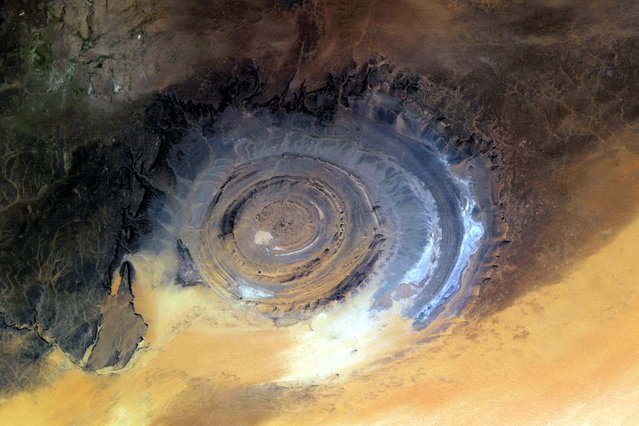
Eye Of The Sahara

The Richat Structure, also known as the Eye of the Sahara and Guelb er Richat, is a prominent circular feature in the Sahara desert of west–central Mauritania near Ouadane. This structure is a deeply eroded, slightly elliptical, 40 km in diameter, dome. The sedimentary rock exposed in this dome range in age from Late Proterozoic within the center of the dome to Ordovician sandstone around its edges.
Details
24 Mar 2013 12:32:00
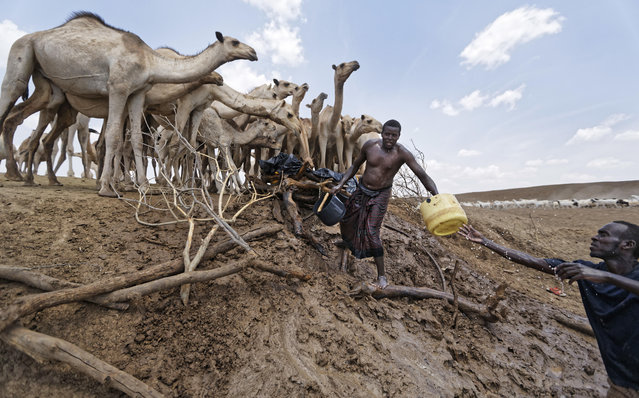
Camel herders scoop up water in plastic buckets from one of the few watering holes in the area, to water their animals near the drought-affected village of Bandarero, near Moyale town on the Ethiopian border, in northern Kenya, Friday, March 3, 2017. The U.N. humanitarian chief, Stephen O'Brien, toured Bandarero village on Friday and called on the international community to act to “avert the very worst of the effects of drought and to avert a famine to make sure we don't go from what is deep suffering to a catastrophe”. (Photo by Ben Curtis/AP Photo)

Camel herders scoop up water in plastic buckets from one of the few watering holes in the area, to water their animals near the drought-affected village of Bandarero, near Moyale town on the Ethiopian border, in northern Kenya, Friday, March 3, 2017. The U.N. humanitarian chief, Stephen O'Brien, toured Bandarero village on Friday and called on the international community to act to “avert the very worst of the effects of drought and to avert a famine to make sure we don't go from what is deep suffering to a catastrophe”. (Photo by Ben Curtis/AP Photo)
Details
05 Mar 2017 00:03:00
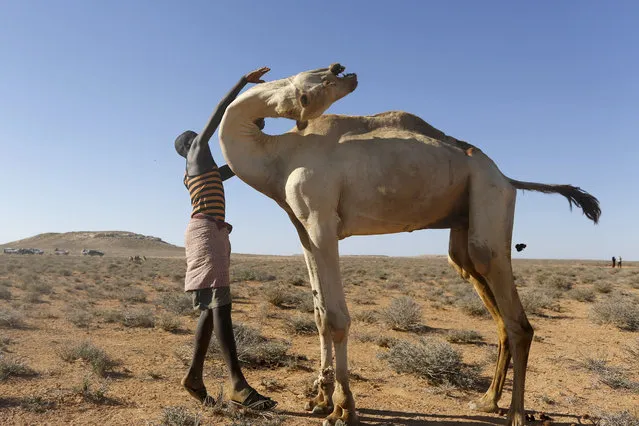
Ali Asair, who has left his family behind and traveled hundreds of kilometers in search for a pasture for his animals, attends to his camel in a pastoralists' settlement in the Bandarbeyla district in Somalia's semi-autonomous region of Puntland, Somalia, 24 March 2017. According to media reports, the United Nations says only 31 percent of 864 million US dollars appeal for a drought-hit Somalia is funded. The UN said the world is facing the largest humanitarian crisis since 1945, adding that more than 20 million people are facing the threat of famine in Somalia, Yemen, South Sudan and Nigeria and 1.4 million children could die from starvation this year. (Photo by Dai Kurokawa/EPA)

Ali Asair, who has left his family behind and traveled hundreds of kilometers in search for a pasture for his animals, attends to his camel in a pastoralists' settlement in the Bandarbeyla district in Somalia's semi-autonomous region of Puntland, Somalia, 24 March 2017. According to media reports, the United Nations says only 31 percent of 864 million US dollars appeal for a drought-hit Somalia is funded. The UN said the world is facing the largest humanitarian crisis since 1945, adding that more than 20 million people are facing the threat of famine in Somalia, Yemen, South Sudan and Nigeria and 1.4 million children could die from starvation this year. (Photo by Dai Kurokawa/EPA)
Details
28 Mar 2017 09:01:00