Loading...
Done
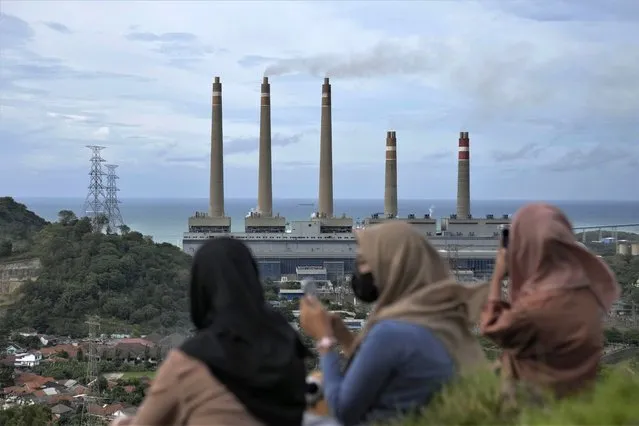
Indonesian women sit on a hill as the Suralaya coal power plant looms in the background in Cilegon, Indonesia, on January 8, 2023. A plan for how Indonesia will spend $20 billion to transition to cleaner energy was submitted Wednesday, Aug. 16, to the government and its financing partners, the planners said. (Photo by Dita Alangkara/AP Photo)

Indonesian women sit on a hill as the Suralaya coal power plant looms in the background in Cilegon, Indonesia, on January 8, 2023. A plan for how Indonesia will spend $20 billion to transition to cleaner energy was submitted Wednesday, Aug. 16, to the government and its financing partners, the planners said. (Photo by Dita Alangkara/AP Photo)
Details
15 Jan 2024 17:38:00
A fuzzy caterpillar on a basil plant in west Bengal, India on December 25, 2023. The caterpillar’s defence system is its hair, which has microscopic barbs that break off easily in the skin of would-be predators. (Photo by Soumyabrata Roy/NurPhoto/Rex Features/Shutterstock)

A fuzzy caterpillar on a basil plant in west Bengal, India on December 25, 2023. The caterpillar’s defence system is its hair, which has microscopic barbs that break off easily in the skin of would-be predators. (Photo by Soumyabrata Roy/NurPhoto/Rex Features/Shutterstock)
Details
09 Feb 2024 10:47:00
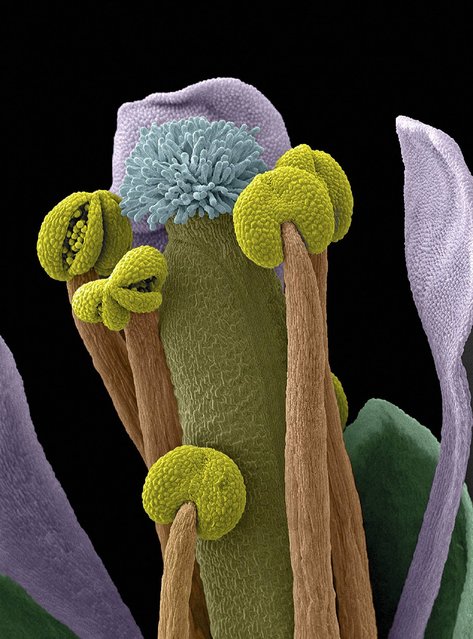
Scanning electron micrograph (SEM) of an Arabidopsis thaliana flower, also commonly known as thale cress. Some of the anthers are open, revealing pollen grains ready for dispersal. Arabidopsis was the first plant to have its entire genome sequenced and is widely used as a model organism in molecular and plant biology. Horizontal width of image is 1200 microns. Magnification 100x. (Photo by Stefan Eberhard/Wellcome Images)

Beautiful, strange and occasionally alarming pictures from the shortlist for this year’s Wellcome image awards – which celebrate the very best in science photography and imaging – from an x-ray of a bat to a micrograph of a kidney stone. The exhibition opens on 12 March at three science centres and the Museum of Science and Industry in Manchester. Photo: Scanning electron micrograph (SEM) of an Arabidopsis thaliana flower, also commonly known as thale cress. Some of the anthers are open, revealing pollen grains ready for dispersal. Arabidopsis was the first plant to have its entire genome sequenced and is widely used as a model organism in molecular and plant biology. Horizontal width of image is 1200 microns. Magnification 100x. (Photo by Stefan Eberhard/Wellcome Images)
Details
11 Mar 2014 05:58:00


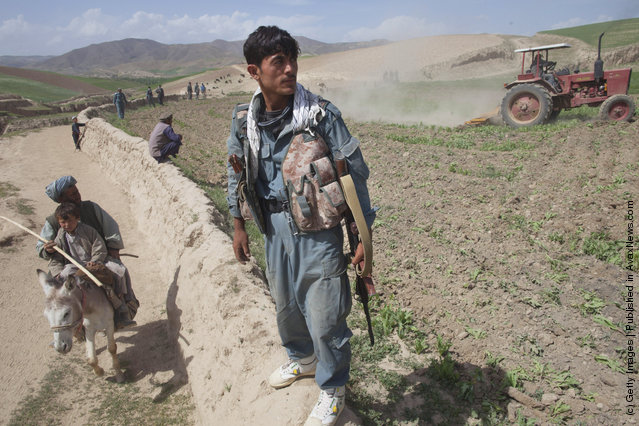
Afghan security stands guard as a tractor eradicates a field of young poppy plants May 25, 2011, in Argu District, Badakshan, Afghanistan. (Photo by Paula Bronstein/Getty Images)
Details
26 May 2011 10:51:00


A young girl navigates her way around Hampton Court maze in the spring sunshine on May 2, 2009 in London, England. The Hampton Court maze is one of the most famous hedge mazes in the world and was planted between 1689 and 1695 by George London and Henry Wise. (Photo by Dan Kitwood/Getty Images)
Details
12 Jun 2011 09:31:00
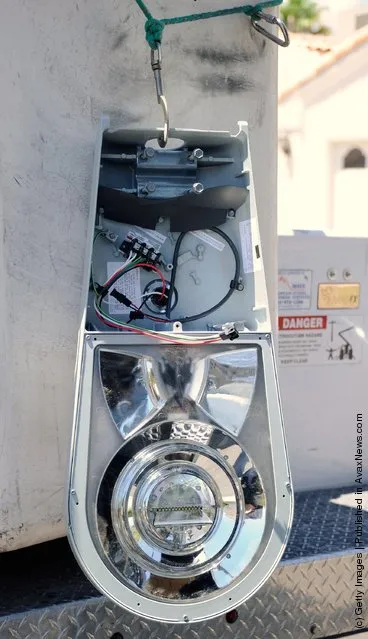
A new LED light fixture is secured to the side of a lift as crews replace existing street lights

A new LED light fixture is secured to the side of a lift as crews replace existing street lights August 1, 2011 in Las Vegas, Nevada. The new energy-efficient fixtures are expected to reduce the city's annual electricity use by eight million kilowatt hours, saving about USD 400,000. The city estimates the LEDs will last about 15 years, nine years longer than the current lights. Funding for the project comes from federal energy conservation bonds and an American Recovery & Reinvestment Act grant. The city plans to replace all of its 50,000 streetlights after more funding is secured. (Photo by Ethan Miller/Getty Images)
Details
02 Aug 2011 14:27:00
Chernobyl

Scaffolding holding a remnant of the Soviet Union, the hammer and sickle, is seen on a rooftop of an abandoned building in the town of Pripyat on January 25, 2006 near Chernobyl, Ukraine. The town of Pripyat, deserted since the 1986 catastrophe, once housed 30,000 people, the majority of being workers from the Chernobyl Nuclear Power Plant. Days after the catastrophe the inhabitants were relocated to other locations in the Soviet Union. The town of Pripyat has remained uninhabited since. Prypyat and the surrounding area will not be safe for human habitation for several centuries. Scientists estimate that the most dangerous radioactive elements will take up to 900 years to decay sufficiently to render the area safe.
Details
14 Mar 2011 10:20:00


“With a fourth explosion rocking the Fukushima nuclear plant on Tuesday, danger of the spent nuke fuel pool boiling and radiation levels at the facility's gate increasing hundredfold, fears of a meltdown in Japan skyrocket”. – Russia Today

Photo: In this handout image provided by U.S. Navy, an aerial view of tsunami and earthquake damage is seen from an SH-60B helicopter assigned to the Chargers of Helicopter Antisubmarine Squadron (HS) 14 from Naval Air Facility Atsugi March 12, 2011 seen from the air of Sendai, Japan. (Photo by U.S. Navy via Getty Images)
Details
16 Mar 2011 10:19:00