Loading...
Done
Mayu adjusts Koiku’s kimono, as Koiku wears a protective face mask while posing for a photograph, before they work at a party where they will entertain with other geisha at Japanese luxury restaurant Asada in Tokyo, Japan, June 23, 2020. The coronavirus pandemic has made Tokyo's geisha fear for their centuries-old profession as never before. Though the number of geisha - famed for their witty conversation, beauty and skill at traditional arts - has been falling for years, they were without work for months due to Japan's state of emergency and now operate under awkward social distancing rules. Engagements are down 95 percent, and come with new rules: no pouring drinks for customers or touching them even to shake hands, and sitting 2 meters apart. Masks are hard to wear with their elaborate wigs, so they mostly don't. “I was just full of anxiety”, said Mayu, 47. “I went through my photos, sorted my kimonos ... The thought of a second wave is terrifying”. (Photo by Kim Kyung-Hoon/Reuters)

Mayu adjusts Koiku’s kimono, as Koiku wears a protective face mask while posing for a photograph, before they work at a party where they will entertain with other geisha at Japanese luxury restaurant Asada in Tokyo, Japan, June 23, 2020. (Photo by Kim Kyung-Hoon/Reuters)
Details
23 Jul 2020 00:03:00
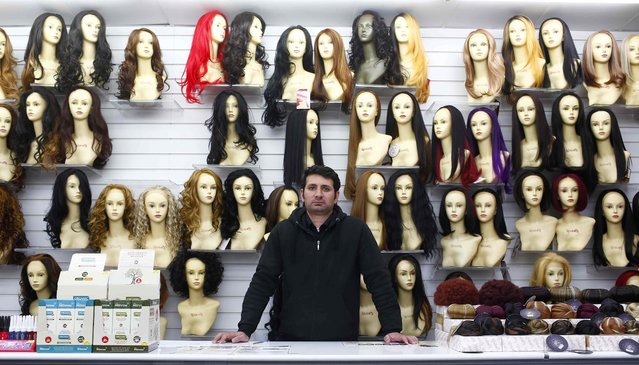
Kashir Mir, 34, poses for a photograph at his workplace, Juliet Wig Shop, in the London constituency of Brent Central, Britain, April 13, 2015. Mir, who was born in Pakistan, said: “I will vote but it's a secret. I also hope they can manage immigration better as I have been stopped and interviewed for hours returning from Pakistan. I'm an honest man, working here and paying my tax”. (Photo by Eddie Keogh/Reuters)

Kashir Mir, 34, poses for a photograph at his workplace, Juliet Wig Shop, in the London constituency of Brent Central, Britain, April 13, 2015. Mir, who was born in Pakistan, said: “I will vote but it's a secret. I also hope they can manage immigration better as I have been stopped and interviewed for hours returning from Pakistan. I'm an honest man, working here and paying my tax”. Brent, a northwest London neighbourhood that's home to Wembley football stadium, is among the most ethnically diverse areas in the United Kingdom. As the country approaches a closely fought election on May 7, Reuters photographer Eddie Keogh visited shopkeepers to get their views on the poll. (Photo by Eddie Keogh/Reuters)

Details
29 Apr 2015 06:30:00
Kyaiktiyo, Burma, 1978. The Golden Rock at Shwe Pyi Daw (the Golden Country), the Buddhist holy place. Hiroji Kubota writes: “I was desperate to keep a distance from America for a while; luckily, I found Burma and its gentle and compassionate people. In the spring of 1978, on the top of the hill where I took this photo, I had two Leica bodies: the one with Tri-X and the other with Kodachrome 64. Soon after, I realised that the colour one looked very colourful and was more powerful. That was my decisive moment, to become a colour photographer”. (Photo by Hiroji Kubota/Magnum Photos)

Kyaiktiyo, Burma, 1978. The Golden Rock at Shwe Pyi Daw (the Golden Country), the Buddhist holy place. Hiroji Kubota writes: “I was desperate to keep a distance from America for a while; luckily, I found Burma and its gentle and compassionate people. In the spring of 1978, on the top of the hill where I took this photo, I had two Leica bodies: the one with Tri-X and the other with Kodachrome 64. Soon after, I realised that the colour one looked very colourful and was more powerful. That was my decisive moment, to become a colour photographer”. (Photo by Hiroji Kubota/Magnum Photos)
Details
10 Jun 2016 13:30:00
Senji Nakajima sleeps with his Love Doll “Saori” at Love Hotel on June 4, 2016 in Nagano, Japan. Senji Nakajima, 61 years old, lives with his life-size 'love doll' named “Saori” in his apartment in Tokyo, Japan. Nakajima, married with two children, who lives away from home for work, first started his life with Saori six years ago. At first, he used to imagine as if the doll was his first girl friend, and used it only for sexual purposes to fill the loneliness, but months later, he started to find Saori actually has an original personality. “She never betrays, not after only money. I'm tired of modern rational humans. They are heartless”, Nakajima says, “for me, she is more than a doll. Not just a silicon rubber. She needs much help, but still is my perfect partner who shares precious moments with me and enriches my life”. (Photo by Taro Karibe/Getty Images)

Senji Nakajima sleeps with his Love Doll “Saori” at Love Hotel on June 4, 2016 in Nagano, Japan. Senji Nakajima, 61 years old, lives with his life-size “love doll” named “Saori” in his apartment in Tokyo, Japan. Nakajima, married with two children, who lives away from home for work, first started his life with Saori six years ago. (Photo by Taro Karibe/Getty Images)
Details
07 Aug 2016 09:21:00
The Wildscreen festival is the world’s biggest celebration of screen-based natural history storytelling which takes place every two years in Bristol. Here: “Walrus in Midnight Sun”. Walrus feed mostly on bivalves in productive, shallow and often sandy habitats in the Arctic. This individual, though, arrived on a beach outside Tromsø, northern Norway, and found comfort on a stranded dead sperm whale. After two weeks he approached Audun, and only half a metre away he stretched his tusk forward and touched his hand gently. “This was one of the most memorable moments of my life”, Rikardsen says. He named the 500kg male Buddy. After two months, the dead whale was decomposed and Buddy suddenly disappeared. (Photo by Audun Rikardsen/Wildscreen 2016)

The Wildscreen festival is the world’s biggest celebration of screen-based natural history storytelling which takes place every two years in Bristol. Here: “Walrus in Midnight Sun”. Walrus feed mostly on bivalves in productive, shallow and often sandy habitats in the Arctic. This individual, though, arrived on a beach outside Tromsø, northern Norway, and found comfort on a stranded dead sperm whale. After two weeks he approached Audun, and only half a metre away he stretched his tusk forward and touched his hand gently. “This was one of the most memorable moments of my life”, Rikardsen says. He named the 500kg male Buddy. After two months, the dead whale was decomposed and Buddy suddenly disappeared. (Photo by Audun Rikardsen/Wildscreen 2016)
Details
07 Oct 2016 10:02:00
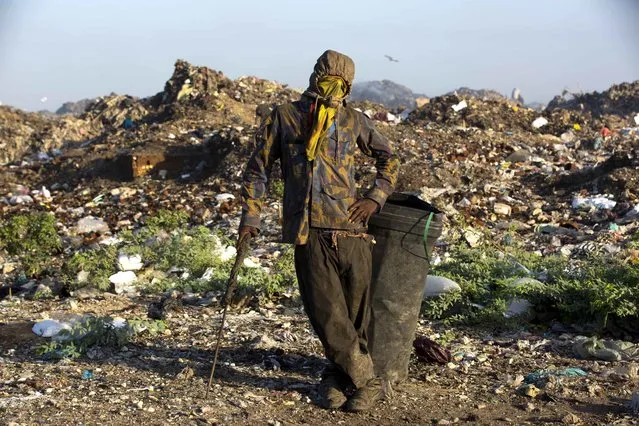
In this August 24, 2018 photo, Changlair Aristide pauses for a portrait, wearing his protective clothing, including an old U.N. peacekeeper's jacket he found in the trash, before scavenging the Truitier landfill in the Cite Soleil slum of Port-au-Prince, Haiti. Before 2004, Aristide recalled having enough money to splurge on shoes, T-shirts and pants, but this year he could not buy his kids anything new for the school year. “Life is like that, up and down”, Aristide said. “They'll go to school anyway, even if I have to sell my pig. I love them”. (Photo by Dieu Nalio Chery/AP Photo)

In this August 24, 2018 photo, Changlair Aristide pauses for a portrait, wearing his protective clothing, including an old U.N. peacekeeper's jacket he found in the trash, before scavenging the Truitier landfill in the Cite Soleil slum of Port-au-Prince, Haiti. Before 2004, Aristide recalled having enough money to splurge on shoes, T-shirts and pants, but this year he could not buy his kids anything new for the school year. “Life is like that, up and down”, Aristide said. “They'll go to school anyway, even if I have to sell my pig. I love them”. (Photo by Dieu Nalio Chery/AP Photo)
Details
03 Oct 2018 00:03:00
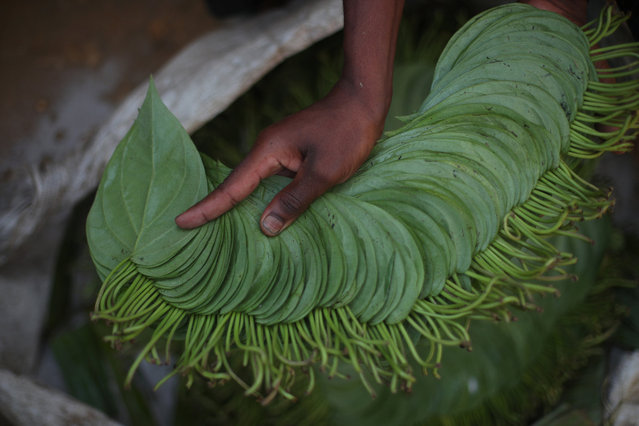
Faruk, 17, a Rohingya refugee trader holds betel leaves which are on sale at a stall in Palong Khali refugee camp near Cox's Bazar, Bangladesh, November 3, 2017. He left his village in Myanmar when the military opened fire towards the Rohingya. “I buy this betel leaf from Palong Khali market, in one bundle there are 160 pieces, I buy it for 80 taka and I sell it for 100 taka. Bangladeshi's and I sell for the same rate in the camp. Outside in the local market it is 80 taka per bundle. My problem is that I don't have money so I can't buy anything to eat, I can't buy fish to eat”, he said. (Photo by Hannah McKay/Reuters)

Faruk, 17, a Rohingya refugee trader holds betel leaves which are on sale at a stall in Palong Khali refugee camp near Cox's Bazar, Bangladesh, November 3, 2017. He left his village in Myanmar when the military opened fire towards the Rohingya. “I buy this betel leaf from Palong Khali market, in one bundle there are 160 pieces, I buy it for 80 taka and I sell it for 100 taka (1 Bangladeshi Taka = 0.012 US Dollar). Bangladeshi's and I sell for the same rate in the camp. Outside in the local market it is 80 taka per bundle. My problem is that I don't have money so I can't buy anything to eat, I can't buy fish to eat”, he said. (Photo by Hannah McKay/Reuters)
Details
27 Nov 2017 08:54:00
Close Encounter of the Insect Kind: Check out the awesome face on this praying mantis. I can't get over the mouth, it's like something from a science fiction movie. Of all photographic styles macro is definitely my favorite. I am constantly amazed, in every photo that I take, by the intricate level of detail that exists on even the smallest of creatures. It's a stark reminder that a very complex and infinitely beautiful world exists just beyond our human-sized level of perception. Photo taken in Donnybrook, Queensland, Australia. (Photo by Andrew Young/National Geographic Photo Contest

Close Encounter of the Insect Kind: “Check out the awesome face on this praying mantis. I can't get over the mouth, it's like something from a science fiction movie. Of all photographic styles macro is definitely my favorite. I am constantly amazed, in every photo that I take, by the intricate level of detail that exists on even the smallest of creatures. It's a stark reminder that a very complex and infinitely beautiful world exists just beyond our human-sized level of perception. Photo taken in Donnybrook, Queensland, Australia” – Andrew Young. (Photo by Andrew Young/National Geographic Photo Contest via The Atlantic)
Details
24 Sep 2012 09:18:00