Loading...
Done
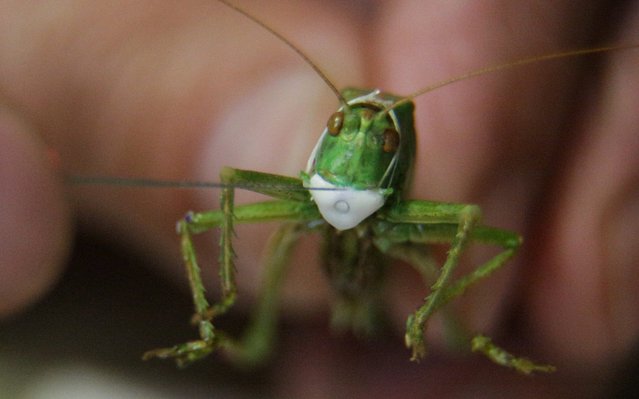
A grasshopper in a protective mask created by microminiaturist Anatoly Konenko in Omsk, Russia on May 21, 2020. Mini-masks about the size of a rice grain are made of a special high-density medical fabric with a built-in air filter. Anatoly Konenko is one of Russia's most famous microminiaturists; his works include a grasshopper playing a violin, a shod flea, a miniature bass guitar, a camel train in a needle's eye, and over 200 miniature books. (Photo by Yevgeny Sofiychuk/TASS)

A grasshopper in a protective mask created by microminiaturist Anatoly Konenko in Omsk, Russia on May 21, 2020. Mini-masks about the size of a rice grain are made of a special high-density medical fabric with a built-in air filter. Anatoly Konenko is one of Russia's most famous microminiaturists; his works include a grasshopper playing a violin, a shod flea, a miniature bass guitar, a camel train in a needle's eye, and over 200 miniature books. (Photo by Yevgeny Sofiychuk/TASS)
Details
23 May 2020 00:07:00
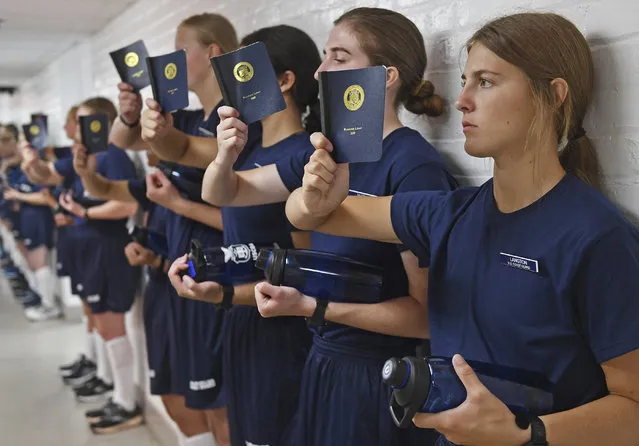
Swab Cadet Langton reads the Running Light guidebook as members of the US Coast Guard academy class of 2026 report for the first day of Swab Summer, a seven-week training programme designed to transform civilian students into military members, in Connecticut on June 27, 2022. The Swabs, as the new cadets are called, cycle through haircuts, uniform issue, drill practice and various administrative in-processing over the course of the day. (Photo by Sean D. Elliot/AP Photo)

Swab Cadet Langton reads the Running Light guidebook as members of the US Coast Guard academy class of 2026 report for the first day of Swab Summer, a seven-week training programme designed to transform civilian students into military members, in Connecticut on June 27, 2022. The Swabs, as the new cadets are called, cycle through haircuts, uniform issue, drill practice and various administrative in-processing over the course of the day. (Photo by Sean D. Elliot/AP Photo)
Details
06 Jul 2022 05:55:00
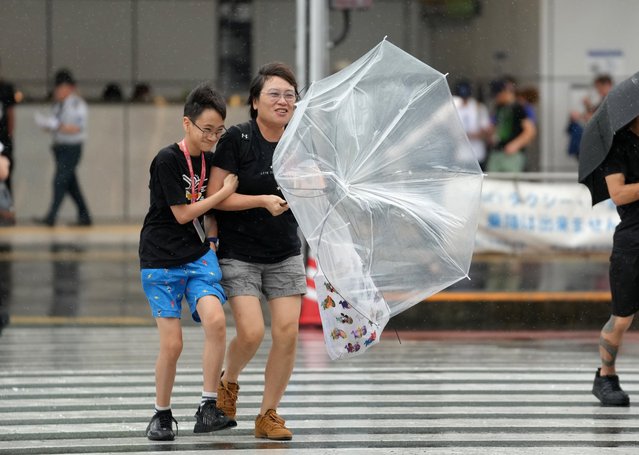
Pedestrians using umbrellas struggle against rain and strong wind in Tokyo, Japan, 16 August 2024, as typhoon Ampil is approaching. The typhoon is approaching to Kanto Tokyo area and Japan's Meteorological Agency has issued heavy rain warning. The powerful typhoon forces to suspend JR Tokaido Shinkansen bullet train service operated by JR Central Japan Company all day between Tokyo and Nagoya, central Japan, and cancel over 600 flights. (Photo by Kimimasa Mayama/EPA/EFE)

Pedestrians using umbrellas struggle against rain and strong wind in Tokyo, Japan, 16 August 2024, as typhoon Ampil is approaching. The typhoon is approaching to Kanto Tokyo area and Japan's Meteorological Agency has issued heavy rain warning. The powerful typhoon forces to suspend JR Tokaido Shinkansen bullet train service operated by JR Central Japan Company all day between Tokyo and Nagoya, central Japan, and cancel over 600 flights. (Photo by Kimimasa Mayama/EPA/EFE)
Details
05 Oct 2024 04:24:00
Afghanistan: Dogs of War Part 1

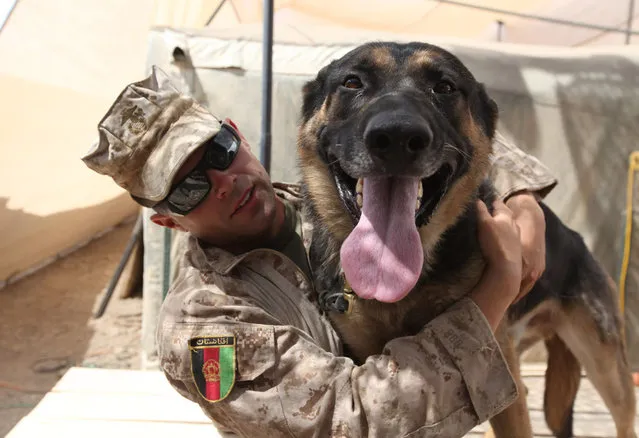
Throughout the course of the long war in Afghanistan, Coalition troops have relied on thousands of military working dogs to help keep them safe, and make their jobs easier. The dogs are trained to detect explosives, to find illegal drugs, to search for missing comrades, or target enemy combatants. Not only are they active on the front lines, but behind the lines they serve as therapy dogs, service dogs, and loyal companions. They also share the same risks as the ground troops, suffering injuries and sometimes death on the battlefields. Gathered here are images of these dogs and their handlers in Afghanistan and back home, from over the past several years, part of the ongoing series here on Afghanistan.
Details
03 Jun 2014 21:02:00
Boat crew members train on the waters of the Tonle Sap River on the morning of the first day of the Water Festival on November 13, 2016 in Phnom Penh, Cambodia. The yearly three-day Water Festival is one of the most important holidays in Cambodia and celebrates the end of the rainy season and the start of the rice harvesting. The Festival also coincides with the Tonle Sap river reversing course, which it does twice a year. Approximately 2 million people are expected to attend this year's festival, during which 259 boats and nearly 20,000 oarsmen will participate in the races. After a fatal stampede resulting in the death of some 353 people during the Water Festival in 2010, it has been cancelled four times over the past five years, with weather used as an official excuse. (Photo by Omar Havana/Getty Images)

Boat crew members train on the waters of the Tonle Sap River on the morning of the first day of the Water Festival on November 13, 2016 in Phnom Penh, Cambodia. The yearly three-day Water Festival is one of the most important holidays in Cambodia and celebrates the end of the rainy season and the start of the rice harvesting. The Festival also coincides with the Tonle Sap river reversing course, which it does twice a year. Approximately 2 million people are expected to attend this year's festival, during which 259 boats and nearly 20,000 oarsmen will participate in the races. After a fatal stampede resulting in the death of some 353 people during the Water Festival in 2010, it has been cancelled four times over the past five years, with weather used as an official excuse. (Photo by Omar Havana/Getty Images)
Details
15 Nov 2016 11:26:00
A student uses a ruler to measure the distance between forks before a formal dinner at The International Butler Academy China on September 16, 2014 in Chengdu, China. (Photo by Taylor Weidman/Getty Images)

A student uses a ruler to measure the distance between forks before a formal dinner at The International Butler Academy China on September 16, 2014 in Chengdu, China. Over the last several years, there has been a surge in demand among China's wealthy for Western-trained butlers, with many academies seeing large portions of their graduating classes hired by Chinese families or companies. (Photo by Taylor Weidman/Getty Images)
Details
18 Sep 2014 11:13:00
A Baby sumatran orangutan (Pongo abelii) plays around in a tree as they train at Sumatran Orangutan Conservation Programme's rehabilitation center on November 12, 2016 in Kuta Mbelin, North Sumatra, Indonesia. The Orangutans in Indonesia have been known to be on the verge of extinction as a result of deforestation and poaching. Found mostly in South-East Asia, where they live on the islands of Sumatra and Borneo, the endangered species continue to lose their habitat as a result of corporate expansion in a developing economy. Indonesia approved palm oil concessions on nearly 15 million acres of peatlands over the past years and thousands of square miles have been cleared for plantations, including the lowland areas that are the prime habitat for orangutans. (Photo by Ulet Ifansasti/Getty Images)

A Baby sumatran orangutan (Pongo abelii) plays around in a tree as they train at Sumatran Orangutan Conservation Programme's rehabilitation center on November 12, 2016 in Kuta Mbelin, North Sumatra, Indonesia. The Orangutans in Indonesia have been known to be on the verge of extinction as a result of deforestation and poaching. Found mostly in South-East Asia, where they live on the islands of Sumatra and Borneo, the endangered species continue to lose their habitat as a result of corporate expansion in a developing economy. Indonesia approved palm oil concessions on nearly 15 million acres of peatlands over the past years and thousands of square miles have been cleared for plantations, including the lowland areas that are the prime habitat for orangutans. (Photo by Ulet Ifansasti/Getty Images)
Details
16 Nov 2016 11:14:00


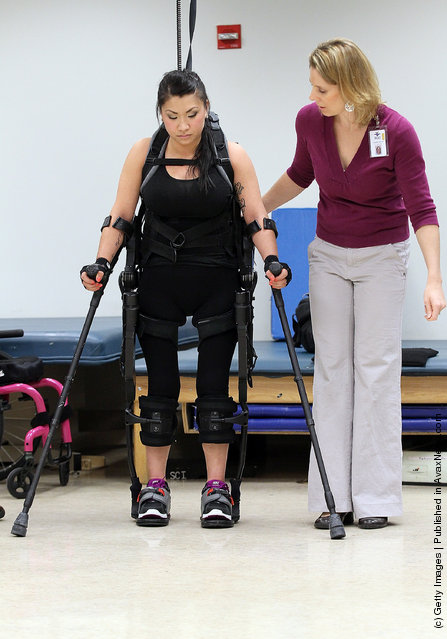
“eLEGS is a wearable, artificially intelligent, bionic device that enables people with paralysis to stand up and walk again. The exoskeleton is battery-powered and rechargeable, fitting comfortably and securely over clothing. Initially, eLEGS will be used under medical supervision for rehabilitation and training”. – BerkeleyBionics.com

Photo: Paralysis victim Stephanie Sablan (L) is helped by physical therapist Shonna Moran as she walks using eLEGS robotic legs at Santa Clara Valley Medical Center on May 25, 2011 in San Jose, California. Sablan, 24, was paralyzed from the waist down earlier this year when she was in a car accident and has begun using the newly developed eLEGS made by Berkeley Bionics. The robot-like battery powered eLEGS fit over clothing and enables people with paralysis to stand up and walk again. (Photo by Justin Sullivan/Getty Images)
Details
26 May 2011 09:56:00