Loading...
Done
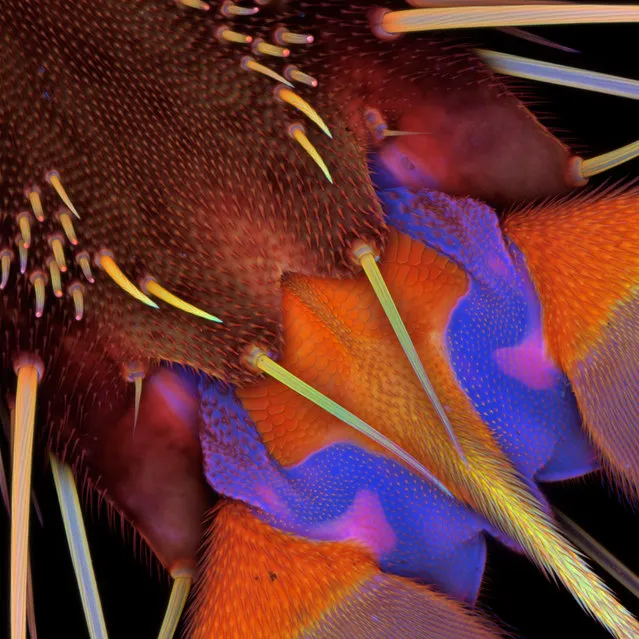
Pretarsus of the third leg of a female drone fly (Eristalis tenax), ventral view, by Dr. Jan Michels, Institute of Zoology, Christian-Albrechts-University of Kiel, Germany. (Photo by Olympus BioScapes)

“Microscope images forge an extraordinary bond between science and art, said Hidenao Tsuchiya, Olympus America's Vice President and General Manager for the Scientific Equipment Group. We founded this competition to focus on the fascinating stories coming out of today's life science research laboratories. The thousands of images that people have shared with the competition over the years reflect some of the most exciting work going on in research today – work that can help shed light on the living universe and ultimately save lives. We look at BioScapes and these beautiful images as sources of education and inspiration to us and the world”. – OlympusBioScapes

Photo: Pretarsus of the third leg of a female drone fly (Eristalis tenax), ventral view, by Dr. Jan Michels, Institute of Zoology, Christian-Albrechts-University of Kiel, Germany. (Photo by Olympus BioScapes)
Details
29 Jul 2012 09:20:00
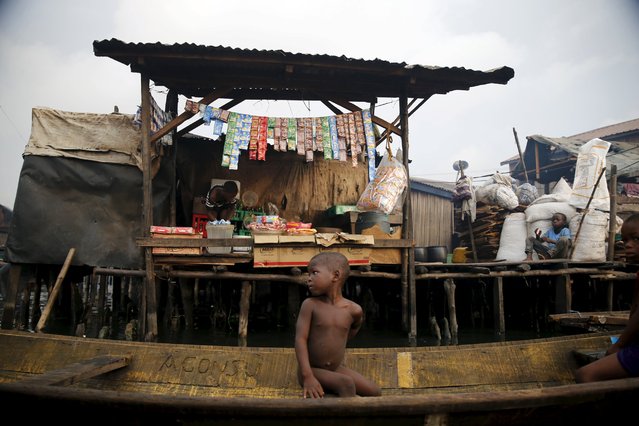
A boy sits in a canoe in front of a shed built on a raft in the Makoko fishing community on the Lagos Lagoon, Nigeria February 29, 2016. Makoko, a vast slum of houses on stilts in a Lagos lagoon, now boasts a new school – pyramid-shaped, floating and capable of withstanding the waterways' extreme weather, it is a beacon of hope for the nearly 100,000 Nigerians who live there.  (Photo by Akintunde Akinleye/Reuters)

A boy sits in a canoe in front of a shed built on a raft in the Makoko fishing community on the Lagos Lagoon, Nigeria February 29, 2016. In Makoko, a sprawling slum of Nigeria's megacity Lagos, a floating school capable of holding up to a hundred pupils has since November brought free education to the waterways known as the Venice of Lagos. It offers the chance of social mobility for youngsters who, like most of the city's 21 million inhabitants, lack a reliable electricity and water supply and whose water-based way of life is threatened by climate change as well as rapid urbanisation. (Photo by Akintunde Akinleye/Reuters)
Details
05 Mar 2016 12:01:00
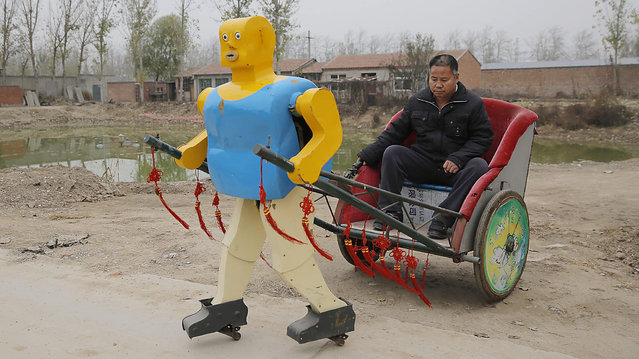
Robot inventor Wu Yulu sits on a rickshaw driven by a robot which he invented in his village in rural Beijing's Tongzhou district, China, 17 November 2016. The 54-year-old Chinese farmer living in rural Beijing's Tongzhou district invented 63 robots in the past 30 years. Wu, who only received primary school education, plans to give up the agricultural work for his robot products. He regularly participates in exhibitions, transfers patent rights and teaches at the university to earn money. (Photo by Wu Hong/EPA)

Robot inventor Wu Yulu sits on a rickshaw driven by a robot which he invented in his village in rural Beijing's Tongzhou district, China, 17 November 2016. The 54-year-old Chinese farmer living in rural Beijing's Tongzhou district invented 63 robots in the past 30 years. Wu, who only received primary school education, plans to give up the agricultural work for his robot products. He regularly participates in exhibitions, transfers patent rights and teaches at the university to earn money. (Photo by Wu Hong/EPA)
Details
21 Nov 2016 10:41:00
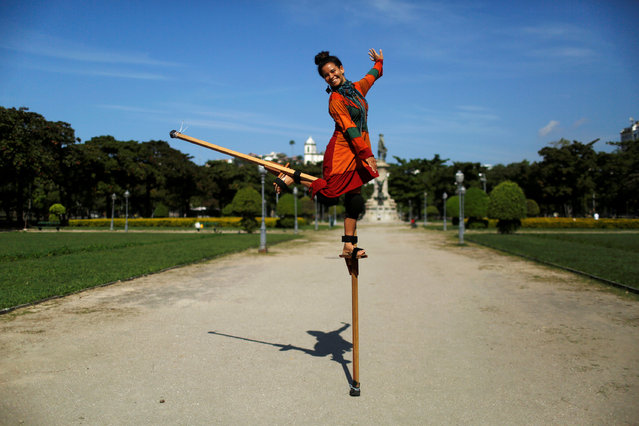
Raquel Poti, a 32-year-old street artist, poses at a park in Rio de Janeiro, Brazil, June 25, 2016. Raquel thinks the Olympics promotes a lifestyle that combines sports, culture and education. She is concerned about the large investment for the event while the population needs improvements in basic services. (Photo by Pilar Olivares/Reuters)

Just a week before Rio de Janeiro hosts South America's first Olympics, city residents expressed mixed feelings about the cost and security of the Games, while holding out hope they will bring joy to a nation facing economic and political crises. The conflicted thoughts mirror a recent survey by the Datafolha polling group showing that half of Brazilians were opposed to holding the Games, while 63 percent think the costs of hosting the event will outweigh benefits. (Photo by Pilar Olivares/Reuters)
Details
03 Aug 2016 11:51:00
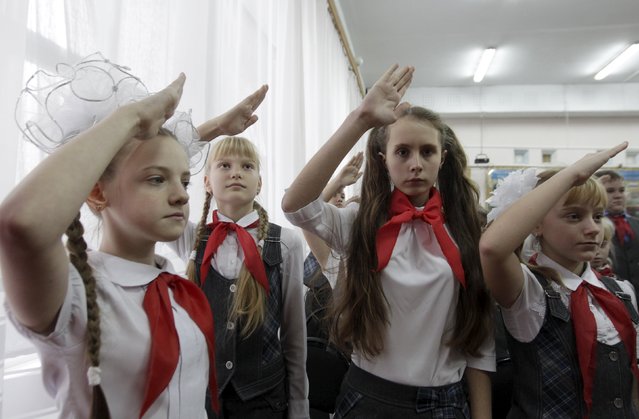
Children, wearing red neckerchiefs, a symbol of the Pioneer Organization, salute during a ceremony for the inauguration of 18 new members at a local school in the southern settlement of Kazminskoye in Stavropol region, Russia, November 19, 2015. Early pro-communist youth movements, which appeared in Russia after the 1917 Bolshevik revolution, were reformed into the Pioneer Organization of the Soviet Union. (Photo by Eduard Korniyenko/Reuters)

Children, wearing red neckerchiefs, a symbol of the Pioneer Organization, salute during a ceremony for the inauguration of 18 new members at a local school in the southern settlement of Kazminskoye in Stavropol region, Russia, November 19, 2015. Early pro-communist youth movements, which appeared in Russia after the 1917 Bolshevik revolution, were reformed into the Pioneer Organization of the Soviet Union. While the organization lost its dominance among students in post-Soviet Russia, some educational institutions and families still carry on this tradition. (Photo by Eduard Korniyenko/Reuters)
Details
22 Nov 2015 08:01:00
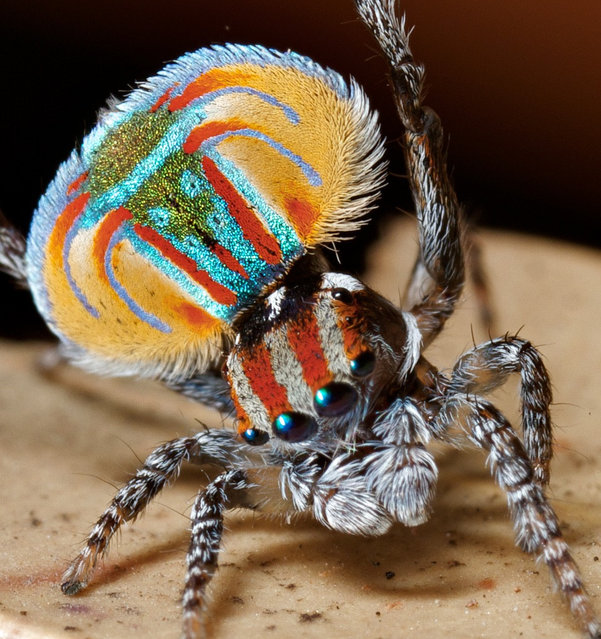
Peacock spider

Jumping spiders are often very colourful spiders. Maratus volans is not an exception. Although tiny, male spiders have an iridescent colouring of red, green and blue.
Details
22 Dec 2012 12:39:00
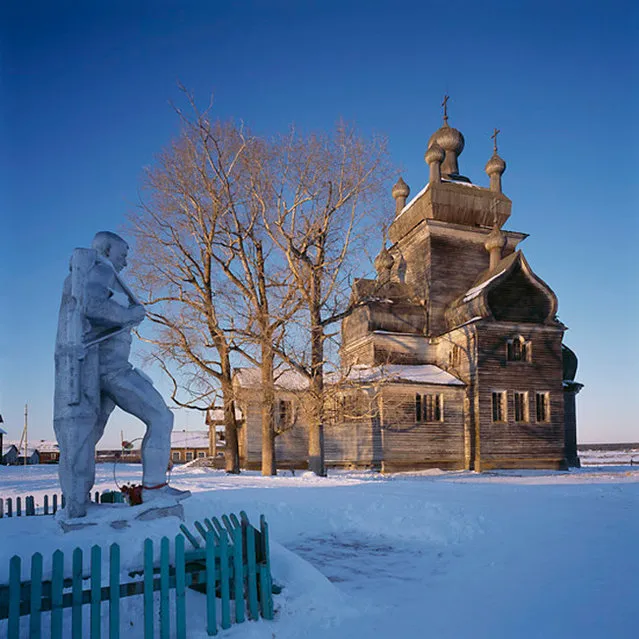
Wooden Churches - Travelling In The Russian North By Richard Davies Part 2

While communism, collectivism, worms, dry rot and casual looting failed to destroy the majestic wooden churches of Russia, it may be ordinary neglect that finally does them in. Dwindled now to several hundred remaining examples, these glories of vernacular architecture lie scattered amid the vastness of the world’s largest country. Just over a decade ago, Richard Davies, a British architectural photographer, struck out on a mission to record the fragile and poetic structures. Austerely beautiful and haunting, “Wooden Churches: Traveling in the Russian North” (White Sea Publishing; $132) is the result. Covering thousands of miles, Mr. Davies described how he and the writer Matilda Moreton tracked down the survivors from among the thousands of onion-domed structures built after Prince Vladimir converted to Christianity in 988.

See also: Wooden Churches Part1
Details
28 Nov 2013 12:13:00
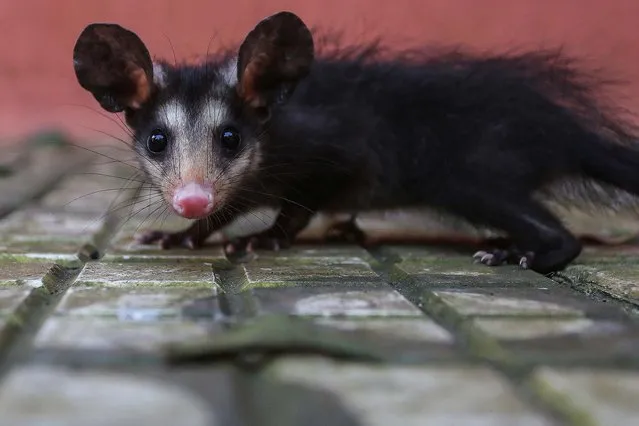
Photo taken on September 19, 2015 shows a baby Brazilian opossum at the “Parque Estoril” zoo in Sao Bernardo do Campo of Sao Paulo, Brazil. According to local press, the “Parque Estoril” zoo houses currently 23 orphan cubs of wild animals rescued in the south region of Sao Paulo, victims of illegal wildlife trade or problems caused by urban growth. (Photo by Rahel Patrasso/Xinhua via ZUMA Wire)

Photo taken on September 19, 2015 shows a baby Brazilian opossum at the “Parque Estoril” zoo in Sao Bernardo do Campo of Sao Paulo, Brazil. According to local press, the “Parque Estoril” zoo houses currently 23 orphan cubs of wild animals rescued in the south region of Sao Paulo, victims of illegal wildlife trade or problems caused by urban growth. According to the zoo, all the animals arrived in the last three months, and many of them, not being able to be reintroduced to their natural habitat, will be used as examples in environmental education classes. (Photo by Rahel Patrasso/Xinhua via ZUMA Wire)
Details
26 Sep 2015 08:00:00