Loading...
Done
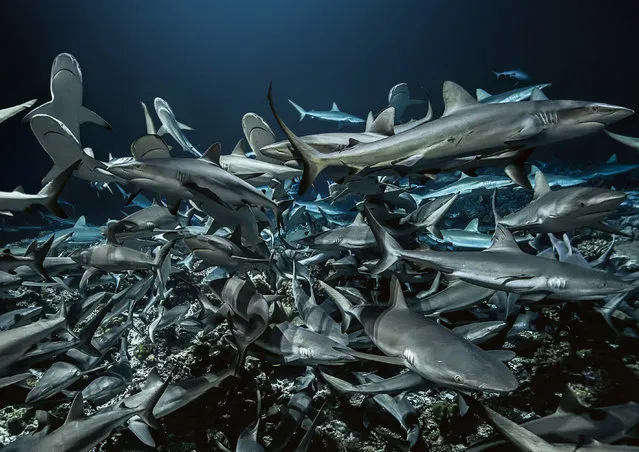
The men also decreased the time for Laurent to decompress from 20 hours to six. (Photo by Laurent Ballesta/Caters News Agency)

ne committed photographer spent a grand total of 3,000 dive hours trying to get the perfect shots, capturing beautiful images of a rare shark feeding frenzy. Laurent Ballesta’s images show the glimmering gray reef sharks hunting in swift packs, flying through the water and feasting on the likes of helpless grouper. (Photo by Laurent Ballesta/Caters News Agency)
Details
06 Jun 2018 00:03:00
A file photograph dated 07 January 2006 and released by Greenpeace, showing the Yushin Maru, a factory ship in a Japanese whaling fleet, injuring a whale with it's first harpoon attempt. A UN court in The Hague on 31 March 2014 halted Japan's much-criticized whaling programme, ruling that it contravenes a 1986 moratorium on whale hunting. Japan must end its 'research whaling' programme, the International Court of Justice (ICJ) said. (Photo by Kate Davison/EPA)

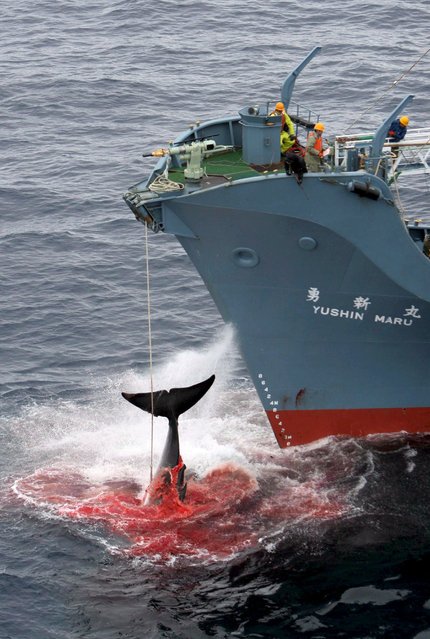
A file photograph dated 07 January 2006 and released by Greenpeace, showing the Yushin Maru, a factory ship in a Japanese whaling fleet, injuring a whale with it's first harpoon attempt. A UN court in The Hague on 31 March 2014 halted Japan's much-criticized whaling programme, ruling that it contravenes a 1986 moratorium on whale hunting. Japan must end its 'research whaling' programme, the International Court of Justice (ICJ) said. Japan said the programme was for scientific research and permitted under international conventions. Australia had brought the case to the ICJ in 2010, charging that Japan was breaching international law by killing hundreds of whales every year for commercial purposes. Japan was “deeply disappointed” by the ruling, an unnamed government official was quoted by the Kyodo News agency as saying. But the official said Japan would stand by the ruling. (Photo by Kate Davison/EPA)

Details
01 Apr 2014 08:38:00
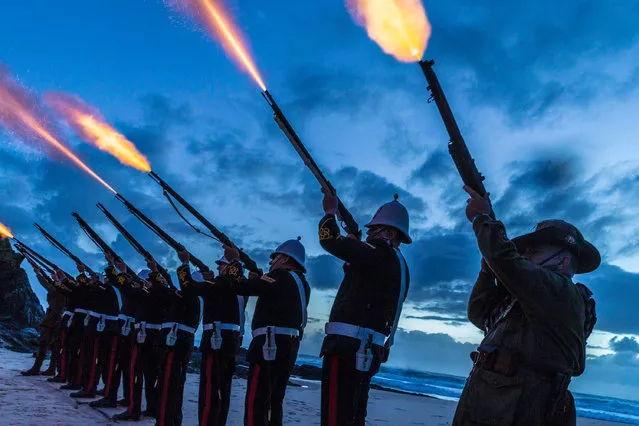
Members of the Albert Battery perform a gun salute during the Anzac Day dawn service held by the Currumbin RSL on the Gold Coast in Currumbin, Australia, 25 April 2016. The Anzac day marks the landing of the Australian and New Zealand Army Corps (Anzac) troops at Gallipoli in what is today Turkey during WWI. World War One, also called the Great War, according to official statistics cost more than 37 million military and civilian casualties between 1914 and 1918. (Photo by Glenn Hunt/EPA)

Members of the Albert Battery perform a gun salute during the Anzac Day dawn service held by the Currumbin RSL on the Gold Coast in Currumbin, Australia, 25 April 2016. The Anzac day marks the landing of the Australian and New Zealand Army Corps (Anzac) troops at Gallipoli in what is today Turkey during WWI. World War One, also called the Great War, according to official statistics cost more than 37 million military and civilian casualties between 1914 and 1918. (Photo by Glenn Hunt/EPA)
Details
26 Apr 2016 12:23:00
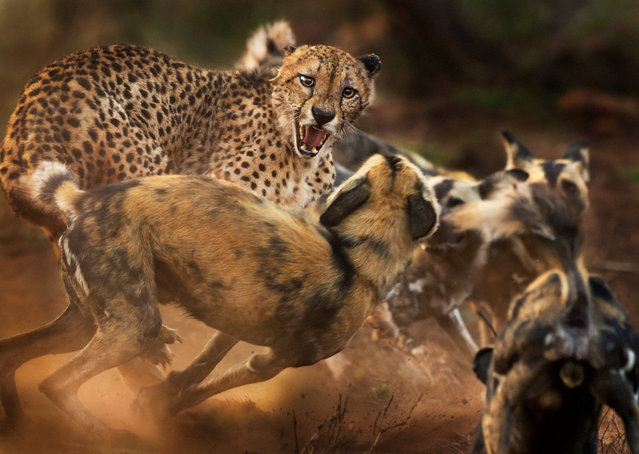
A lone male cheetah is set upon by a pack of African wild dogs. Peter Haygarth had been following the dogs as they hunted in Zimanga Private Game Reserve in KwaZulu-Natal, South Africa. On first encountering the cheetah, the dogs were wary, but as the rest of the pack arrived, their confidence grew and they began to encircle the cat. Peter kept his focus on the cat’s face. In a few minutes the spat was over as the cheetah fled. (Behaviour: mammals category). (Photo by Peter Haygarth)

A lone male cheetah is set upon by a pack of African wild dogs. Peter Haygarth had been following the dogs as they hunted in Zimanga Private Game Reserve in KwaZulu-Natal, South Africa. On first encountering the cheetah, the dogs were wary, but as the rest of the pack arrived, their confidence grew and they began to encircle the cat. Peter kept his focus on the cat’s face. In a few minutes the spat was over as the cheetah fled. (Behaviour: mammals category). (Photo by Peter Haygarth)
Details
10 Sep 2019 00:03:00
A man dressed up as the devil jumps over babies lying on a mattress in the street during “El Colacho”, the “baby jumping festival” in the village of Castrillo de Murcia, near Burgos on June 18, 2017. Baby jumping (El Colacho) is a traditional Spanish practice dating back to 1620 that takes place annually to celebrate the Catholic feast of Corpus Christi. During the act – known as El Salto del Colacho (the devil's jump) or simply El Colacho – men dressed as the Devil jump over babies born in the last twelve months of the year who lie on mattresses in the street. (Photo by Cesar Manso/AFP Photo)

A man dressed up as the devil jumps over babies lying on a mattress in the street during “El Colacho”, the “baby jumping festival” in the village of Castrillo de Murcia, near Burgos on June 18, 2017. Baby jumping (El Colacho) is a traditional Spanish practice dating back to 1620 that takes place annually to celebrate the Catholic feast of Corpus Christi. During the act – known as El Salto del Colacho (the devil's jump) or simply El Colacho – men dressed as the Devil jump over babies born in the last twelve months of the year who lie on mattresses in the street. (Photo by Cesar Manso/AFP Photo)
Details
20 Jun 2017 07:29:00
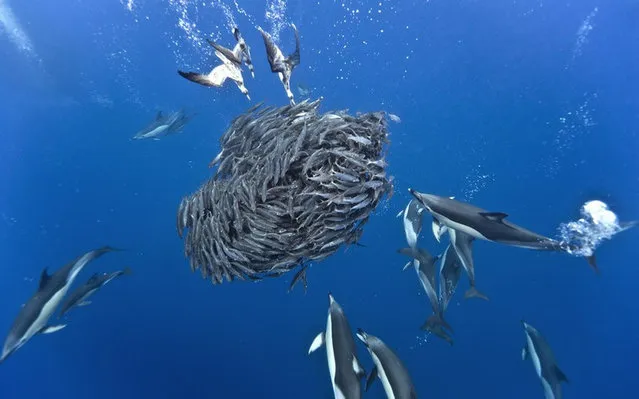
Sharks And Dolphins Preying On Mackerel

British photographer Christopher Swann captures the fascinating underwater action that takes place when sharks and dolphins prey on a school of mackerel. We rarely think about how members of the animal kingdom hunt or defend themselves, but the wildlife photographer gives some perspective on these particular creatures off the coast of Azores.
Details
10 Feb 2013 12:04:00
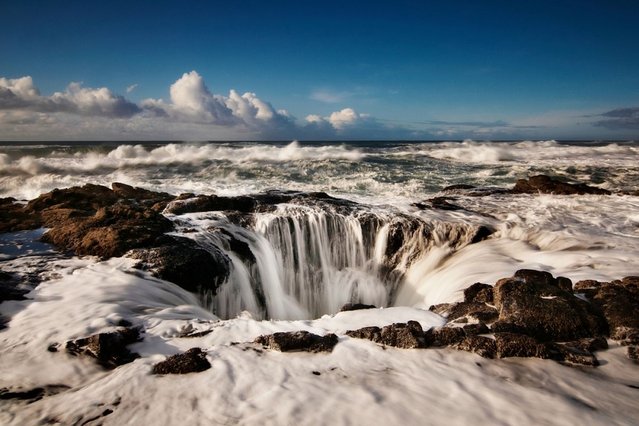
Thor's Well in Cape Perpetua

For at least 6,000 years Native Americans hunted for mussels, crabs, sea urchins, and clams along the coast near Cape Perpetua. Evidence of their lives can still be found in the huge piles of discarded mussel shells that lie along the shore near the Cape Perpetua Visitor Center
Details
22 Jul 2012 20:13:00


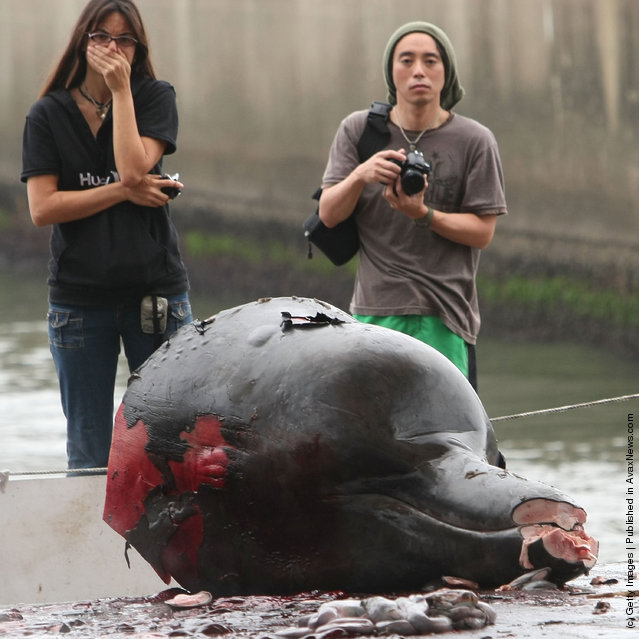
Fishermen slaughter a 9.61m Baird's Beaked whale at Wada Port on June 28, 2008 in Minami Boso, Chiba, Japan. Only five ports are allowed whaling under the coastal whaling program which tries to keep whaling tradition that dates back to the seventeenth century. Japan is only allowed to hunt a limited number of whales every year. (Photo by Koichi Kamoshida/Getty Images)
Details
26 Apr 2011 08:07:00