Loading...
Done
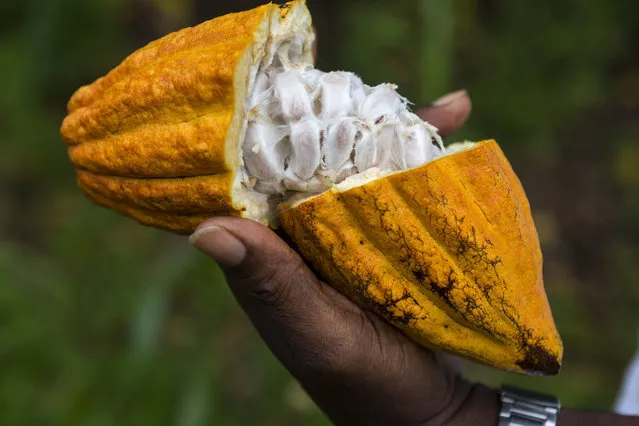
Farmer holding a freshly cut cocoa bean pod, revealing the pulp and seed inside on a rainforest farm. (Photo by Doug McKinlay/Getty Images)

Chocolate is the greatest gift the Earth has given us. The dessert table would be a sad sight without it. It’s so beloved, so appreciated, that the Swedish scientist who named the cocoa plant that gives us chocolate called it Theobroma cacao, which means “food of the gods”. Here: Farmer holding a freshly cut cocoa bean pod, revealing the pulp and seed inside on a rainforest farm. (Photo by Doug McKinlay/Getty Images)
Details
10 Aug 2016 10:20:00
Christopher Jonassen’s Alien Landscapes

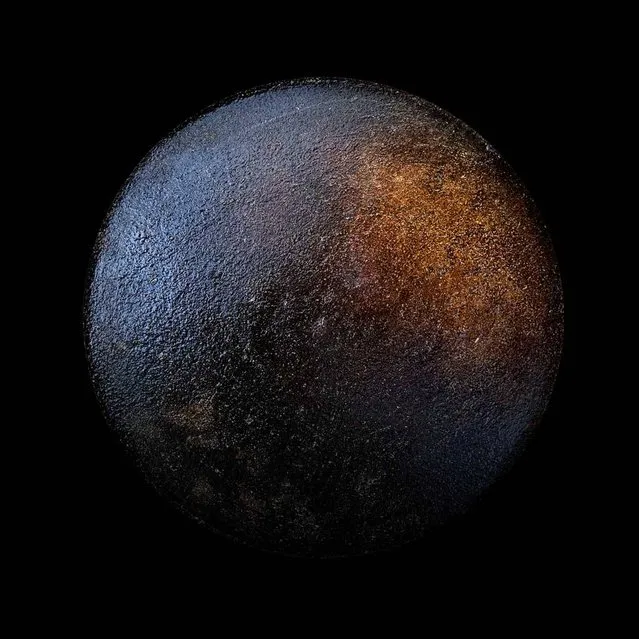
Is it the surface of the Mars or Venus or an undiscovered planet? Not at all. These pictures aren’t what you think they are. Christopher Jonassen, a Norwegian photographer shot these beautiful and otherworldly series called ‘Devour of frying pan bottoms’, which are visually similar to craters and scars on a planet’s surface. In his series Jonassen refers to a quote of Jean-Paul Satre who said: ‘To eat is to appropriate destruction’ and the meaning of the word ‘devour’, which stands for eating up greedily, destroying, consuming, and wasting.
Details
30 Aug 2013 08:18:00
Food In Faces By Victor Nunes

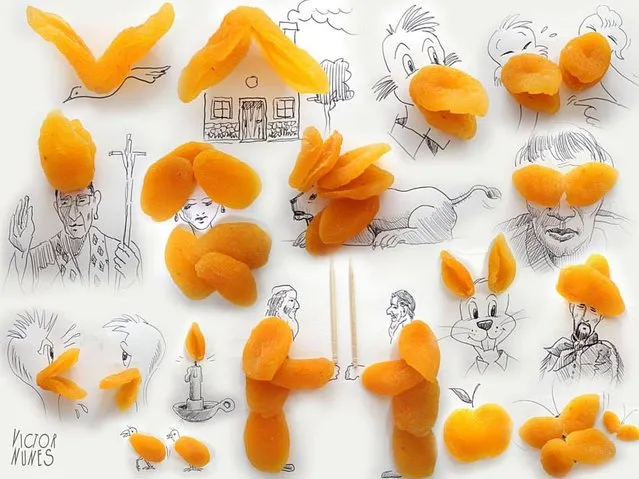
Artist Victor Nunes combines every-day objects with simple illustrations to turn them into pictures of faces, animals and other playful scenes. His images invite us to look at the world differently and find creative images in our surroundings. Nunes’ art is a great example of pareidolia, which is our propensity to give meaning to random objects (like in this post about seeing faces in random objects). It’s the reason why we associate a smiley face with a human face and why some of Nunes’ pieces of popcorn or bread resemble faces to us.
Details
02 Feb 2014 11:58:00
A makeshift aircraft plummets into the Moskva River during the Red Bull Flugtag Moscow 2011 competition. (Photo by Sergei Karpukhin/Reuters)

Spectators in Moscow were treated to the site of humorously designed makeshift aircraft plunging into the Muskova River during the Red Bull Flugtag Moscow 2011 competition. 38 teams took part at the Flugtag – which means “flying day” – a competition in which teams in fancy dress attempt to pilot human-powered, home-made flying machines off a six-meter-high platform into water.

Photo: A makeshift aircraft plummets into the Moskva River during the Red Bull Flugtag Moscow 2011 competition. (Photo by Sergei Karpukhin/Reuters)
Details
27 Jul 2012 08:09:00
Magazine Store By Farhad Moshiri

Farhad Moshiri, an Iranian artist working a lot with carpet media using it as a mean to joke about consumerism culture, was one of the participants of the group show Love Me Love Me Not of Yarat! pavilion curate by Dina Nasser-Khadivi (read on her curating Lalla Essaydi's Harem here) at Venice 2013 Art Biennial. The installation consists of more than 500 carpets depicting celebrities-covered magazines from all over the world.
Details
02 Oct 2014 12:15:00


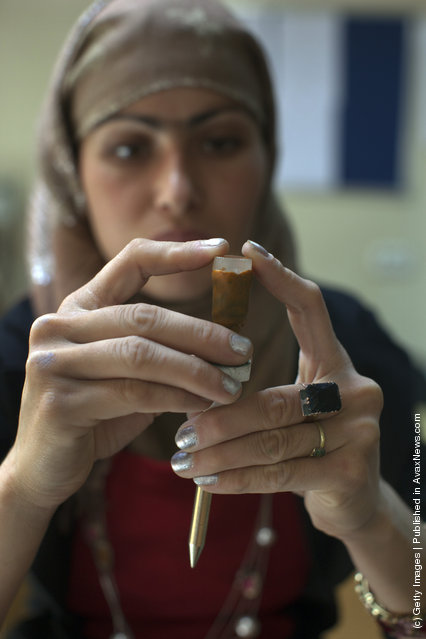
Student, Shoukria positions a stone for cutting at the Turquoise Mountain Gem cutting class on May 18, 2011, in Kabul, Afghanistan. The mineral resources of Afghanistan are relatively unexplored even with Afghanistan's mineral wealth of coal, copper, gold and iron ore, with precious and semiprecious stones, including high-quality emerald, lapis lazuli, red garnet and ruby. Given the country's remote and rugged terrain, on-going instability plus an inadequate infrastructure and transportation means that mining is still difficult. While many are trying to bring positive changes, Afghanistan's mining industry uses unregulated, primitive methods and outdated equipment. (Photo by Paula Bronstein/Getty Images)
Details
22 May 2011 09:11:00
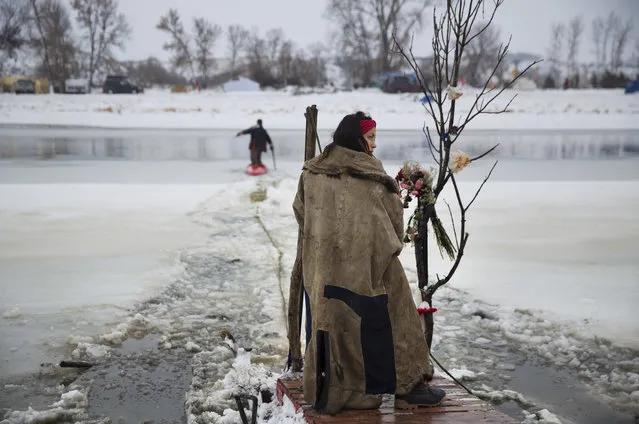
In this Thursday, December 1, 2016 photo, Cat Bigney, part of the Oglala Native American tribe, waits on the shore of the Cannonball river for travelers to arrive by canoe at the Oceti Sakowin camp where people have gathered to protest the Dakota Access oil pipeline in Cannon Ball, N.D. So far, those at the camp have shrugged off the heavy snow, icy winds and frigid temperatures. But if they defy next week's government deadline to abandon the camp, demonstrators know the real deep freeze lies ahead. Life-threatening wind chills and towering snow drifts could mean the greatest challenge is simple survival. (Photo by David Goldman/AP Photo)

In this Thursday, December 1, 2016 photo, Cat Bigney, part of the Oglala Native American tribe, waits on the shore of the Cannonball river for travelers to arrive by canoe at the Oceti Sakowin camp where people have gathered to protest the Dakota Access oil pipeline in Cannon Ball, N.D. So far, those at the camp have shrugged off the heavy snow, icy winds and frigid temperatures. But if they defy next week's government deadline to abandon the camp, demonstrators know the real deep freeze lies ahead. Life-threatening wind chills and towering snow drifts could mean the greatest challenge is simple survival. (Photo by David Goldman/AP Photo)
Details
06 Dec 2016 10:22:00


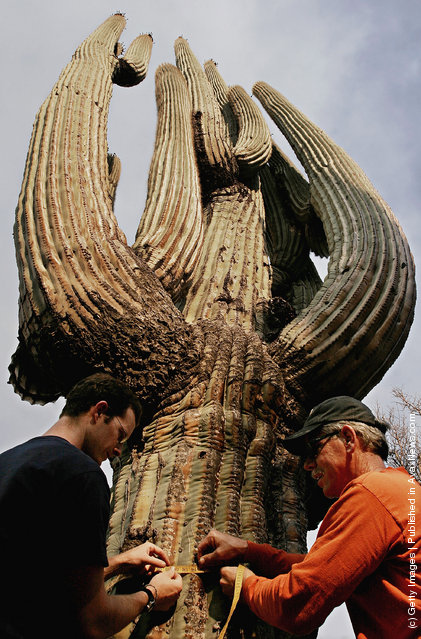
“The saguaro (scientific name Carnegiea gigantea) is a large, tree-sized cactus species in the monotypic genus Carnegiea. It is native to the Sonoran Desert in the U.S. state of Arizona, the Mexican state of Sonora, a small part of Baja California in the San Felipe Desert and an extremely small area of California, U.S. The saguaro blossom is the State Wildflower of Arizona”. – Wikipedia

Photo: Daniel Appel (L), a firefighter with Engine 84 from the Lassen National Forest in California and Mike Hallen, (R), Arizona representative of the National Register of Big Trees, measure the circumference of this Saguaro cactus called the "Grand One," in the Tonto National Forest on July 1, 2005 35 miles north of Phoenix, near Carefree, Arizona. The cactus, estimated to be more than 200 years old, measures a circumference of 7 feet, 10 inches (2.4 meters) and stands 46 feet high (14 meters). The cactus was burned in the Cave Creek Complex fire and may not survive. It was once the largest Saguaro in the world, two others have been found recently that have tied it's measurements. The fire has burned more than 214,000 acres of the Sonoran desert. (Photo by Jeff Topping/Getty Images)

Details
26 Jul 2011 12:27:00