Loading...
Done
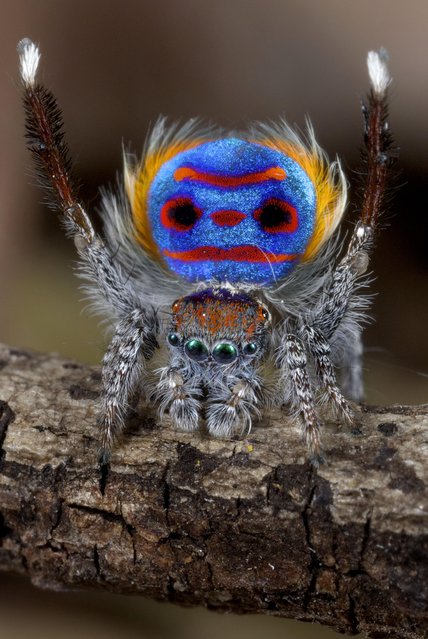
Peacock Spider Maratus Speciosus by Jurgen Otto

Maratus is a spider genus of the Salticidae family (jumping spiders). These spiders are commonly referred to as peacock spiders due to their colorful abdominal flaps that they display during courtship. In at least one species, Maratus vespertilio, the expansion of the flaps also occurs during ritualised contests between males. All described species, except M. furvus, are endemic to Australia. (Photo by Jurgen Otto)
Details
27 Feb 2014 12:20:00
Giulia Steingruber of Switzerland competes in the Vault apparatus final during day nine of the Artistic Gymnastics World Championships Tokyo 2011

Giulia Steingruber of Switzerland competes in the Vault apparatus final during day nine of the Artistic Gymnastics World Championships Tokyo 2011 at Tokyo Metropolitan Gymnasium on October 15, 2011 in Tokyo, Japan. (Photo by Adam Pretty/Getty Images)
Details
21 Oct 2011 09:59:00
A Syrian man sells vegetables in front of a damaged tank in Homs, on December 20, 2024. Islamist-led rebels took Damascus in a lightning offensive on December 8, ousting president Bashar al-Assad and ending five decades of Baath rule in Syria. (Photo by Sameer Al-Doumy/AFP Photo)

A Syrian man sells vegetables in front of a damaged tank in Homs, on December 20, 2024. Islamist-led rebels took Damascus in a lightning offensive on December 8, ousting president Bashar al-Assad and ending five decades of Baath rule in Syria. (Photo by Sameer Al-Doumy/AFP Photo)
Details
21 Jun 2025 03:19:00
Four pillars of light from the 4 Laser Guide Star Facility on ESO's Very Large Telescope (VLT) are shown reaching into the Chilean night sky in this image from ESO Photo Ambassador Fred Kamphues, on September 2, 2016. The lasers are a key part of the adaptive optics system on the VLT. Adaptive optics allows astronomers to drastically reduce the atmospheric distortion present at even the best sites in the world for astronomy, including Paranal in Chile, the home of the VLT. (Photo by F. Kamphues/ESO)

Four pillars of light from the 4 Laser Guide Star Facility on ESO's Very Large Telescope (VLT) are shown reaching into the Chilean night sky in this image from ESO Photo Ambassador Fred Kamphues, on September 2, 2016. The lasers are a key part of the adaptive optics system on the VLT. Adaptive optics allows astronomers to drastically reduce the atmospheric distortion present at even the best sites in the world for astronomy, including Paranal in Chile, the home of the VLT. (Photo by F. Kamphues/ESO)
Details
23 Feb 2017 00:06:00
A woman carries her child as she watches Mount Sinabung volcano spewing thick volcanic ash, as seen from Karo on July 21, 2017. Sinabung roared back to life in 2010 for the first time in 400 years, after another period of inactivity it erupted once more in 2013, and has remained highly active since. (Photo by Gatha Ginting/AFP Photo)

A woman carries her child as she watches Mount Sinabung volcano spewing thick volcanic ash, as seen from Karo on July 21, 2017. Sinabung roared back to life in 2010 for the first time in 400 years, after another period of inactivity it erupted once more in 2013, and has remained highly active since. (Photo by Gatha Ginting/AFP Photo)
Details
22 Jul 2017 08:47:00


“Snowflake (c. 1964 – November 24, 2003) was an albino gorilla. He was the only known albino gorilla so far, and the most popular resident of the Barcelona Zoo in Catalonia, Spain. Originally named Nfumu Ngui in Fang language ("white gorilla") by his captor, he was then nicknamed Floquet de Neu (Catalan for little snowflake) by his keeper Jordi Sabater Pi. On his arrival to Barcelona where he was given an official reception by the then Mayor of Barcelona, Josep Maria de Porcioles, in November 1966, he was called Blancanieves (“Snow White”) in the newspaper Tele/Exprés. But he became famous with the name given to him by Sabater when National Geographic Magazine featured him on the main page in March 1967, with the English name Snowflake. This name spread among the press (Stern, Life, Paris-Match) and was later translated to Spanish as Copito de Nieve. Sabater himself called the gorilla Floquet or Copi, and in the later years Nfumu. The asteroid 95962 Copito, discovered by Catalan astronomer J. Manteca, is named in his honour”.

Details
07 Mar 2011 15:50:00
Kaw-Claa, a Tlingit native woman in full potlatch dancing costume, 1906. (Photo by Case & Draper/Buyenlarge/Getty Images)

Kaw-Claa, a Tlingit native woman in full potlatch dancing costume, 1906. (Photo by Case & Draper/Buyenlarge/Getty Images)
Details
11 Jan 2017 14:42:00
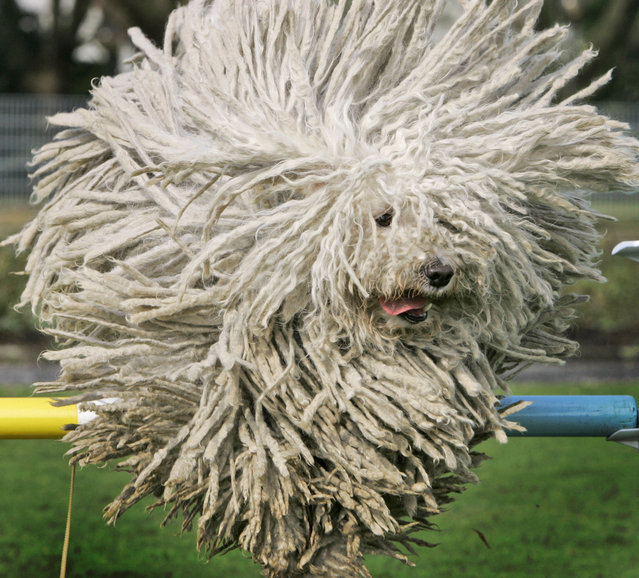
Hungarian Puli sheep dog, Fee, jumps over a hurdle during a preview for a pedigree dog  show in Dortmund on Thursday April 24, 2008. (Photo by Frank Augstein/AP Photo)

Hungarian Puli sheep dog, Fee, jumps over a hurdle during a preview for a pedigree dog show in Dortmund on Thursday April 24, 2008. (Photo by Frank Augstein/AP Photo)
Details
03 Sep 2015 12:49:00