Loading...
Done
A woman (C) shops for an offering at the witch doctor's street in La Paz, July 31, 2015. (Photo by David Mercado/Reuters)

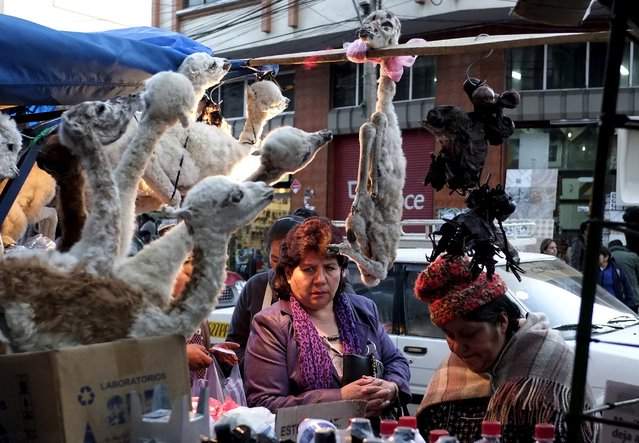
A woman (C) shops for an offering at the witch doctor's street in La Paz, July 31, 2015. According to Andean culture, the all the month of August is a time to give offerings to “Pachamama” to give thanks for their farms and health. The Aymaras use coca leaves, candies, animal fat, llama fetuses, some dried fruits, powdered minerals and alcohol during these rituals. (Photo by David Mercado/Reuters)
Details
02 Aug 2015 12:27:00
The possible surface of TRAPPIST-1f, one of seven newly discovered planets in the TRAPPIST-1 system that scientists using the Spitzer Space Telescope and ground based telescopes have discovered. (Photo by Reuters/NASA/JPL-Caltech)

The possible surface of TRAPPIST-1f, one of seven newly discovered planets in the TRAPPIST-1 system that scientists using the Spitzer Space Telescope and ground based telescopes have discovered. (Photo by Reuters/NASA/JPL-Caltech)
Details
07 Mar 2017 00:02:00
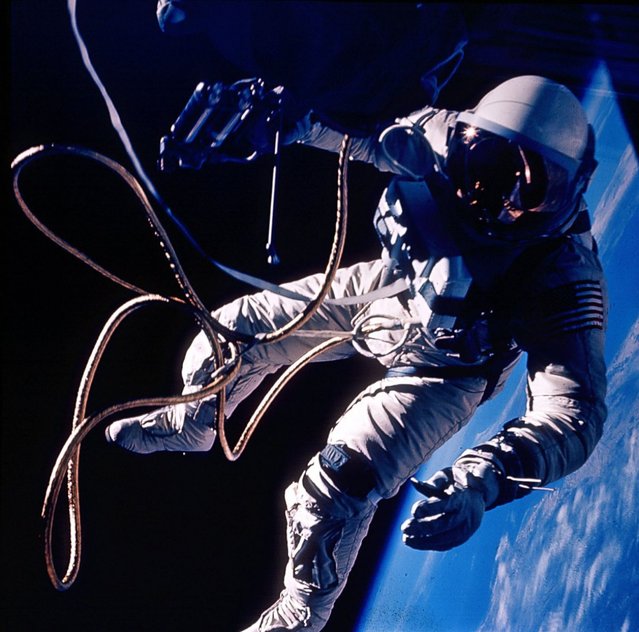
The First U.S. Spacewalk – Gemini 4 Ed White made the United States' first spacewalk on June 3, 1965 during the Gemini 4 mission. The extra-vehicular activity (EVA) started at 19:45 UT (3:45 p.m. EDT) on the third orbit when White opened his hatch and used the hand-held manuevering oxygen-jet gun to push himself out of the capsule. (Photo by NASA)

The First U.S. Spacewalk – Gemini 4 Ed White made the United States' first spacewalk on June 3, 1965 during the Gemini 4 mission. The extra-vehicular activity (EVA) started at 19:45 UT (3:45 p.m. EDT) on the third orbit when White opened his hatch and used the hand-held manuevering oxygen-jet gun to push himself out of the capsule. (Photo by NASA)
Details
11 Apr 2014 08:40:00
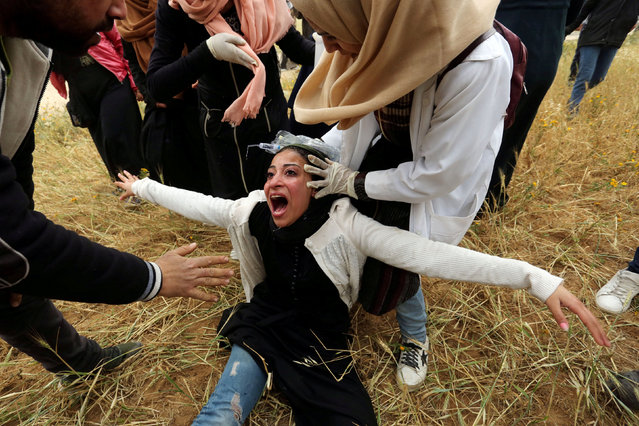
A Palestinian woman reacts after inhaling tear gas fired by Israeli forces during a protest marking Land Day and the first anniversary of a surge of border protests, at the Israel-Gaza border fence, in the southern Gaza Strip March 30, 2019. (Photo by Ashraf Abu Amrah/Reuters)

A Palestinian woman reacts after inhaling tear gas fired by Israeli forces during a protest marking Land Day and the first anniversary of a surge of border protests, at the Israel-Gaza border fence, in the southern Gaza Strip on March 30, 2019. (Photo by Ashraf Abu Amrah/Reuters)
Details
01 Apr 2019 00:07:00
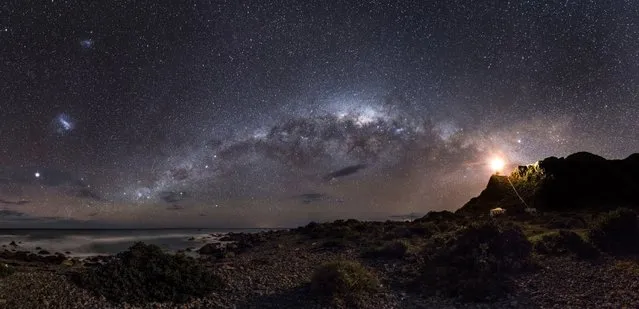
Astronomy Photographer Of The Year 2013 Part2

The Royal Observatory just announced its Astronomy Photographer Of The Year 2013 winners. Australian photographer Mark Gee was chosen among a thousand amateur and professional photographers around the globe to win the top title. His work is part of an exhibition of the winning photographers, which opened on Sept. 19 at the Royal Observatory Greenwich. The Royal Observatory shared with us the winners and notable mentions of the competition. Their descriptions of the prizewinners can be found below the images.
Details
05 Oct 2013 12:23:00
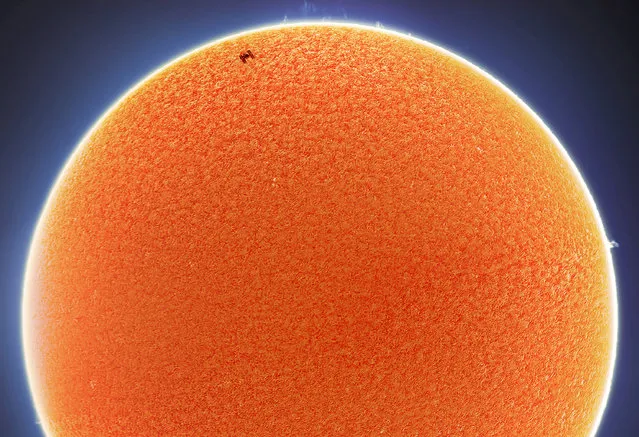
The International Space Station (ISS) moving in front of the sun in November 2020 by astrophotographer Andrew McCarthy. These incredible photos capture the clearest images ever taken of the International Space Station (ISS) moving in front of both the moon and the sun. The photos, taken within days of one another, were captured in the space of less than a second, as the space station could be clearly seen zooming across against the bright backdrops of both moon and sun. Photographer Andrew McCarthy, from California, USA, said the photo of the ISS in front of the sun, in broad daylight, was “one of my trickiest shots ever”. (Photo by Andrew McCarthy/South West News Service)

The International Space Station (ISS) moving in front of the sun in November 2020 by astrophotographer Andrew McCarthy. These incredible photos capture the clearest images ever taken of the International Space Station (ISS) moving in front of both the moon and the sun. The photos, taken within days of one another, were captured in the space of less than a second, as the space station could be clearly seen zooming across against the bright backdrops of both moon and sun. Photographer Andrew McCarthy, from California, USA, said the photo of the ISS in front of the sun, in broad daylight, was “one of my trickiest shots ever”. (Photo by Andrew McCarthy/South West News Service)
Details
28 Nov 2020 00:05:00
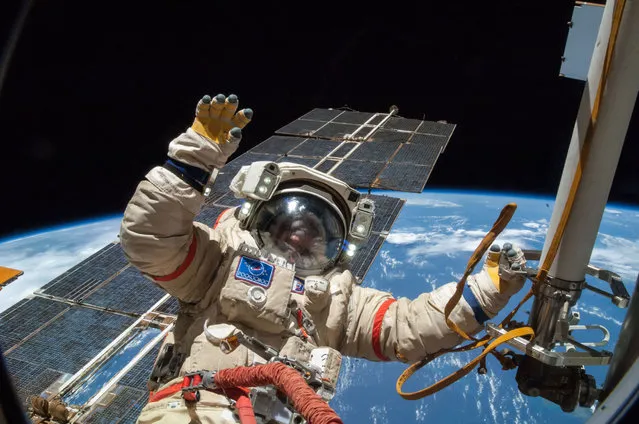
Russian cosmonaut Alexander Skvortsov, Expedition 40 flight engineer, attired in a Russian Orlan spacesuit, participates in a session of extravehicular activity (EVA) in support of science and maintenance on the International Space Station on August 18, 2014. During the five-hour, 11-minute spacewalk, Skvortsov and cosmonaut Oleg Artemyev (out of frame) deployed a small science satellite, retrieved and installed experiment packages and inspected components on the exterior of the orbital laboratory. (Photo by NASA)

Russian cosmonaut Alexander Skvortsov, Expedition 40 flight engineer, attired in a Russian Orlan spacesuit, participates in a session of extravehicular activity (EVA) in support of science and maintenance on the International Space Station on August 18, 2014. During the five-hour, 11-minute spacewalk, Skvortsov and cosmonaut Oleg Artemyev (out of frame) deployed a small science satellite, retrieved and installed experiment packages and inspected components on the exterior of the orbital laboratory. (Photo by NASA)
Details
13 Apr 2022 06:53:00
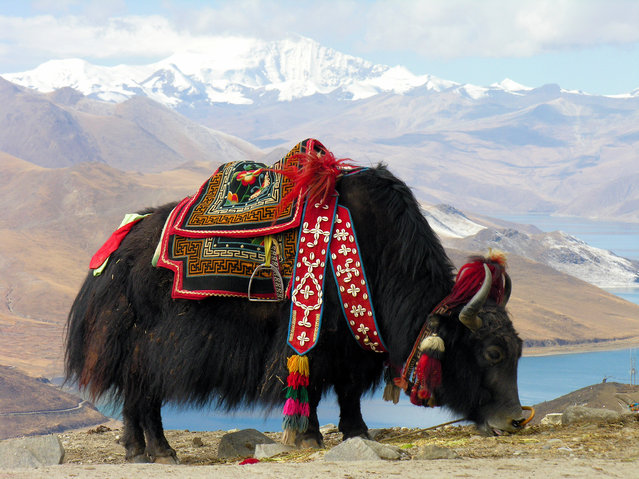
Yak near Yamdrok lake, Tibet. It is a long-haired bovinae found throughout the Himalayan region of south Central Asia, the Tibetan Plateau and as far north as Mongolia and Russia. The Tibetan economy is dominated by subsistence agriculture. Due to limited arable land, the primary occupation of the Tibetan Plateau is raising livestock, such as sheep, cattle, goats, camels, yaks, dzo, and horses. The Tibetan yak is an integral part of Tibetan life. (Photo by Dennis Jarvis)

Yak near Yamdrok lake, Tibet. It is a long-haired bovinae found throughout the Himalayan region of south Central Asia, the Tibetan Plateau and as far north as Mongolia and Russia. The Tibetan economy is dominated by subsistence agriculture. Due to limited arable land, the primary occupation of the Tibetan Plateau is raising livestock, such as sheep, cattle, goats, camels, yaks, dzo, and horses. The Tibetan yak is an integral part of Tibetan life. (Photo by Dennis Jarvis)
Details
10 Jun 2015 10:48:00