Loading...
Done
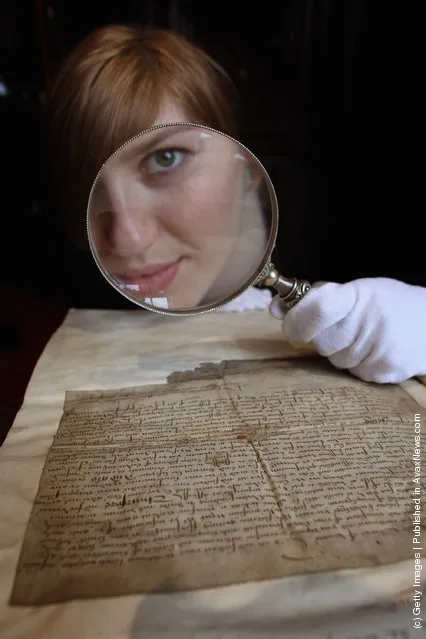
Charlotte Roirdan from Lyon & Turnbull views a letter written by Mary Queen of Scots

Charlotte Roirdan from Lyon & Turnbull views a letter written by Mary Queen of Scots on March 8, 2012 in Edinburgh, Scotland. The 450 year old letter, unearthed in Blair Castle in Ayrshire, has been verified as the hand writing of Mary Queen of Scotts and has been valued at 3,000 GBP. The letter, dated March 20, 1554, relieves the then laird of Blair from his duties due to gout and will be put up for sale next week at an auction in Edinburgh. (Photo by Jeff J. Mitchell/Getty Images)
Details
11 Mar 2012 10:19:00
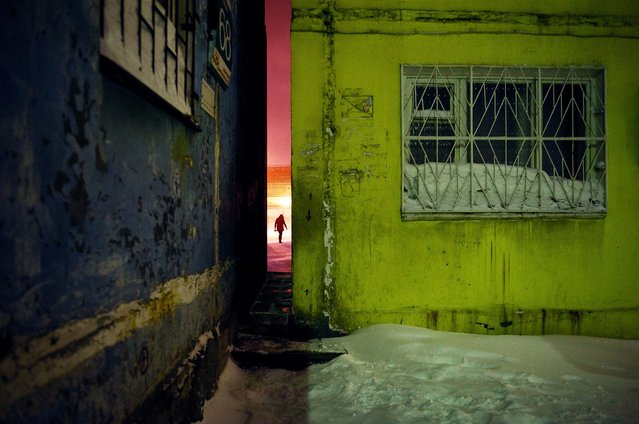
2013. A woman is visible through a narrow passageway between two buildings. Norilsk's urban spaces were designed to shorten distances around large developments and give residents maximum protection from arctic winds. (Photo by Elena Chernyshova)

Elena Chernyshova's vision of Norilsk, Russia, the northernmost city in the world, is a series of surprises by which she extracts otherworldly beauty from ugly realities. Here: 2013. A woman is visible through a narrow passageway between two buildings. Norilsk's urban spaces were designed to shorten distances around large developments and give residents maximum protection from arctic winds. (Photo by Elena Chernyshova)
Details
10 Jan 2016 08:03:00
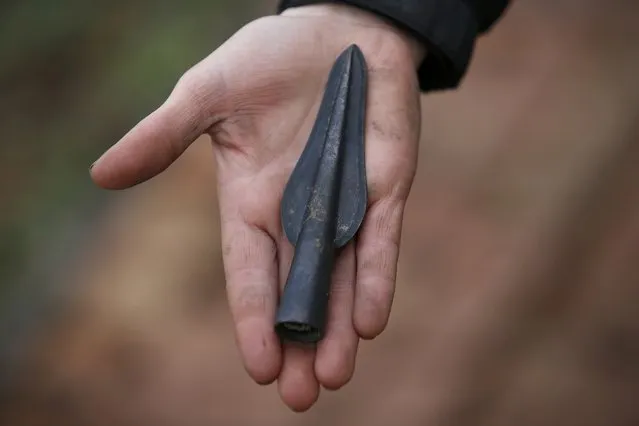
An arrow-head discovered in 2006 by Archaeologists of the University of Cambridge Archaeological Unit, is displayed by one of the team uncovering Bronze Age wooden houses, preserved in silt, from a quarry near Peterborough, Britain, January 12, 2016. (Photo by Peter Nicholls/Reuters)

An arrow-head discovered in 2006 by Archaeologists of the University of Cambridge Archaeological Unit, is displayed by one of the team uncovering Bronze Age wooden houses, preserved in silt, from a quarry near Peterborough, Britain, January 12, 2016. Archaeologists said on Tuesday they had discovered what were believed to be the best-preserved Bronze Age dwellings ever found in Britain, providing an extraordinary insight into prehistoric life from 3,000 years ago. (Photo by Peter Nicholls/Reuters)
Details
14 Jan 2016 08:00:00
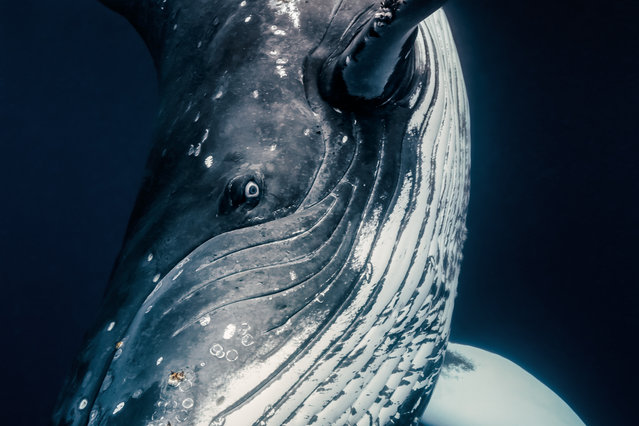
“To look into a whale’s eye is life-changing and humbling. Well, it’s the same with dolphins but they are mostly very fast in the water. A whale’s eye is unexpectedly looking, just like a human eye, kinda checking you out”. (Photo by Rita Kluge/The Guardian)

With the humpback calving season drawing to a close, here’s a look at some of Rita Kluge’s distinctive marine photos from the south Pacific. The Sydney-based photographer fell in love with whales after witnessing southern rights from the New South Wales coastline as they travelled to and from their feeding grounds in the Antarctic. She has since been to Tonga, where humpbacks breed and calf in winter months, to photograph them in the water. (Photo by Rita Kluge/The Guardian)
Details
26 Oct 2016 11:09:00
Fishermen collect their catch from a net at Dojran Lake, Macedonia, January 4, 2017. (Photo by Ognen Teofilovski/Reuters)

Fishermen collect their catch from a net at Dojran Lake, Macedonia, January 4, 2017. Fish from the lake is a traditional food for locals for orthodox Christmas eve, which falls on January 6. The lake faced sustainability issues during the 1990s due to drought and excessive use of its water but has since recovered after measures were taken to replenish and sustain water levels, according to local media. Dojran Lake is one of the three natural lakes in Macedonia, and also the warmest. It is said it is also the richest lake in fish in Europe. (Photo by Ognen Teofilovski/Reuters)
Details
05 Jan 2017 13:41:00
Queen of the North (created by Emilie Steele and Sebastian Dell’Uva) is one of the more intense rooms, with the bed surrounded by the head and hands of an icy goddess. (Photo by Asaf Kliger/IceHotel/The Guardian)

Founded in 1989, the Icehotel in Swedish Lapland is built from the snow up each year, using ice from the local river. The rooms are designed by international artists and this year feature spacemen and an ice queen. The hotel has 35 suites, featuring ice carvings designed by 36 different artists from 17 countries. (Photo by Asaf Kliger/IceHotel/The Guardian)
Details
20 Dec 2017 07:11:00
An infrared portrait from NASA's Spitzer Space Telescope which shows generations of stars is seen in this undated NASA handout image released February 14, 2013. In this wispy star-forming region, called W5, the oldest stars can be seen as blue dots in the centers of the two hollow cavities (other blue dots are background and foreground stars not associated with the region). Red shows heated dust that pervades the region's cavities, while green highlights dense clouds. (Photo by NASA/Reuters/JPL-Caltech/Harvard-Smithsonian/Handout)

An infrared portrait from NASA's Spitzer Space Telescope which shows generations of stars is seen in this undated NASA handout image released February 14, 2013. In this wispy star-forming region, called W5, the oldest stars can be seen as blue dots in the centers of the two hollow cavities (other blue dots are background and foreground stars not associated with the region). Red shows heated dust that pervades the region's cavities, while green highlights dense clouds. (Photo by NASA/Reuters/JPL-Caltech/Harvard-Smithsonian/Handout)
Details
03 Mar 2013 08:44:00
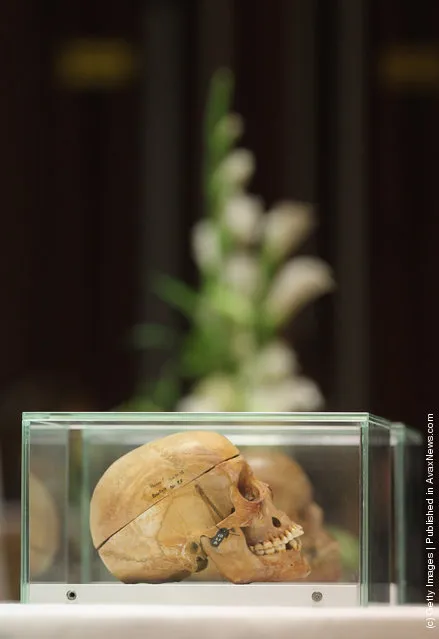
Charite Hospital Returns Herero Skulls To Namibia

Two of 20 skulls to be taken possession of by a delegation from Namibia stand on display at a ceremony at Charite hospital on September 30, 2011 in Berlin, Germany. The skulls are from Herero and Nama tribespeople taken by German colonial forces between 1904 and 1908, when the Germans violently suppressed an uprising in what was then German Southwest Africa, which is today's Namibia, and in the process killed tens of thousand of Herero and Nama. German scientists at the time took the skulls back to Berlin to demonstrate the racial superiority of Europeans over black Africans. Many Namibians demand a formal apology from the German government. (Photo by Sean Gallup/Getty Images)
Details
02 Oct 2011 11:42:00