Loading...
Done
Activists from the animal rights group PETA wearing bikinis and crocodile masks assist each other outside a store of the French fashion label Hermes in Sydney on March 4, 2021, as they protest against their use of crocodile skins and the recent purchases by Hermes and LVMH of crocodile farms in Australia's Northern Territory. (Photo by David Gray/AFP Photo)

Activists from the animal rights group PETA wearing bikinis and crocodile masks assist each other outside a store of the French fashion label Hermes in Sydney on March 4, 2021, as they protest against their use of crocodile skins and the recent purchases by Hermes and LVMH of crocodile farms in Australia's Northern Territory. (Photo by David Gray/AFP Photo)
Details
22 Jan 2022 06:31:00
Pink Champagne Fox Miko

Meet this Miko, a 4-month fox color "pink champagne". Fox this color were first bred on the Canadian farm, one hundred years ago. They are so rare species that currently exist in the world only two such individuals: one lives in Ontario, and the other is Miko. Such foxes bred in captivity and contain only as pets in Canada.
Details
21 Mar 2014 12:49:00


Beyonce Knowles performs at the Glastonbury Festival at Worthy Farm, Pilton on June 26, 2011 in Glastonbury, England. The festival, which started in 1970 when several hundred hippies paid 1 GBP to watch Marc Bolan, has grown into Europe's largest music festival attracting more than 175,000 people over five days. (Photo by Dave Hogan/Getty Images)
Details
28 Jun 2011 11:02:00
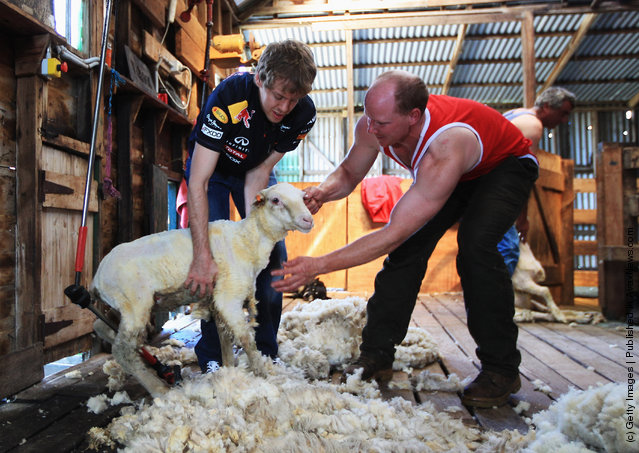
Sebastian Vettel

Sebastian Vettel of Germany and Red Bull Racing tries his hand at sheep shearing as he visits a local farm during previews to the Australian Formula One Grand Prix on March 23, 2011 in Melbourne, Australia.
Details
24 Mar 2011 10:50:00


A Republican farmer defending a farm on the outskirts of Irun against Nationalist forces during the Spanish Civil War, 6th September 1936. A comrade lies dead by his side. (Photo by Keystone/Hulton Archive/Getty Images)
Details
23 May 2011 05:59:00
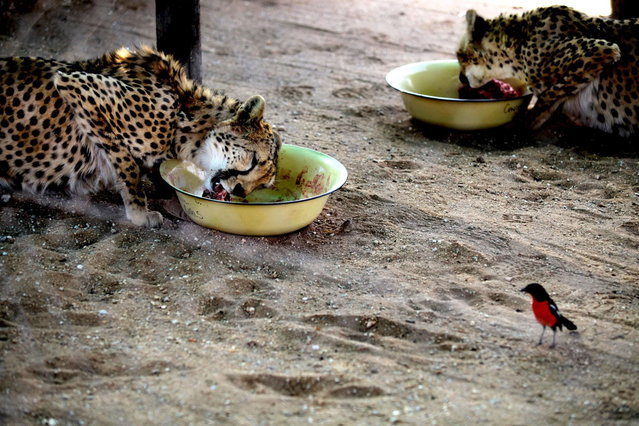
Young cheetahs eat meat at The Cheetah Conservation Fund (CCF) center in Otjiwarongo, Namibia, on August 13, 2013. The CCF started breeding Anatolian livestock dogs to promote cheetah-friendly farming after some 10,000 big cats – the current total worldwide population – were killed or moved off farms in the 1980s.  Up to 1,000 cheetahs were being killed a year, mostly by farmers who saw them as livestock killers. But the use of dogs has slashed losses for sheep and goat farmers and led to less retaliation against the vulnerable cheetah. (Photo by Jennifer Bruce/AFP Photo)

Young cheetahs eat meat at The Cheetah Conservation Fund (CCF) center in Otjiwarongo, Namibia, on August 13, 2013. The CCF started breeding Anatolian livestock dogs to promote cheetah-friendly farming after some 10,000 big cats – the current total worldwide population – were killed or moved off farms in the 1980s. Up to 1,000 cheetahs were being killed a year, mostly by farmers who saw them as livestock killers. But the use of dogs has slashed losses for sheep and goat farmers and led to less retaliation against the vulnerable cheetah. (Photo by Jennifer Bruce/AFP Photo)
Details
29 Aug 2013 10:56:00
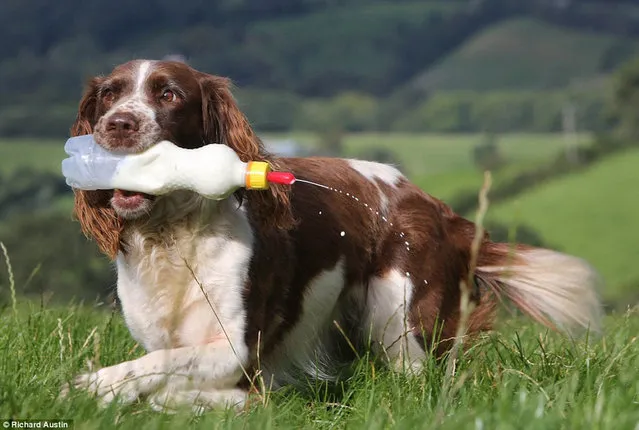
Spaniel Plays Mum For Lambs

A springer spaniel is helping out on her owner's farm – by playing mum for four lambs. Jess even feeds the Dorset Horn lambs, which could not be fed by their own mother, using a bottle held in her mouth.
Details
05 Dec 2012 13:39:00
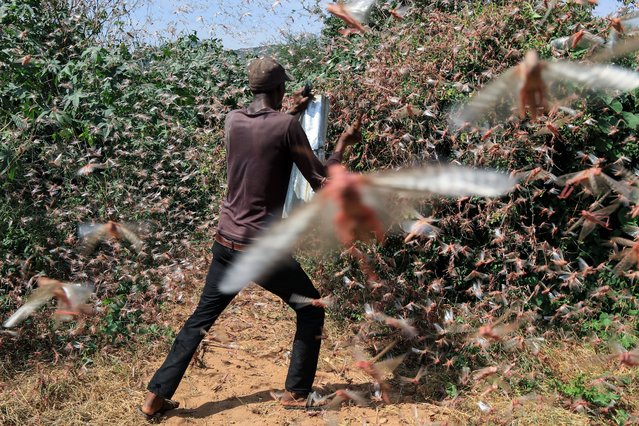
A man uses iron sheet to make noises, as a way of trying to disperse desert locusts that had invaded their farms during the second wave invasion in Kakongo village, in Nuu-Mwingi East, in Kitui, Kenya, 06 February 2021. The second wave invasion of the desert locusts in the country comes at a time where most famers are expecting to harvest their farm produce in the country. According to the United Nations Food and Agriculture Organization (FAO), on 04 February, warned numerous immature desert locust swarms persist in southern Ethiopia and Kenya. Some of the swarms are in community areas and therefore cannot be treated. In Kenya, immature swarms continue to spread westwards across northern and central counties where there are currently about 20 small swarms present, mostly about 50 hectares in size, it said. (Photo by Daniel Irungu/EPA/EFE)

A man uses iron sheet to make noises, as a way of trying to disperse desert locusts that had invaded their farms during the second wave invasion in Kakongo village, in Nuu-Mwingi East, in Kitui, Kenya, 06 February 2021. The second wave invasion of the desert locusts in the country comes at a time where most famers are expecting to harvest their farm produce in the country. (Photo by Daniel Irungu/EPA/EFE)
Details
25 Feb 2021 08:17:00