Loading...
Done
A man carries his dog as he prays during Vesak Day, an annual celebration of Buddha's birth, enlightenment and death, at Wat Yai Chai Mongkhon temple in Ayutthaya, Thailand, May 10, 2017. (Photo by Athit Perawongmetha/Reuters)

A man carries his dog as he prays during Vesak Day, an annual celebration of Buddha's birth, enlightenment and death, at Wat Yai Chai Mongkhon temple in Ayutthaya, Thailand, May 10, 2017. (Photo by Athit Perawongmetha/Reuters)
Details
11 May 2017 07:12:00
Delta CEO Ed Bastian talks about the century-old airline's past and technology such as generative artificial intelligence that he sees shaping its future during a Consumer Electronics Show (CES) presentation at The Sphere concert venue in Las Vegas on January 7, 2025. Delta on January 7 marked a century of flying with visions of a future in which artificial intelligence and internet age partnerships make air travel fun and seamless. (Photo by Glenn Chapman/AFP Photo)

Delta CEO Ed Bastian talks about the century-old airline's past and technology such as generative artificial intelligence that he sees shaping its future during a Consumer Electronics Show (CES) presentation at The Sphere concert venue in Las Vegas on January 7, 2025. Delta on January 7 marked a century of flying with visions of a future in which artificial intelligence and internet age partnerships make air travel fun and seamless. (Photo by Glenn Chapman/AFP Photo)
Details
05 Mar 2025 04:24:00
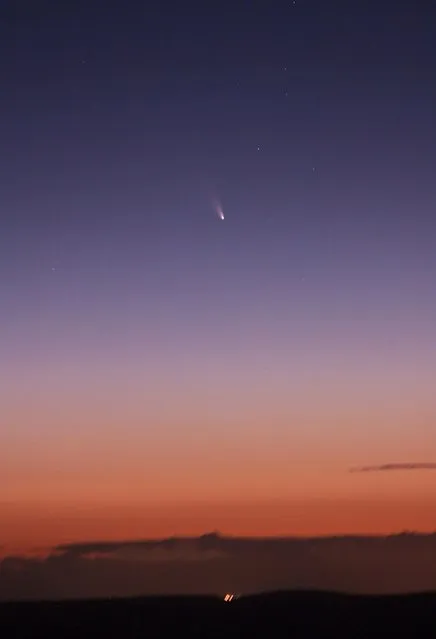
This image provided by NASA shoaws the comet PANSTARRS as seen from Mount Dale, Western Australia on March 5, 2013. According to NASA on March 10, it will make its closest approach to the sun about 28 million miles (45 million kilometers) away. As it continues its nightly trek across the sky, the comet may get lost in the sun's glare but should return and be visible to the naked eye by March 12. (Photo by AP Photo/NASA)

It’s time to start watching for Comet PANSTARRS, one of two comets to get excited about in 2013. Photo: This image provided by NASA shoaws the comet PANSTARRS as seen from Mount Dale, Western Australia on March 5, 2013. According to NASA on March 10, it will make its closest approach to the sun about 28 million miles (45 million kilometers) away. As it continues its nightly trek across the sky, the comet may get lost in the sun's glare but should return and be visible to the naked eye by March 12. (Photo by AP Photo/NASA)
Details
13 Mar 2013 08:03:00


In this artist's impression supplied by the ESO (European Southern Observatory) on April 25, 2007, the planetary system around the red dwarf, Gliese 581, is pictured showing what astronomers believe is the most earth like planet found outside our solar system to date. Using the ESO 3.6-m telescope in Chile, astronomers have uncovered the planet which could have water running on its surface. The planet orbits the faint star Gliese 581, which is 20.5 light-years away in the constellation Libra. (Photo by ESO via Getty Images)
Details
12 Apr 2011 11:00:00
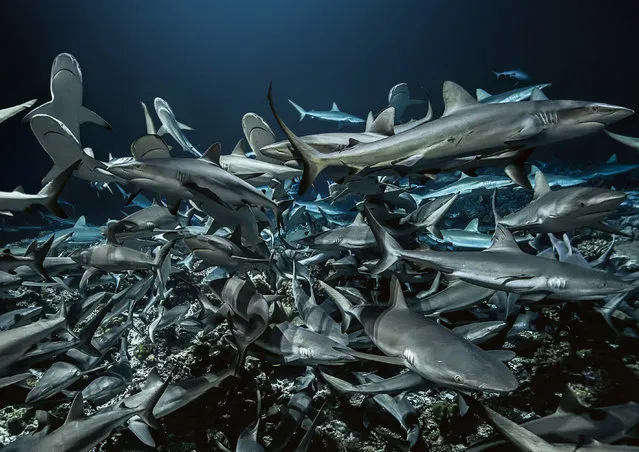
The men also decreased the time for Laurent to decompress from 20 hours to six. (Photo by Laurent Ballesta/Caters News Agency)

ne committed photographer spent a grand total of 3,000 dive hours trying to get the perfect shots, capturing beautiful images of a rare shark feeding frenzy. Laurent Ballesta’s images show the glimmering gray reef sharks hunting in swift packs, flying through the water and feasting on the likes of helpless grouper. (Photo by Laurent Ballesta/Caters News Agency)
Details
06 Jun 2018 00:03:00
Actors perform in a scene during the “Dino Safari” show in Tokyo, Japan, 25 April 2018. The Dino Safari show features dinosaurs moving in a realistic way thanks to the Dino-Tronics mechanism that enable the dinosaurs to walk, move their heads and jaws. The event will run from 26 April to 05 May 2018. (Photo by Franck Robichon/EPA/EFE)

Actors perform in a scene during the “Dino Safari” show in Tokyo, Japan, 25 April 2018. The Dino Safari show features dinosaurs moving in a realistic way thanks to the Dino-Tronics mechanism that enable the dinosaurs to walk, move their heads and jaws. The event will run from 26 April to 05 May 2018. (Photo by Franck Robichon/EPA/EFE)
Details
27 Apr 2018 05:35:00
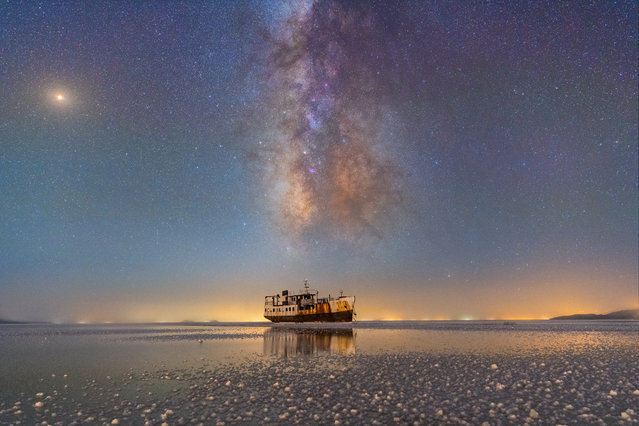
Sharafkhaneh port and lake Urmia. Masoud Ghadiri (Iran). The summer Milky Way is very prominent in this photo. On the galaxy zone, Saturn is located besides the Lagoon nebula. On the right of the horizon, you can see the extreme light pollution of Urmia, which is caused by ever-increasing city development. (Photo by Masoud Ghadiri/National Maritime Museum)

Sharafkhaneh port and lake Urmia. Masoud Ghadiri (Iran). The summer Milky Way is very prominent in this photo. On the galaxy zone, Saturn is located besides the Lagoon nebula. On the right of the horizon, you can see the extreme light pollution of Urmia, which is caused by ever-increasing city development. (Photo by Masoud Ghadiri/National Maritime Museum)
Details
20 Jun 2019 00:01:00
An infrared portrait from NASA's Spitzer Space Telescope which shows generations of stars is seen in this undated NASA handout image released February 14, 2013. In this wispy star-forming region, called W5, the oldest stars can be seen as blue dots in the centers of the two hollow cavities (other blue dots are background and foreground stars not associated with the region). Red shows heated dust that pervades the region's cavities, while green highlights dense clouds. (Photo by NASA/Reuters/JPL-Caltech/Harvard-Smithsonian/Handout)

An infrared portrait from NASA's Spitzer Space Telescope which shows generations of stars is seen in this undated NASA handout image released February 14, 2013. In this wispy star-forming region, called W5, the oldest stars can be seen as blue dots in the centers of the two hollow cavities (other blue dots are background and foreground stars not associated with the region). Red shows heated dust that pervades the region's cavities, while green highlights dense clouds. (Photo by NASA/Reuters/JPL-Caltech/Harvard-Smithsonian/Handout)
Details
03 Mar 2013 08:44:00