Loading...
Done
In this Wednesday, July 23, 2014 file photo, Omaha photographer Lane Hickenbottom photographs the night sky in a pasture near Callaway, Neb. With no moon in the sky, the Milky Way was visible to the naked eye. More than one-third of the world’s population can no longer see the Milky Way because of man-made lights, according to a scientific paper by Light Pollution Science and Technology Institute's Fabio Falchi and his team members, published on Friday, June 10, 2016. (Photo by Travis Heying/The Wichita Eagle via AP Photo)

In this Wednesday, July 23, 2014 file photo, Omaha photographer Lane Hickenbottom photographs the night sky in a pasture near Callaway, Neb. With no moon in the sky, the Milky Way was visible to the naked eye. More than one-third of the world’s population can no longer see the Milky Way because of man-made lights, according to a scientific paper by Light Pollution Science and Technology Institute's Fabio Falchi and his team members, published on Friday, June 10, 2016. (Photo by Travis Heying/The Wichita Eagle via AP Photo)
Details
11 Jun 2016 12:37:00
Merit: A Night at Deadvlei. The night before returning to Windhoek, we spent several hours at Deadveli. The moon was bright enough to illuminate the sand dunes in the distance, but the skies were still dark enough to clearly see the milky way and magellanic clouds. Deadveli means “dead marsh. (Photo and caption by Beth McCarley/National Geographic Traveler Photo Contest)

Merit: A Night at Deadvlei. The night before returning to Windhoek, we spent several hours at Deadveli. The moon was bright enough to illuminate the sand dunes in the distance, but the skies were still dark enough to clearly see the milky way and magellanic clouds. Deadveli means “dead marsh. The camelthorn trees are believed to be about 900 years old, but have not decomposed because the environment is so dry. (Photo and caption by Beth McCarley/National Geographic Traveler Photo Contest)
Details
04 Aug 2015 11:50:00
A Nepalese army solder stand next to a horse during the “Ghodejatra” Horse Race festival, which is organised by the Nepal Army, in Kathmandu, Nepal, April 7, 2016. Ghode Jatra, the horse racing festival of Nepal, celebrated on the New Moon day of mid March or early April is among the important celebrations of the Kathmandu Valley. exists a tree in the South-East part of the Tundikhel where Gurumapa supposed to be resides. (Photo by Navesh Chitrakar/Reuters)

A Nepalese army solder stand next to a horse during the “Ghodejatra” Horse Race festival, which is organised by the Nepal Army, in Kathmandu, Nepal, April 7, 2016. Ghode Jatra, the horse racing festival of Nepal, celebrated on the New Moon day of mid March or early April is among the important celebrations of the Kathmandu Valley. Grand horse parade including various acrobatic style of shows are performed by Nepal military at Tundikhel-a fenced parade ground located in the heart of Kathmandu city. (Photo by Navesh Chitrakar/Reuters)
Details
08 Apr 2016 14:33:00
Women blow coloured power during Holi celebrations in Chennai, India, March 10, 2020. (Photo by P. Ravikumar/Reuters)

Women blow coloured power during Holi celebrations in Chennai, India, March 10, 2020. Holi is observed in India at the end of the winter season on the last full moon of the lunar month. (Photo by P. Ravikumar/Reuters)
Details
12 Mar 2020 00:01:00
Brad Snead walks past melting ice on the Cook Inlet beach, Saturday, March 26, 2011, in Kenai, Alaska, while looking for agates

Brad Snead walks past melting ice on the Cook Inlet beach, Saturday, March 26, 2011, in Kenai, Alaska, while looking for agates. (AP Photo/Peninsula Clarion, M. Scott Moon)
Details
11 Apr 2012 12:18:00
Cave Diver, Anhumas Abyss, Bonito, Brazil: The Anhumas Abyss is an underground cavern with a crystal-clear lake below, more than 260 feet (79 m) deep. A visitor must enter through a narrow opening at the top of the chamber and rappel into the cave. Snorkeling and scuba diving in the lake reveal amazing scenery. Distinctive, conical limestone stalagmites and stalactites occupy the lake and the surrounding area, some reaching 65 feet (20 m) high. “One must rappel about 235 feet (72 m) to get down into this deep lake. The photo was taken at a depth of 50 feet (15 m). It was a challenge to create the image because of the high contrast, plus the diver could not see into the darkness, making communication impossible”. (Photo by Marcio Cabral/Nature’s Best Photography Awards 2017)

Cave Diver, Anhumas Abyss, Bonito, Brazil: The Anhumas Abyss is an underground cavern with a crystal-clear lake below, more than 260 feet (79 m) deep. A visitor must enter through a narrow opening at the top of the chamber and rappel into the cave. Snorkeling and scuba diving in the lake reveal amazing scenery. Distinctive, conical limestone stalagmites and stalactites occupy the lake and the surrounding area, some reaching 65 feet (20 m) high. (Photo by Marcio Cabral/Nature’s Best Photography Awards 2017)
Details
26 Oct 2017 08:10:00
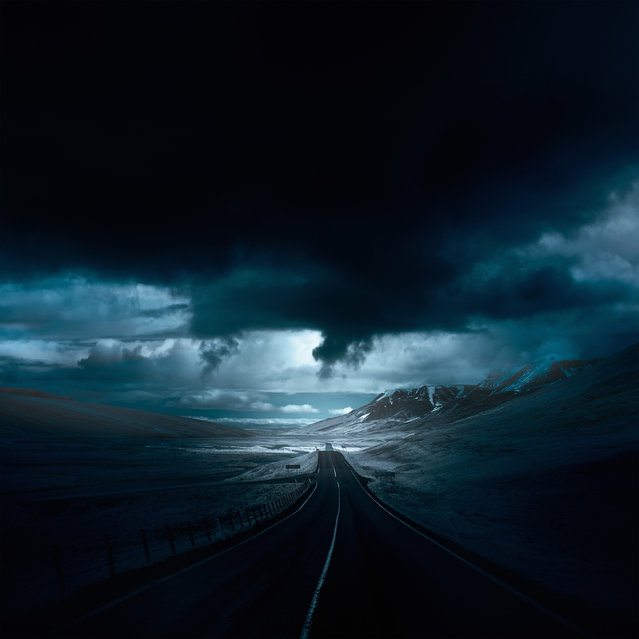
A globe-trotting photographer has captured some of the worlds most beautiful roads. Andy Lee's roads series features picturesque routes running through the likes of Iceland, Wales, England and Scotland. Here: moon sky over Hvammstangi, Iceland. (Photo by Andy Lee/Caters News)

A globe-trotting photographer has captured some of the worlds most beautiful roads. Andy Lee's roads series features picturesque routes running through the likes of Iceland, Wales, England and Scotland. The photographer, 46, began taking pictures for this series in 2013. And since then Andy, from Stackpole, Pembrokeshire, has been travelling the world for the most stunning drives. In searching for the ideal road he often drives miles upon miles in order to find a suitable, remote area. Here: moon sky over Hvammstangi, Iceland. (Photo by Andy Lee/Caters News)
Details
24 Jan 2015 14:19:00
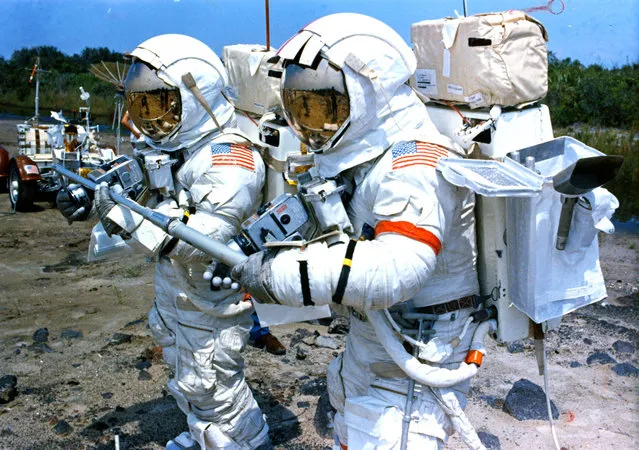
Astronauts Harrison Schmitt (left) and Eugene Andrew Cernan practice taking geological samples at the Kennedy Space Center in Florida, in preparation for NASA's scheduled Apollo 17 lunar landing mission, on August 28, 1972. Schmitt is the Lunar Module Pilot and Cernan is the mission's Commander. They are training for their period of EVA (extravehicular activity) on the Moon. (Photo by Space Frontiers/Getty Images)

Astronauts Harrison Schmitt (left) and Eugene Andrew Cernan practice taking geological samples at the Kennedy Space Center in Florida, in preparation for NASA's scheduled Apollo 17 lunar landing mission, on August 28, 1972. Schmitt is the Lunar Module Pilot and Cernan is the mission's Commander. They are training for their period of EVA (extravehicular activity) on the Moon. (Photo by Space Frontiers/Getty Images)
Details
24 Dec 2022 04:10:00