Loading...
Done
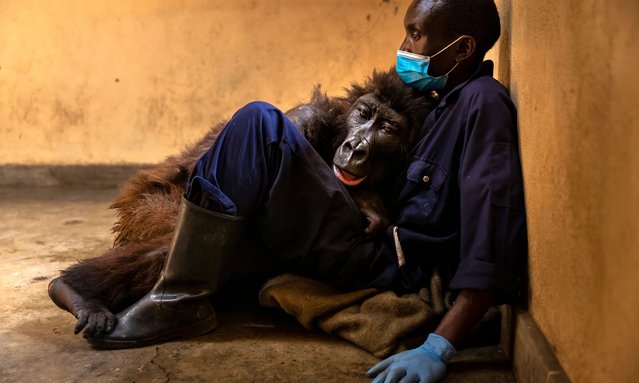
Orphaned mountain gorilla, Ndakasi, lies in the arms of her caregiver, Andre Bauma, on September 21, 2021 shortly before her death, which the park confirmed on September 26. Mr Bauma and others at the Senkwekwe Mountain Gorilla Center had cared for Ndakasi and other orphans for 13 years. Ndakasi had suffered a prolonged illness prior to her death. This is the only mountain gorilla orphanage in the world and takes in mountain gorilla orphans who have lost their families to poaching or conflict. A number of the orphans here were rescued from sales by poachers in sting operations carried out by Congolese National Park Authority (ICCN) rangers. (Photo by Brent Stirton/Getty Images)

Orphaned mountain gorilla, Ndakasi, lies in the arms of her caregiver, Andre Bauma, on September 21, 2021 shortly before her death, which the park confirmed on September 26. Mr Bauma and others at the Senkwekwe Mountain Gorilla Center had cared for Ndakasi and other orphans for 13 years. Ndakasi had suffered a prolonged illness prior to her death. This is the only mountain gorilla orphanage in the world and takes in mountain gorilla orphans who have lost their families to poaching or conflict. A number of the orphans here were rescued from sales by poachers in sting operations carried out by Congolese National Park Authority (ICCN) rangers. (Photo by Brent Stirton/Getty Images)
Details
17 Oct 2021 08:04:00
Yan Mengjie sits on a boat as she poses for photos near Erhai Lake in Dali Bai Autonomous Prefecture, Yunnan province, China on June 16, 2019. Erhai is one of China's biggest freshwater lakes and a backdrop to the city of Dali, which drew 47 million visitors last year, more than triple the number in 2010. Hotels and homestays have sprung up along a 31-mile (50-km) stretch of lakeside road to accommodate tourists. But officials ordered some hotels demolished after President Xi Jinping during a 2015 visit called for the lake to be protected. (Photo by Tingshu Wang/Reuters)

Yan Mengjie sits on a boat as she poses for photos near Erhai Lake in Dali Bai Autonomous Prefecture, Yunnan province, China on June 16, 2019. Erhai is one of China's biggest freshwater lakes and a backdrop to the city of Dali, which drew 47 million visitors last year, more than triple the number in 2010. Hotels and homestays have sprung up along a 31-mile (50-km) stretch of lakeside road to accommodate tourists. But officials ordered some hotels demolished after President Xi Jinping during a 2015 visit called for the lake to be protected. (Photo by Tingshu Wang/Reuters)
Details
25 Jun 2019 00:01:00
Anti-nuclear activists demonstrate during a Say to Goodbye to Nuclear Energy protest in Kobe, Japan

Anti-nuclear activists demonstrate during a “Say to Goodbye to Nuclear Energy” protest on September 11, 2011 in Kobe, Japan. Japan is marking sixth months since a magnitude 9.0 earthquake struck Japan offshore on March 11 at 2:46pm local time, triggering a tsunami wave of up to ten metres which engulfed large parts of north-eastern Japan and also damaged the Fukushima nuclear plant, causing the worst nuclear crisis in decades. The current number of dead and missing is reportedly estimated to be 22,900. (Photo by Buddhika Weerasinghe/Getty Images)
Details
12 Sep 2011 10:16:00
Loi Krathong Festival In Thailand

We are all drawn to fire, entranced by its beauty and ferociousness. Its brilliance draws us in like moths to a candle flame. Thus, many of the celebrations that humans have involve lighting fires. They can be big or small; there could be many little lights or one giant inferno; they may float on water, burn on land, or rise high into the skies. Loi Krathong is a festival that is held each year in Thailand and a number of other places. During this festival thousands of little fires are lighted, presenting a marvelous sight for all the onlookers. It is believed that this tradition is an adaptation of Brahmanical festival, which was adopted by Thai Buddhists to honor Buddha.
Details
30 Jan 2015 10:38:00
The National Geographic Photo Ark is a travelling exhibition of photographer Joel Sartore’s quest to create a photo archive of biodiversity around the world. So far, Sartore has captured studio portraits of more than 6,000 species – a number that he hopes to double. On 1 July, the ark will open at Melbourne zoo – the first time it has been exhibited in the southern hemisphere. More than 50 portraits will be on display, including many of Australian endangered animals being protected by programs at the zoo itself. These captions have been edited from text supplied by Melbourne zoo. Here: Barking owl. So-named because its call sounds like a barking dog, these birds are native to Australia, Indonesia and Papua New Guinea. In Victoria they are listed as an endangered species, and in 2003 there were estimated to be fewer than 50 breeding pairs. The main threat to the species in Victoria is loss of habitat, especially large trees with hollows in which they can nest and on which many of their prey depend. Apart from a bark, they may utter a chilling scream when they feel threatened. (Photo by Joel Sartore/National Geographic Photo Ark/The Guardian)

The National Geographic Photo Ark is a travelling exhibition of photographer Joel Sartore’s quest to create a photo archive of biodiversity around the world. So far, Sartore has captured studio portraits of more than 6,000 species – a number that he hopes to double. On 1 July, the ark will open at Melbourne zoo – the first time it has been exhibited in the southern hemisphere. More than 50 portraits will be on display, including many of Australian endangered animals being protected by programs at the zoo itself. These captions have been edited from text supplied by Melbourne zoo. Here: Barking owl. (Photo by Joel Sartore/National Geographic Photo Ark/The Guardian)
Details
01 Jul 2017 07:45:00
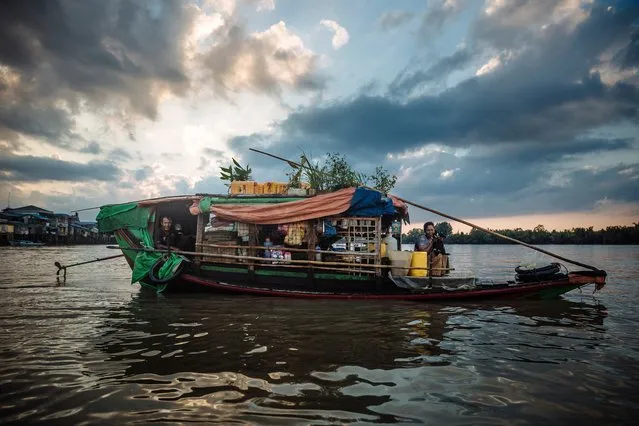
Tin and Naing win live on a small boat which they sail throughout the Delta region in Myanmar. The former gardeners once had a home on land but it was destroyed when a powerful cyclone ravaged the area in 2008. Since then, the couple have not been able to afford to rebuild their home, so they live on the boat from which they sell fish paste to make a living. (Photo by Muse Mohammed/IOM)

The ferocity of crises worldwide is forcing a record number of people to flee their homes, seeking some form of safety within their own country or across international borders. There are 65.3 million displaced people worldwide, including 21.3 million refugees. Most have lost their homes to armed conflict or natural disasters but other factors, such as extreme poverty and climate change, also drive displacement. The International Organisation for Migration commissioned photojournalist Muse Mohammed to document the plight of the displaced. (Photo by Muse Mohammed/IOM)
Details
02 Jan 2017 12:04:00
A woman wears a mask while carrying a dog in the street on January 22, 2020 in Wuhan, Hubei province, China. A new infectious coronavirus known as “2019-nCoV” was discovered in Wuhan as the number of cases rose to over 400 in mainland China. Health officials stepped up efforts to contain the spread of the pneumonia-like disease which medicals experts confirmed can be passed from human to human. The death toll has reached 17 people as the Wuhan government issued regulations today that residents must wear masks in public places. Cases have been reported in other countries including the United States, Thailand, Japan, Taiwan, and South Korea. (Photo by Getty Images/China Stringer Network)

A woman wears a mask while carrying a dog in the street on January 22, 2020 in Wuhan, Hubei province, China. A new infectious coronavirus known as “2019-nCoV” was discovered in Wuhan as the number of cases rose to over 400 in mainland China. Health officials stepped up efforts to contain the spread of the pneumonia-like disease which medicals experts confirmed can be passed from human to human. The death toll has reached 17 people as the Wuhan government issued regulations today that residents must wear masks in public places. Cases have been reported in other countries including the United States, Thailand, Japan, Taiwan, and South Korea. (Photo by Getty Images/China Stringer Network)
Details
31 Dec 2020 00:01:00


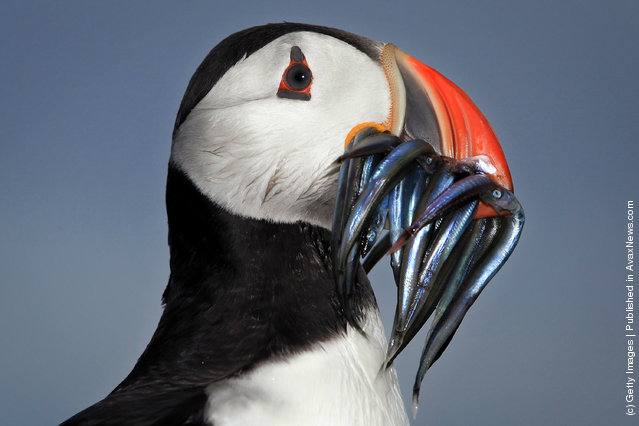
A Puffin returns to it's nest with a beak full of sand eels on June 25, 2011 on Inner Farne, England. The Farne Islands, which are run by the National Trust, are situated two to three miles off the Northumberland coastline. The archipeligo of 16-28 separate islands (depending on the tide) make the summer home to approximately 100,000 pairs of breeding seabirds including around 36,000 Puffins, 32,000 Guillemots and 2,000 pairs of Arctic Terns. The species of birds which nest in internationally important numbers include Shag, Sandwich Tern and Arctic Tern. The coastline around The Farnes are also the breeding ground to one of Europe's largest Grey Seal colonies with around 4,000 adults giving birth to 1500 pups every year. (Photo by Dan Kitwood/Getty Images)
Details
27 Jun 2011 12:58:00