Loading...
Done
Indian artist Sudarsan Pattnaik works on a sand sculpture depicting drowned Syrian boy Aylan Kurdi at Puri beach, some 65 kilometers away from Bhubaneswar, on September 4, 2015. Charities helping refugees saw a surge in donations on September 4 across Europe as people shocked by the heart-rending images of a drowned Syrian boy on a Turkish beach dug deep to help out. (Photo by Asit Kumar/AFP Photo)

Indian artist Sudarsan Pattnaik works on a sand sculpture depicting drowned Syrian boy Aylan Kurdi at Puri beach, some 65 kilometers away from Bhubaneswar, on September 4, 2015. Charities helping refugees saw a surge in donations on September 4 across Europe as people shocked by the heart-rending images of a drowned Syrian boy on a Turkish beach dug deep to help out. The photos of the lifeless body of three-year-old Aylan Kurdi, lying on a beach in Bodrum, Turkey, have triggered a wave of emotion across the continent, despite deep divisions among European governments on how to deal with the crisis. (Photo by Asit Kumar/AFP Photo)
Details
05 Sep 2015 12:59:00
A waterfall is seen at the end of the rainy season, in August, when the water level finally decreases, in the Cano Cristales RIver in the Sierra de la Macarena in Colombia. It has become covered with a bright pink endemic aquatic plant, Macarenia Clavigera. (Photo by Olivier Grunewald)

“El rio mas bonito del Mundo”, the most beautiful river of the world, the “River of five colors”, the “Rainbow River”, or even the “Escaped from Paradise”, are the shimmering appellations that Colombians give to Cano Cristales, a small stream located in the heart of the Macarena National Park, 150 km (93 miles) south of Bogota. Photo: A waterfall is seen at the end of the rainy season, in August, when the water level finally decreases, in the Cano Cristales RIver in the Sierra de la Macarena in Colombia. It has become covered with a bright pink endemic aquatic plant, Macarenia Clavigera. (Photo by Olivier Grunewald)
Details
25 Mar 2014 15:15:00
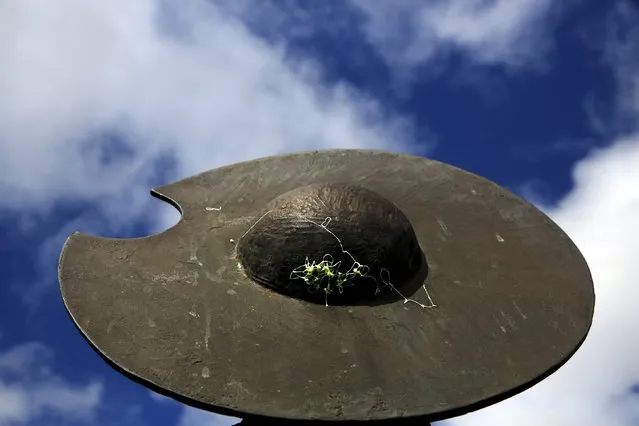
A sculpture of Don Quixote shows him wearing the basin he mistook for the enchanted helmet of the fictional Moorish king Mambrino in Alcazar de San Juan, Spain, April 5, 2016. (Photo by Susana Vera/Reuters)

A sculpture of Don Quixote shows him wearing the basin he mistook for the enchanted helmet of the fictional Moorish king Mambrino in Alcazar de San Juan, Spain, April 5, 2016. The arid central Spanish region of La Mancha is the setting for “Don Quixote”, the seventeenth-century novel by Miguel de Cervantes. Four hundred years after his death, references to the characters of Don Quixote, his loyal squire Sancho Panza and his beautiful lady Dulcinea abound in the surrounding villages from sweet treats to theatre productions involving livestock. Cervantes did not give away the name of the birthplace of Don Quixote, a middle-aged gentleman who becomes obsessed with chivalrous ideals. But many identify the village of Argamasilla de Alba as his hometown. The anniversary of Cervantes’ death is marked on the 23 April. (Photo by Susana Vera/Reuters)
Details
21 Apr 2016 12:32:00
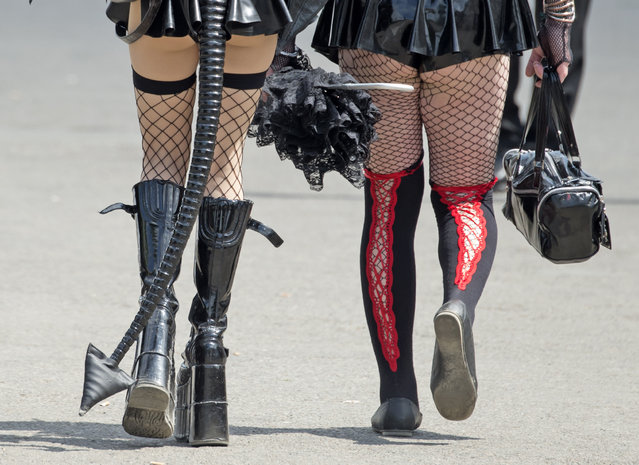
Participants of the the goth festival “Wave Gothic Festival” walk in fancy costumes along the festival area  in Leipzig, central Germany, Saturday, May 23, 2015. About 20,000 members of the scene are expected to attend  one of the world's largest gothic and “dark” culture festivals until May 25,  2015. (Photo by Jens Meyer/AP Photo)

Participants of the the goth festival “Wave Gothic Festival” walk in fancy costumes along the festival area in Leipzig, central Germany, Saturday, May 23, 2015. About 20,000 members of the scene are expected to attend one of the world's largest gothic and “dark” culture festivals until May 25, 2015. (Photo by Jens Meyer/AP Photo)
Details
24 May 2015 10:10:00
“Drag Race Thailand” contestants Thanisorn Hengsoontorn “Annee Maywong” (L) and Supattarapon Kasikam “Dearis Doll” pose at a studio in Bangkok, Thailand March 23, 2018. (Photo by Athit Perawongmetha/Reuters)

“Drag Race Thailand” contestants Thanisorn Hengsoontorn “Annee Maywong” (L) and Supattarapon Kasikam “Dearis Doll” pose at a studio in Bangkok, Thailand March 23, 2018. (Photo by Athit Perawongmetha/Reuters)
Details
28 Mar 2018 08:38:00
The snitch runner takes the broom from between the legs of a Werewolves of London quidditch player during the Crumpet Cup quidditch tournament on Clapham Common on February 18, 2017 in London, England. (Photo by Jack Taylor/Getty Images)

The snitch runner takes the broom from between the legs of a Werewolves of London quidditch player during the Crumpet Cup quidditch tournament on Clapham Common on February 18, 2017 in London, England. (Photo by Jack Taylor/Getty Images)
Details
23 Feb 2017 00:04:00
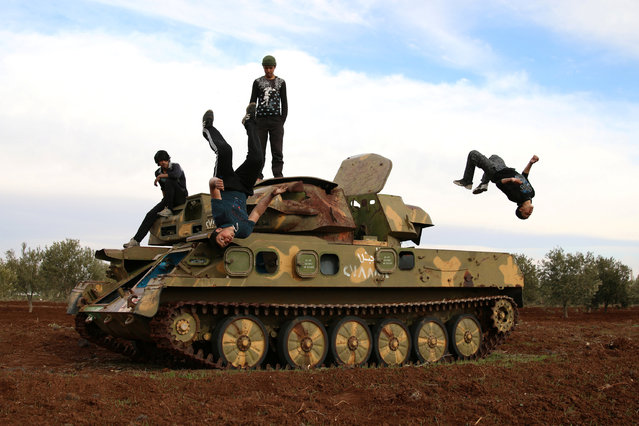
Muhannad al-Kadiri (R),18, and Ibrahim Eid, 16, demonstrate their Parkour skills over a military vehicle in the rebel-held city of Inkhil, west of Deraa, Syria, February 4, 2017. (Photo by Alaa Al-Faqir/Reuters)

Muhannad al-Kadiri (R),18, and Ibrahim Eid, 16, demonstrate their Parkour skills over a military vehicle in the rebel-held city of Inkhil, west of Deraa, Syria, February 4, 2017. (Photo by Alaa Al-Faqir/Reuters)
Details
05 May 2017 07:26:00
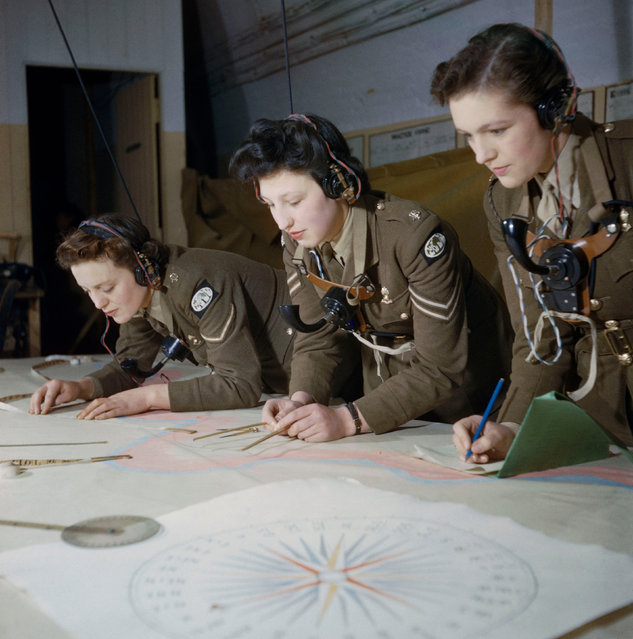
Auxiliary Territorial Service (ATS) plotters at work at Coastal Artillery Headquarters in Dover, December 1942. (Photo by Ted Dearberg/IWM/PA Wire)

Auxiliary Territorial Service (ATS) plotters at work at Coastal Artillery Headquarters in Dover, December 1942. The Auxiliary Territorial Service was the women's branch of the British Army during the Second World War. It was formed on 9 September 1938, initially as a women's voluntary service, and existed until 1 February 1949, when it was merged into the Women's Royal Army Corps. The ATS had its roots in the Women's Auxiliary Army Corps (WAAC), which was formed in 1917 as a voluntary service. During the First World War its members served in a number of jobs including clerks, cooks, telephonists and waitresses. The WAAC was disbanded after four years in 1921. (Photo by Ted Dearberg/IWM/PA Wire)
Details
13 Jul 2017 07:52:00