Loading...
Done
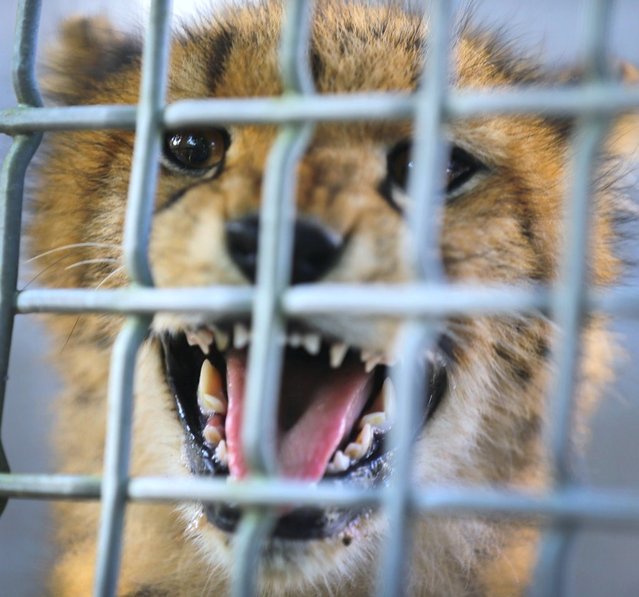
One of two 9-month old Cheetahs is seen after it was released into a quarantine facility at Zoo Miami on November 29, 2012 in Miami, Florida. The two sub-adult brothers who arrived today were captive-born on March 6th of this year at the Ann van Dyk Cheetah Centre just outside of Pretoria, South Africa. (Photo by Joe Raedle)

One of two 9-month old Cheetahs is seen after it was released into a quarantine facility at Zoo Miami on November 29, 2012 in Miami, Florida. The two sub-adult brothers who arrived today were captive-born on March 6th of this year at the Ann van Dyk Cheetah Centre just outside of Pretoria, South Africa. The Cheetahs, after being monitored and examined for a minimum of 30 days to insure that they are healthy and stable, will be featured in Zoo Miami's Wildlife Show at the newly constructed amphitheater and will continue the work of Zoo Miami's Cheetah Ambassador Program by making appearances off Zoo grounds at a variety of venues including schools and civic organizations. (Photo by Joe Raedle)
Details
30 Nov 2012 11:54:00
An employee in a bookshop adjusts packaged cigarettes which have to be sold in identical olive-brown packets bearing the same typeface and largely covered with graphic health warnings, with the same style of writing so the only identifier of a brand will be the name on the packet, in Sydney on December 1, 2012.  A new world-first law forcing tobacco companies to sell cigarettes in identical packets came into effect Saturday in Australia in an effort to strip any glamour from smoking and prevent young people from taking up the habit

An employee in a bookshop adjusts packaged cigarettes which have to be sold in identical olive-brown packets bearing the same typeface and largely covered with graphic health warnings, with the same style of writing so the only identifier of a brand will be the name on the packet, in Sydney on December 1, 2012. A new world-first law forcing tobacco companies to sell cigarettes in identical packets came into effect Saturday in Australia in an effort to strip any glamour from smoking and prevent young people from taking up the habit. (Photo by William West/AFP Photo)
Details
02 Dec 2012 09:18:00
Nicolas Silberfaden: Superheroes

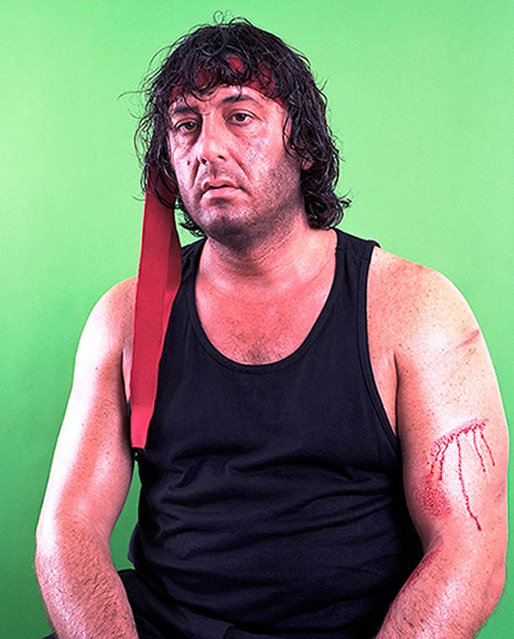
Due to the current economic, social and cultural crisis in The United States of America today, I have decided to do a photographic project consisting of a series of studio portraits of superhero and celebrity impersonators that live and work in the city of Los Angeles. Most of them unemployed Americans, they decided to suit up with their costumes and hit the streets, animate parties and events in efforts to make ends meet. Making them pose in their costumes against a colorful backdrop, I ask them to manifest feelings of genuine sadness – honest emotions that are a consequence of our current times. The result is a somber, striking visual image that contradicts the iconic nature of strength and moral righteousness typical in American superhero and celebrity imagery. Creating the illusion that Superman does exist – that he too was fallible and affected by America’s downturn.

Nicolas Silberfaden
Details
06 Dec 2012 12:13:00


“Snowflake (c. 1964 – November 24, 2003) was an albino gorilla. He was the only known albino gorilla so far, and the most popular resident of the Barcelona Zoo in Catalonia, Spain. Originally named Nfumu Ngui in Fang language ("white gorilla") by his captor, he was then nicknamed Floquet de Neu (Catalan for little snowflake) by his keeper Jordi Sabater Pi. On his arrival to Barcelona where he was given an official reception by the then Mayor of Barcelona, Josep Maria de Porcioles, in November 1966, he was called Blancanieves (“Snow White”) in the newspaper Tele/Exprés. But he became famous with the name given to him by Sabater when National Geographic Magazine featured him on the main page in March 1967, with the English name Snowflake. This name spread among the press (Stern, Life, Paris-Match) and was later translated to Spanish as Copito de Nieve. Sabater himself called the gorilla Floquet or Copi, and in the later years Nfumu. The asteroid 95962 Copito, discovered by Catalan astronomer J. Manteca, is named in his honour”.
Details
07 Mar 2011 15:50:00


“Harisu (하리수 or 河莉秀) is the stage name of Lee Kyung-eun originally Lee Kyung-yeop (born February 17, 1975), a transsexual pop singer, model and actress from South Korea. Born biologically male, Harisu identified as female from early childhood, and underwent s*x reassignment surgery in the 1990s. She is noted for being South Korea's first transgender entertainer, and in 2002 became only the second person in Korea to legally change their gender. Her stage name is an adaptation of the English phrase «hot issue»”.

Photo: South Korean transsexual singer and actress Harisu (R) poses for pictures with a fan who played the role of groom during a simulated Chinese wedding at a fan club activity on August 5, 2006 in Changchun of Jilin Province, China. (Photo by China Photos/Getty Images)
Details
17 Mar 2011 11:31:00


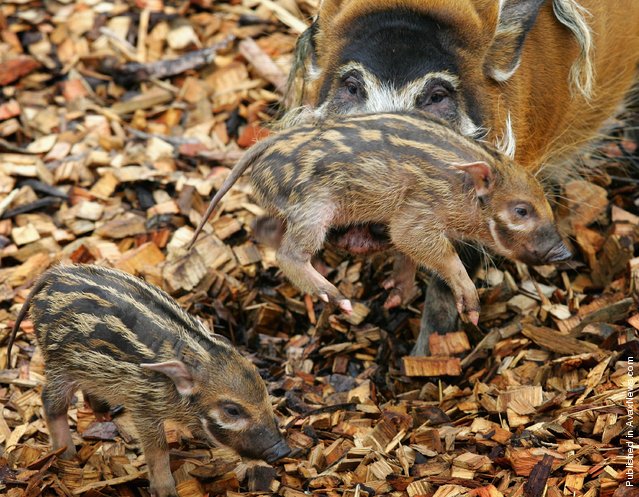
“The Red River Hog (Potamochoerus porcus), also known as the Bush Pig (but not to be confused with P. larvatus, common name “Bushpig”), is a wild member of the pig family living in Africa, with most of its distribution in the Guinean and Congolian forests. It is rarely seen away from rainforests, and generally prefers areas near rivers or swamps.

Red River Hogs eat grass, berries, roots, insects, molluscs, small vertebrates and carrion. They are capable of causing damage to plantations. Red River Hogs typically live in herds of 6-20 members led by a dominant boar. Sows rear 3-6 piglets at a time.”

Photo: Two 17 day old red river hoglet twins forage for food next to their mother Bahiti at London Zoo on August 23, 2007 in London, England. Red River hoglets inhabit the forests and swamps of West and Central Africa. The recent additions to the London Zoo pig pen have been eagerly awaited by zoo keepers. (Photo by Chris Jackson/Getty Images)
Details
18 Mar 2011 15:15:00


“Chameleons (family Chamaeleonidae) are a distinctive and highly specialized clade of lizards. They are distinguished by their parrot-like zygodactylous feet, their separately mobile and stereoscopic eyes, their very long, highly modified, and rapidly extrudable tongues, their swaying gait, the possession by many of a prehensile tail, crests or horns on their distinctively shaped heads, and the ability of some to change color. Uniquely adapted for climbing and visual hunting, the approximately 160 species of chameleon range from Africa, Madagascar, Spain and Portugal, across south Asia, to Sri Lanka, have been introduced to Hawaii, California and Florida, and are found in warm habitats that vary from rain forest to desert conditions”. – Wikipedia

Photo: A woman with the latest fashion accessory, a chameleon. (Photo by Fox Photos/Getty Images). Circa 1926
Details
20 Mar 2011 15:45:00


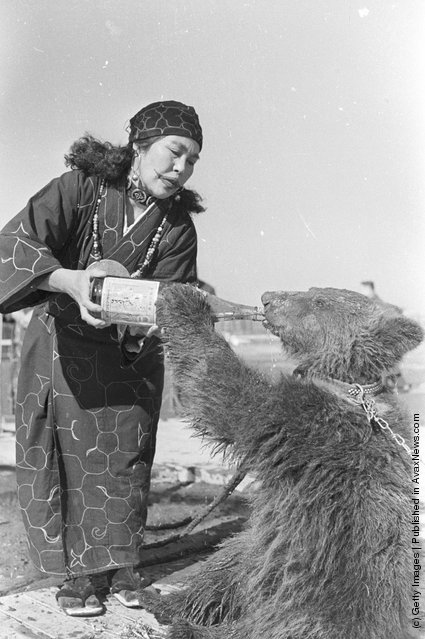
“The Ainu (アイヌ?), also called Aynu, Aino (アイノ), and in historical texts Ezo (蝦夷), are indigenous people or groups in Japan and Russia. Historically they spoke the Ainu language and related varieties and lived in Hokkaidō, the Kuril Islands, and much of Sakhalin. Most of those who identify themselves as Ainu still live in this same region, though the exact number of living Ainu is unknown. This is due to ethnic issues in Japan resulting in those with Ainu backgrounds hiding their identities and confusion over mixed heritages. In Japan, because of intermarriage over many years with Japanese, the concept of a 'pure Ainu' ethnic group is no longer feasible. Official estimates of the population are of around 25,000, while the unofficial number is upwards of 200,000 people”. – Wkipedia

Photo: A captive bear drinking from a large bottle held by an Ainu tribeswoman. (Photo by Evans/Three Lions/Getty Images). Circa 1955
Details
24 Mar 2011 14:01:00