Loading...
Done
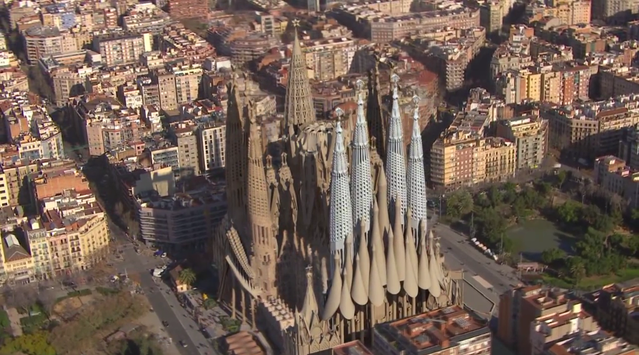
We Build Tomorrow – Sagrada Familia 2026 ( VIDEO )

For more than a century, the Barcelona skyline has been graced (or marred, depending on who’s talking) by the spectacle of the Basilica designed by Anton Gaudi, first started in 1882. If you want to know what it’ll look like when finished, don’t fret — 2026 is right around the corner. Or you can watch this video, released last week on YouTube by Basílica de la Sagrada Família and titled simply “2026 We Build Tomorrow,” a 3-D artists’ rendering of the building stages through completion.
(If 144 years sounds like a long time to finish a cathedral, keep in mind that there were decades that they didn’t work on it — and that Notre Dame de Paris took 182 years, although the 13th century Parisians didn’t have diesel-powered industrial cranes.) Now, if only the video could show us what the admission and hours will be in 2026 (and how to avoid the inevitable long lines).
Details
11 Jan 2014 10:59:00
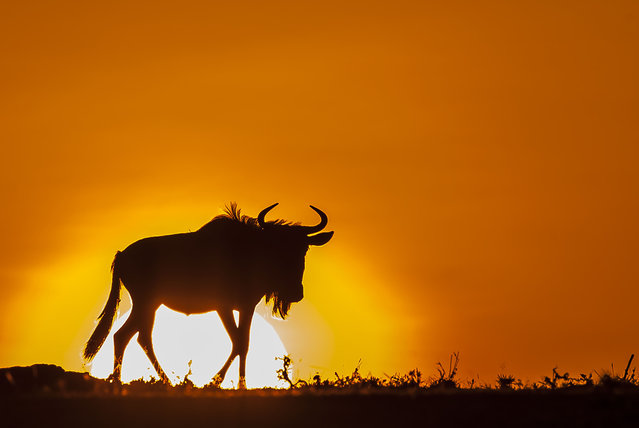
A blue wildebeest moves through grassland at dawn with the sun in the background in Mara Naboisho Conservancy, Kenya, Africa. (Photo by Renato Granieri/Caters News/Ardea)

These images show off some of the world's most majestic creatures silhouetted against the beautiful rising and setting sun. The vibrant pictures feature a variety of animals in the wild and were taken by a host of photographers at locations around the world. The striking images all have one thing in common: the photographers' awe-inspiring ability to perfectly capture the silhouettes of earth's beautiful creatures. Here: a blue wildebeest moves through grassland at dawn with the sun in the background in Mara Naboisho Conservancy, Kenya, Africa. (Photo by Renato Granieri/Caters News/Ardea)
Details
02 Sep 2015 11:12:00
A Nubian Royal Starship hovers over the Malaysian rice fields. (Photo by Zahir Batin/Mercury Press)

A “Star Wars” superfan has brought the universe to his backyard. Amateur photographer Zahir Batin, from Selangor in Malaysia, added stormtroopers, X-wings and other famous sights to his native Tanjong Karang rice fields. The Malaysian snapper decided to combine his love for his hometown with his passion for the out-of-this-world space opera and, in particular, the toys. The amazing shots show TIE fighters on fire flying overhead and AT-AT walking tanks towering over tiny children, as well as Dark Side forces marching through the countryside. Here: a Nubian Royal Starship hovers over the Malaysian rice fields. (Photo by Zahir Batin/Mercury Press)
Details
30 Jun 2015 12:41:00
In 1831 an unsuccessful uprising against the Russian czar left many rebels dead. Relatives of the dead rebels, with no bodies to bury, instead left crosses, according to the Daily Mail. (Photo by Richard Gardner/Rex USA)

The phenomenon of the Hill of Crosses in northern Lithuania began when people started leaving crosses there hundreds of years ago – and continues to this day. These photos of a hill covered in crosses show the amazing sight it has become. Photo: In 1831 an unsuccessful uprising against the Russian czar left many rebels dead. Relatives of the dead rebels, with no bodies to bury, instead left crosses, according to the Daily Mail. (Photo by Richard Gardner/Rex USA)
Details
06 Jun 2013 09:56:00
Hot Tub Cinema

Hot Tub Cinema is an experience like no other. Combining relaxing hot tubs, great films and amazing spaces, it is a luxurious event that celebrates film in a fun and engaging way. Attendees can purchase whole tubs to share with friends or buy individual tickets to share with fellow hot tubbers. The tubs are cleaned, refilled and heated before every show. Popping-up throughout the year in London and around the UK, Hot Tub Cinema is also preparing to tour internationally in the near future. During the summer, we takeover rooftops in central London with astounding views across the city's inimitable skyline. For the autumn/winter we move indoors to continue the fun hidden away from the unpredictable weather.
Details
13 Jun 2013 09:06:00
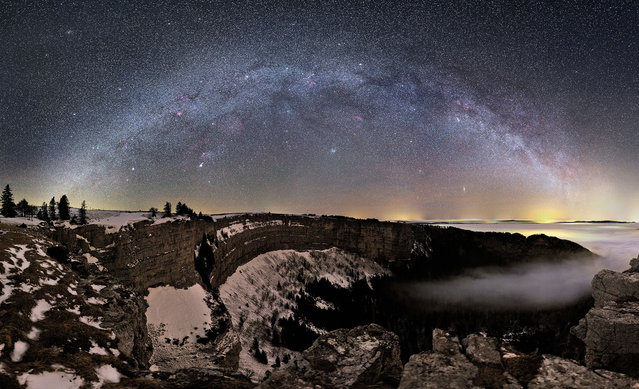
Milky Way over Switzerland

Milky Way over Switzerland

The Milky Way is the galaxy in which Earth is contained. This name derives from its appearance as a dim “milky” glowing band arching across the night sky, in which the naked eye cannot distinguish individual stars. The term “Milky Way” is a translation of the Classical Latin via lactea, from the Hellenistic Greek γαλαξίας κύκλος (pr. galaxías kýklos, “milky circle”). The Milky Way appears like a band because it is a disk-shaped structure being viewed from inside. The fact that this faint band of light is made up of stars was proven in 1610 when Galileo Galilei used his telescope to resolve it into individual stars. In the 1920s, observations by astronomer Edwin Hubble showed that the Milky Way is just one of many galaxies.


Details
20 Jun 2012 10:11:00
Art by Christian Faur

Christian Faur is an artist based in Granville, Ohio. Looking for a new technique, he experimented with painting with wax, but he didn’t feel the results were satisfactory.Then, at Christmas in 2005, his young daughter opened a box of 120 Crayola crayons he’d bought her, and everything clicked into place. Faur decided he would create pictures out of the crayons themselves, packing thousands of them together so they become like the colored pixels on a TV screen. He starts each work by scanning a photo into a computer and breaking the image down into colored blocks He then draws a grid that shows him exactly where to place each crayon The finished artworks are packed tightly into wooden frames. He actually makes the crayons himself, hand-casting each one in a mould.
Details
28 Jul 2012 10:03:00


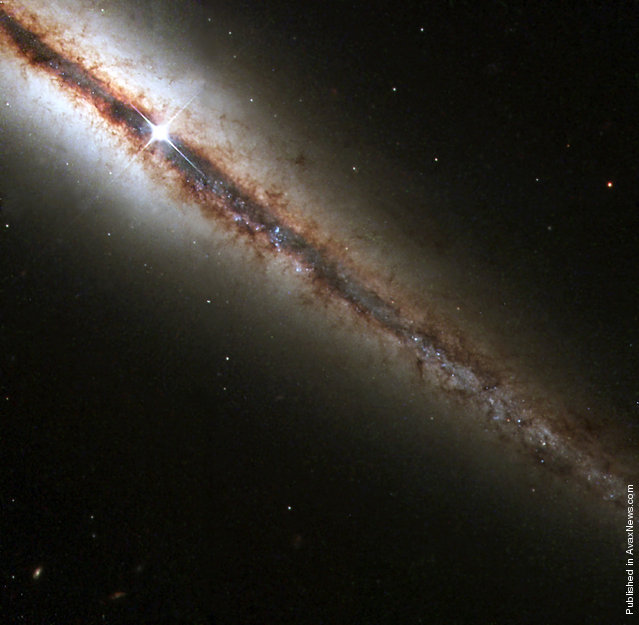
An image produced by the Hubble telescope of the perfectly “edge-on” galaxy, or NGC 4013, March 1, 2001. This new Hubble picture reveals, with great detail, huge clouds of dust and gas extending along, as well as far above, the galaxy's main disk. NGC 4013 is a spiral galaxy, similar to the Milky Way, lying some 55 million light-years from Earth in the direction of the constellation Ursa Major. Viewed face-on, it would look like a nearly circular pinwheel, but NGC 4013 happens to be seen edge-on from our vantage point. Even at 55 million light-years, the galaxy is larger than Hubble's field of view, and the image shows only a little more than half of the object, albeit with unprecedented detail. (Photo Courtesy of NASA/Newsmakers)
Details
28 Feb 2015 22:33:00