Loading...
Done
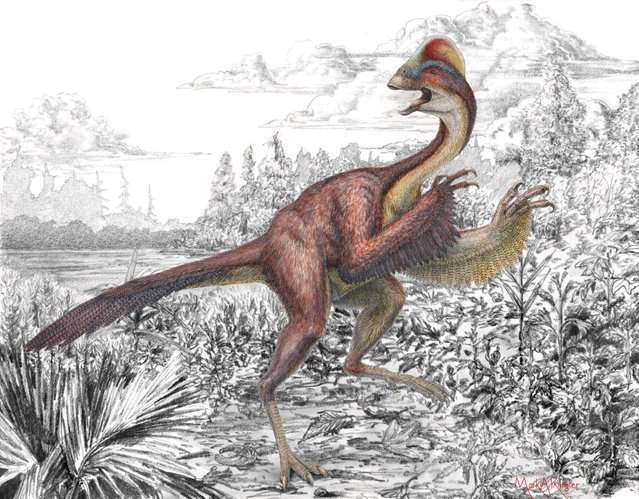
Life reconstruction of the new oviraptorosaurian dinosaur species Anzu wyliei in its 66 million-year-old environment in western North America as seen in an undated handout illustration by Mark A. Klinger, Carnegie Museum of Natural History. Some 18,000 species, great and small, were discovered in 2014, adding to the 2 million already known, scientists said on May 21, 2015 as they released a “Top 10” list that highlights the diversity of life. (Photo by Mark A. Klingler/Reuters/Carnegie Museum of Natural History)

Life reconstruction of the new oviraptorosaurian dinosaur species Anzu wyliei in its 66 million-year-old environment in western North America as seen in an undated handout illustration by Mark A. Klinger, Carnegie Museum of Natural History. Some 18,000 species, great and small, were discovered in 2014, adding to the 2 million already known, scientists said on May 21, 2015 as they released a “Top 10” list that highlights the diversity of life. Anzu wyliei, one of the top 10, dubbed “the chicken from hell”, is extinct. The feathered dinosaur whose partial skeletons were unearthed in the Dakotas was a contemporary of T. rex and Triceratops. (Photo by Mark A. Klingler/Reuters/Carnegie Museum of Natural History)
Details
22 May 2015 12:31:00
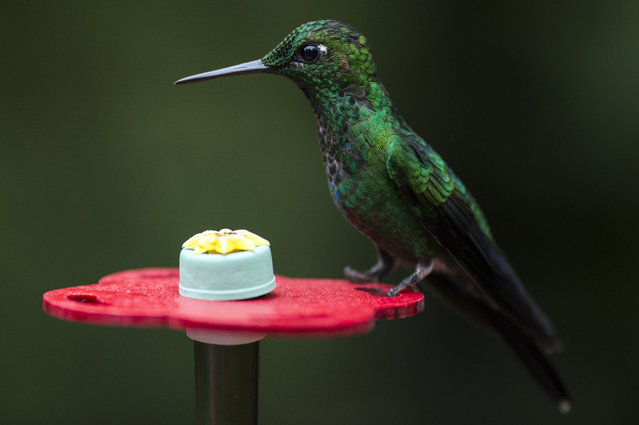
A Green Crowned Brilliant is pictured at a Hummingbird feeding station on January 15, 2016 in Alajuela Costa Rica. (Photo by Dan Kitwood/Getty Images)

A Green Crowned Brilliant is pictured at a Hummingbird feeding station on January 15, 2016 in Alajuela Costa Rica. Of the 338 known species of Hummingbird worldwide there are around 50 in Costa Rica. Hummingbirds are named for the distinctive sound made by their tiny beating wings, and are admired for their vibrantly coloured iridescent plumage. Their ability to hover, with wings beating between 12 and 90 times a second, and to fly backwards makes them different from all other birds. (Photo by Dan Kitwood/Getty Images)
Details
05 Feb 2016 10:45:00
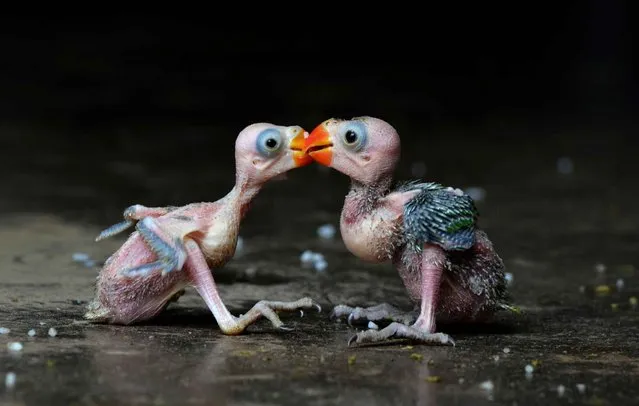
Baby Parrots meet each other after they were caught and preserved by local hunters for sale. Parrots, are among the most intelligent birds, and the ability of some species to imitate human voices enhances their popularity as pets. (Photo by Caisii Mao/NurPhoto/Sipa USA)

Wildlife are hunted down for consumption or for sale in the India eastern state of Nagaland. Hunters can make a good living, with some bred for food or to be sold as pets. These baby parrots, photographed by Caisii Mao via Sipa USA, are seen after they were caught and preserved by a local hunter and for sale at a private residence in Dimapur, India north eastern state of Nagaland on Wednesday, July 24, 2013. (Photo by Caisii Mao/NurPhoto/Sipa USA)
Details
28 Jul 2013 08:45:00
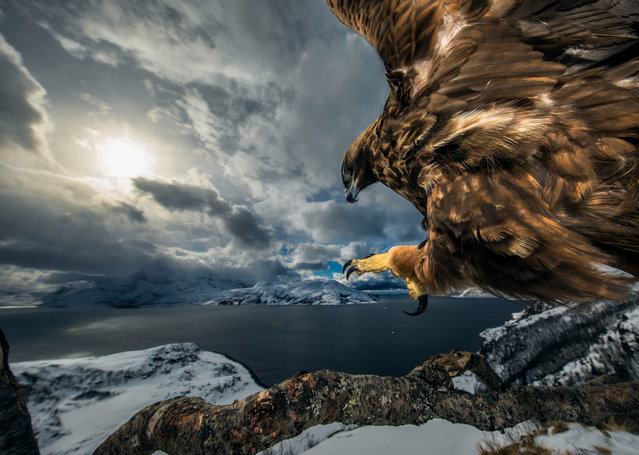
Birds behaviour winner: Land of the Eagle by Audun Rikardsen, Norway. High on a ledge, on the coast near his home in northern Norway, Rikardsen carefully positioned an old tree branch that he hoped would make a perfect golden eagle lookout. To this, he bolted a tripod head with a camera, flashes and motion sensor attached, and built himself a hide a short distance away. From time to time, he left road‑kill carrion nearby. Very gradually – over the next three years – a golden eagle got used to the camera and started to use the branch regularly to survey the coast below. (Photo by Audun Rikardsen/2019 Wildlife Photographer of the Year)

Birds behaviour winner: Land of the Eagle by Audun Rikardsen, Norway. High on a ledge, on the coast near his home in northern Norway, Rikardsen carefully positioned an old tree branch that he hoped would make a perfect golden eagle lookout. To this, he bolted a tripod head with a camera, flashes and motion sensor attached, and built himself a hide a short distance away. From time to time, he left road‑kill carrion nearby. Very gradually – over the next three years – a golden eagle got used to the camera and started to use the branch regularly to survey the coast below. (Photo by Audun Rikardsen/2019 Wildlife Photographer of the Year)
Details
17 Oct 2019 00:03:00
Galapagos – Rocking the Cradle: Four major ocean currents converge along the Galapagos archipelago, creating the conditions for an extraordinary diversity of animal life, April 25, 2016. The islands are home to at least 7,000 flora and fauna species, of which 97 percent of the reptiles, 80 percent of the land birds, 50 percent of the insects and 30 percent of the plants are endemic. The local ecosystem is highly sensitive to the changes in temperature, rainfall and ocean currents that characterize the climatic events known as El Niño and La Niña. These changes cause marked fluctuations in weather and food availability. Many scientists expect the frequency of El Niño and La Niña to increase as a result of climate change, making the Galapagos a possible early-warning location for its effects. (Photo by Thomas P. Peschak for National Geographic/World Press Photo)

Galapagos – Rocking the Cradle: Four major ocean currents converge along the Galapagos archipelago, creating the conditions for an extraordinary diversity of animal life, April 25, 2016. The islands are home to at least 7,000 flora and fauna species, of which 97 percent of the reptiles, 80 percent of the land birds, 50 percent of the insects and 30 percent of the plants are endemic. (Photo by Thomas P. Peschak for National Geographic/World Press Photo)
Details
16 Apr 2018 00:01:00
Pencil Artist Marco Mazzoni

Italian pencil artist Marco Mazzoni‘s work goes far beyond technical perfection. His representation of historical healing women is enigmatic and sublime. Often leaving the eyes blank or covered with an abundance of birds, butterflies and flowers, he gives the impression of a deeper inward focused sight, as well as obscuring the identity of the individual. Many female healers in the past – both medicine woman and midwives – were brutally persecuted by religion, some even burnt as witches… Mazzoni’s work captures their deep connection with nature and their innate power and femininity with delicacy and beautiful detail.
Details
24 Mar 2015 09:33:00
A veiled chameleon extends its tongue to catch a cricket

“Scott Linstead is an internationally published, freelance wildlife photographer/writer. His clients include Natural History Magazine, Hewlett Packard, Ranger Rick Magazine and a number of wildlife publications in North America and Europe. Scott's column on the techniques of bird photography appears in every issue of Outdoor Photography Canada”.

Photo: A veiled chameleon extends its tongue to catch a cricket. Canadian wildlife photographer Scott Linstead, formerly an aerospace engineer and high school teacher, uses a device called Phototrap “to not only photograph the elusive, but also the unimaginably quick”. (Photo by Scott Linstead)
Details
22 May 2012 11:32:00
Aerial Nudes by John Crawford

John Crawford was always fascinated of a birds eye view, looking straight down in a vertical perspective. In his series ‘Aerial Nudes’ he is photographing single naked bodies from a high elevation. Perfectly timed photographs show a distant nude body laying down in a series of interesting locations. On each selected shoot day Crawford would deliver his model Carina to the location in the helicopter, positioning her in the carefully arranged set-up, then flying to 600 feet and capturing the image, which would take no more than ten minutes.
Details
09 Aug 2012 11:35:00