Loading...
Done
A child with his body and face painted prepares to attend the sacred Ngerebeg ritual at the Tegallalang village in Gianyar, Bali, Indonesia, 03 April 2024. The sacred Ngerebeg ritual takes place every six months and it is mainly aimed at driving all evil spirits out of the villages. During the ritual, the participants paint their bodies in various colors and patterns to join the procession across the village. (Photo by Made Nagi/EPA/EFE)

A child with his body and face painted prepares to attend the sacred Ngerebeg ritual at the Tegallalang village in Gianyar, Bali, Indonesia, 03 April 2024. The sacred Ngerebeg ritual takes place every six months and it is mainly aimed at driving all evil spirits out of the villages. During the ritual, the participants paint their bodies in various colors and patterns to join the procession across the village. (Photo by Made Nagi/EPA/EFE)
Details
18 Apr 2024 05:17:00
A visitor jumps for a photograph on the world's highest and longest glass-bottomed bridge  above a valley in Zhangjiajie in China's Hunan Province on August 21, 2016. The bridge, which opened to the public on a trial basis on Saturday, spans 430 meters (1,410 feet) and rises about 300 meters (984 feet) above a valley in a scenic zone, making it the world's highest and longest glass-bottomed bridge according to Chinese state media. (Photo by Fred Dufour/AFP Photo)

A visitor jumps for a photograph on the world's highest and longest glass-bottomed bridge above a valley in Zhangjiajie in China's Hunan Province on August 21, 2016. The bridge, which opened to the public on a trial basis on Saturday, spans 430 meters (1,410 feet) and rises about 300 meters (984 feet) above a valley in a scenic zone, making it the world's highest and longest glass-bottomed bridge according to Chinese state media. (Photo by Fred Dufour/AFP Photo)
Details
22 Aug 2016 13:19:00
People visit an art installation “Alley of Flying Umbrellas” in central St. Petersburg, Russia, May 15, 2015. Art installation inspired by “Umbrella Sky Project” of Portuguese town of Agueda and was made of 500 colored umbrellas. (Photo by Anatoly Maltsev/EPA)

People visit an art installation “Alley of Flying Umbrellas” in central St. Petersburg, Russia, May 15, 2015. Art installation inspired by “Umbrella Sky Project” of Portuguese town of Agueda and was made of 500 colored umbrellas. (Photo by Anatoly Maltsev/EPA)
Details
19 May 2015 12:13:00
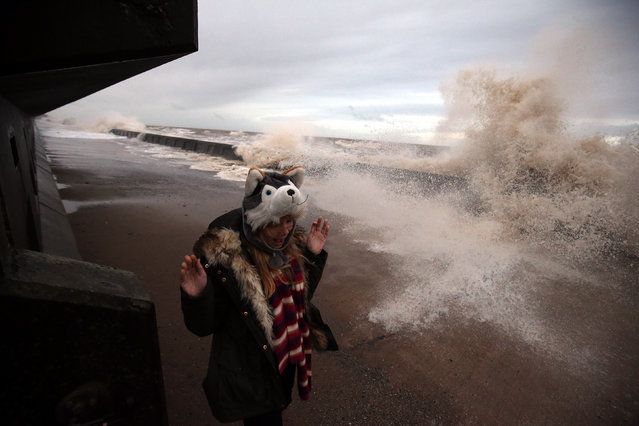
A girl runs from waves crashing over the promenade on December 24, 2015 in Blackpool, England. The Met Office is warning of 80mph winds and torrential downpours over the Christmas holidays, as dozens of flood alerts are issued for already devastated regions. (Photo by Nigel Roddis/Getty Images)

A girl runs from waves crashing over the promenade on December 24, 2015 in Blackpool, England. The Met Office is warning of 80mph winds and torrential downpours over the Christmas holidays, as dozens of flood alerts are issued for already devastated regions. (Photo by Nigel Roddis/Getty Images)
Details
25 Dec 2015 12:08:00
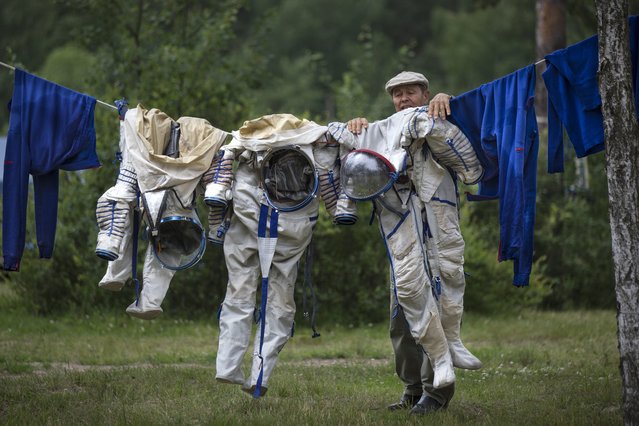
An employe of Russian Space Training Center hangs out to dry space suits of Russian cosmonaut Anatoly Ivanishin, NASA's U.S. flight engineer Kathleen Rubins, and Japanese space agency's flight engineer Takuya Onishi, right, after their undergoing  training near in Noginsk, 60 km (38 miles) east of Moscow, Russia, Wednesday, July 2, 2014. (Photo by Alexander Zemlianichenko/AP Photo)

An employe of Russian Space Training Center hangs out to dry space suits of Russian cosmonaut Anatoly Ivanishin, NASA's U.S. flight engineer Kathleen Rubins, and Japanese space agency's flight engineer Takuya Onishi, right, after their undergoing training near in Noginsk, 60 km (38 miles) east of Moscow, Russia, Wednesday, July 2, 2014. The training was intended to simulate the capsule landing on water. Russian cosmonaut Anatoly Ivanishin, Japanese space agency's flight engineer Takuya Onishi, and NASA's U.S. flight engineer Kathleen Rubins are being trained for a future mission to the International Space Station. (Photo by Alexander Zemlianichenko/AP Photo)
Details
05 Jul 2014 11:47:00
A model showcases Jaton designs during the Fashion x Art at NGV Runway at the Ian Potter Centre on November 16, 2021 in Melbourne, Australia. (Photo by Daniel Pockett/Getty Images)

A model showcases Jaton designs during the Fashion x Art at NGV Runway at the Ian Potter Centre on November 16, 2021 in Melbourne, Australia. (Photo by Daniel Pockett/Getty Images)
Details
18 Nov 2021 08:38:00
An Indian Hindu devotee pours milk on a snake as an offering during the annual Nag Panchami festival, dedicated to the worship of snakes outside the Nagvasuki temple, in Allahabad, on July 28, 2017. (Photo by Sanjay Kanojia/AFP Photo)

An Indian Hindu devotee pours milk on a snake as an offering during the annual Nag Panchami festival, dedicated to the worship of snakes outside the Nagvasuki temple, in Allahabad, on July 28, 2017. Officially the snake charmers' profession is banned in India, but many in the country offered prayers and milk blessings to cobras and other deadly serpents on July 28 in an annual tribute. The 800,000 charmers and their young apprentices come to the fore for the Nag Panchami festival which dates back several centuries. (Photo by Sanjay Kanojia/AFP Photo)
Details
31 Jul 2017 09:17:00
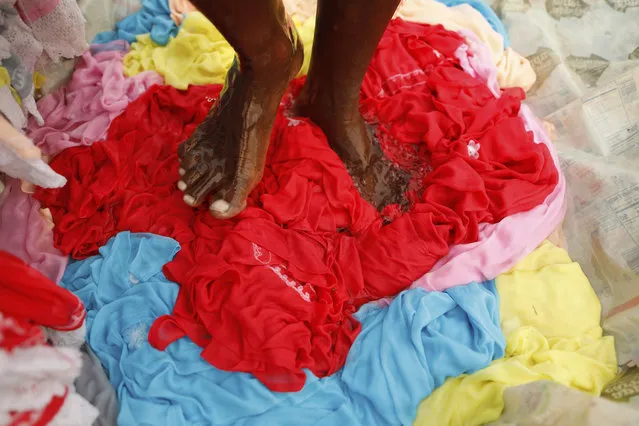
A dhobi, or a washerman washes cloths on the banks of the River Gomti in Lucknow, India, Saturday, September 12, 2020. Dhobis are traditional laundry workers who wash clothes by hand and dry them in the sun, an occupation which has been in existence for generations. Most cities in India have a Dhobi Ghat, or washermen's area, where the city's pile of clothes is laundered. This practice is still popular in India, despite of modern technology. Around 1,000 families work in Lucknow's Dhobi Ghat. However, in light of the novel coronavirus, their wages have decreased drastically. With each family earning around US$100-200 per month. (Photo by Rajesh Kumar Singh/AP Photo)

A dhobi, or a washerman washes cloths on the banks of the River Gomti in Lucknow, India, Saturday, September 12, 2020. Dhobis are traditional laundry workers who wash clothes by hand and dry them in the sun, an occupation which has been in existence for generations. Most cities in India have a Dhobi Ghat, or washermen's area, where the city's pile of clothes is laundered. This practice is still popular in India, despite of modern technology. Around 1,000 families work in Lucknow's Dhobi Ghat. However, in light of the novel coronavirus, their wages have decreased drastically. With each family earning around US$100-200 per month. (Photo by Rajesh Kumar Singh/AP Photo)
Details
25 Sep 2020 00:03:00