Loading...
Done
Indian commuters wade through floodwaters during the continuous rain shower in Calcutta, India, July 10, 2015. A monsoon shower hit the city and disrupted daily life. The Indian monsoon, takes place between May and September. (Photo by Piyal Adhikary/EPA)

Indian commuters wade through floodwaters during the continuous rain shower in Calcutta, India, July 10, 2015. A monsoon shower hit the city and disrupted daily life. The Indian monsoon, takes place between May and September. (Photo by Piyal Adhikary/EPA)
Details
11 Jul 2015 14:18:00
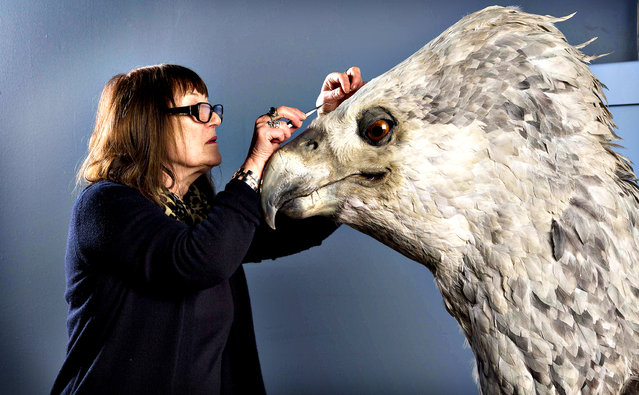
Undated handout photo of Buckbeak, a Hippogriff that lived with Rubeus Hagrid in the Harry Potter series, has his feathers preened and replenished by featherologist Val Jones, as he will feature in the the Feathers and Flight event at Warner Bros. Studio Tour London. (Photo credit should read: Tim Anderson/PA Wire)

Undated handout photo of Buckbeak, a Hippogriff that lived with Rubeus Hagrid in the Harry Potter series, has his feathers preened and replenished by featherologist Val Jones, as he will feature in the the Feathers and Flight event at Warner Bros. Studio Tour London. This is the first make-over Buckbeak has received since the hugely popular Harry Potter film series was made. His intricate coat is created from thousands of individually airbrushed chicken and goose feathers that Val will carefully clean and replenish in time for the start of Feathers and Flight. Val will lead an expert team to demonstrate the techniques that made winged wonders such as Buckbeak and Fawkes the Phoenix a reality on screen. (Photo by Tim Anderson/PA Wire)
Details
22 Mar 2014 13:56:00
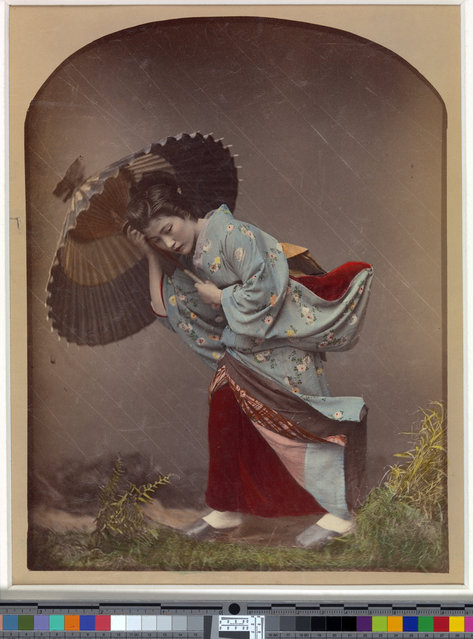
“Woman with Umbrella in Rain” by Raimund von Stillfried. Artist: Kusakabe Kimbei (Japanese, 1841–1934), 1870s. (Photo courtesy of The Metropolitan Museum of Art)

“Woman with Umbrella in Rain” by Raimund von Stillfried. Artist: Kusakabe Kimbei (Japanese, 1841–1934), 1870s. Commercial photography studios in Meiji-era Japan were renowned for the subtlety and refinement of their coloring techniques. This hand-tinted image of a young woman caught in a heavy rainstorm achieved its naturalistic effect by knitting together multiple strands of artifice: the greenery in the foreground was a studio prop; the flaps of the kimono were suspended by thin wires to create the impression of a strong wind; and long, diagonal marks were made on the negative to suggest streaks of rain. (Photo courtesy of The Metropolitan Museum of Art)
Details
12 May 2013 10:13:00
A woman, with her face covered with colored powders, dances during the Holi Festival of Colors in Lisbon, Sunday, September 15 2013. The festival, which is mainly celebrated during the Hindu spring festival Holi in some regions of India and Nepal, has become popular among people in other communities. (Photo by Francisco Seco/AP Photo)

A woman, with her face covered with colored powders, dances during the Holi Festival of Colors in Lisbon, Sunday, September 15 2013. The festival, which is mainly celebrated during the Hindu spring festival Holi in some regions of India and Nepal, has become popular among people in other communities. (Photo by Francisco Seco/AP Photo)
Details
21 Sep 2013 08:02:00
Iranian mourners cover themselves with mud during Ashoura, marking the death anniversary of Imam Hussein, the grandson of Islam's Prophet Muhammad, at the city of Bijar, west of the capital Tehran, Iran, Thursday, November 14, 2013. Hussein, one of Shiite Islam's most beloved saints, was killed in a 7th century battle at Karbala, Iraq. (Photo by Ebrahim Noroozi/AP Photo)

Iranian mourners cover themselves with mud during Ashoura, marking the death anniversary of Imam Hussein, the grandson of Islam's Prophet Muhammad, at the city of Bijar, west of the capital Tehran, Iran, Thursday, November 14, 2013. Hussein, one of Shiite Islam's most beloved saints, was killed in a 7th century battle at Karbala, Iraq. (Photo by Ebrahim Noroozi/AP Photo)
Details
18 Nov 2013 09:13:00
A file photograph dated 07 January 2006 and released by Greenpeace, showing the Yushin Maru, a factory ship in a Japanese whaling fleet, injuring a whale with it's first harpoon attempt. A UN court in The Hague on 31 March 2014 halted Japan's much-criticized whaling programme, ruling that it contravenes a 1986 moratorium on whale hunting. Japan must end its 'research whaling' programme, the International Court of Justice (ICJ) said. (Photo by Kate Davison/EPA)

A file photograph dated 07 January 2006 and released by Greenpeace, showing the Yushin Maru, a factory ship in a Japanese whaling fleet, injuring a whale with it's first harpoon attempt. A UN court in The Hague on 31 March 2014 halted Japan's much-criticized whaling programme, ruling that it contravenes a 1986 moratorium on whale hunting. Japan must end its 'research whaling' programme, the International Court of Justice (ICJ) said. Japan said the programme was for scientific research and permitted under international conventions. Australia had brought the case to the ICJ in 2010, charging that Japan was breaching international law by killing hundreds of whales every year for commercial purposes. Japan was “deeply disappointed” by the ruling, an unnamed government official was quoted by the Kyodo News agency as saying. But the official said Japan would stand by the ruling. (Photo by Kate Davison/EPA)
Details
01 Apr 2014 08:38:00
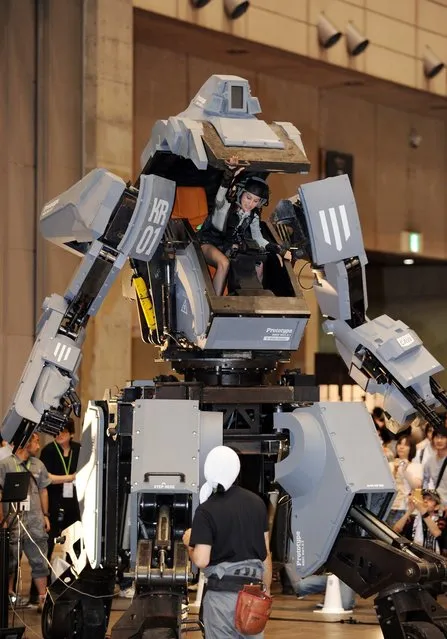
Female “pilot” Anna (C) climbs out the cockpit of Japanese electronics company Suidobashi Heavy Industry's newly unveiled robot “Kuratas” at the Wonder Festival in Chiba, suburban Tokyo on July 29, 2012. The Kuratas robot, which will go on sale with a price tag of one million USD, measures four meters in height, weighs four tons and has four wheeled legs that can either be controlled remotely through the 3G network or by a human seated within the cockpit.

Female pilot Anna climbs out the cockpit of Japanese electronics company Suidobashi Heavy Industry's newly unveiled robot “Kuratas” at the Wonder Festival in Chiba, suburban Tokyo on July 29, 2012. The “Kuratas” robot, which will go on sale with a price tag of one million USD, measures four meters in height, weighs four tons and has four wheeled legs that can either be controlled remotely through the 3G network or by a human seated within the cockpit. (Photo by Yoshikazu Tsuno/AFP Photo)
Details
30 Jul 2012 09:26:00


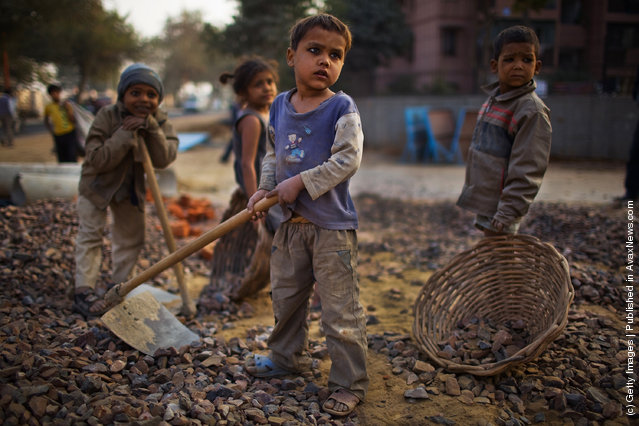
Indian children work nearby to their parents at a construction project in front of the Jawaharlal Nehru Stadium on January 30, 2010 in New Delhi, India. The children accompany their parents to the work site, where if they are prepared to work, they will receive money for bread an milk and be provided with dinner by the contractor. The sheer scale of the project has drawn an enormous population of migrant workers from all over India.
Details
20 May 2011 07:00:00