Loading...
Done
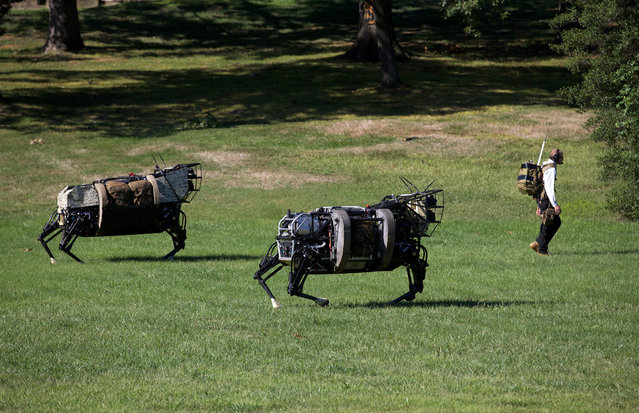
Two robotic legged squad support system (LS3) machines by the Defense Advanced Research Project Agency follow a technician during a demonstration at Joint Base Myer-Henderson Hall, Virginia, on September 10, 2012. (U.S. Marine Corps photo by Sgt. Mallory S. VanderSchans)

Two robotic legged squad support system (LS3) machines by the Defense Advanced Research Project Agency follow a technician during a demonstration at Joint Base Myer-Henderson Hall, Virginia, on September 10, 2012. (U.S. Marine Corps photo by Sgt. Mallory S. VanderSchans via The Atlantic)
Details
20 Oct 2012 10:30:00
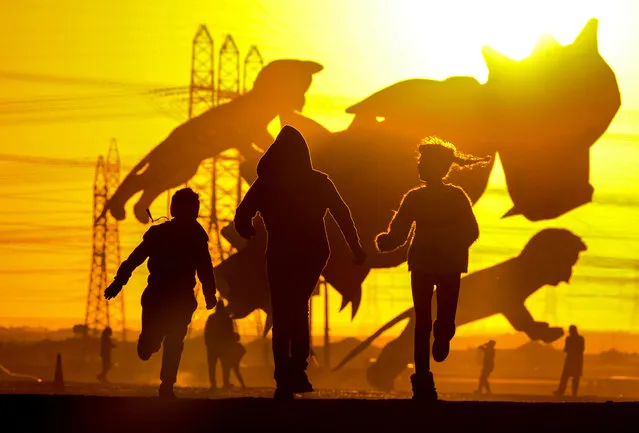
Kuwaitis play in front of kites at for Kuwaiti al-Farsi Kites team, Kuwaiti desert, 50 kilometers south of Kuwait City, 06 January 2017 (Issued 07 January 2017). (Photo by Raed Qutena/EPA)

Kuwaitis play in front of kites at for Kuwaiti al-Farsi Kites team, Kuwaiti desert, 50 kilometers south of Kuwait City, 06 January 2017 (Issued 07 January 2017). (Photo by Raed Qutena/EPA)
Details
08 Jan 2017 15:01:00
2016 Rio Olympics, Weightlifting, Final, Women's 63kg, Riocentro, Pavilion 2, Rio de Janeiro, Brazil on August 9, 2016. Marina Rodriguez (CUB) of Cuba competes. (Photo by Stoyan Nenov/Reuters)

2016 Rio Olympics, Weightlifting, Final, Women's 63kg, Riocentro, Pavilion 2, Rio de Janeiro, Brazil on August 9, 2016. Marina Rodriguez (CUB) of Cuba competes. (Photo by Stoyan Nenov/Reuters)
Details
10 Aug 2016 10:34:00
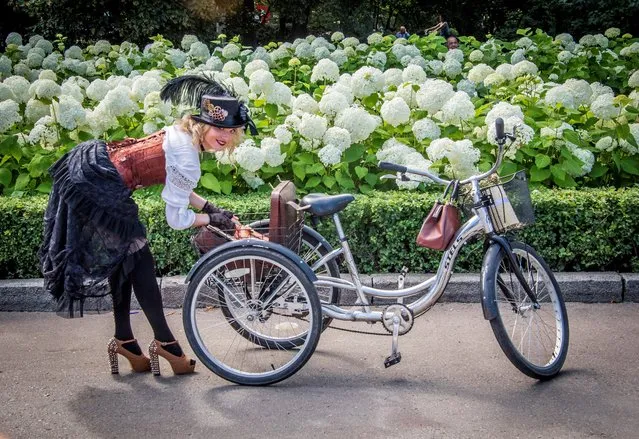
A participant in the 5th Lady on Bicycle annual festival opens her bag in the back basket of her tricycle in the Sokolniki park in Moscow on August 6, 2017. The festival's aim is to capture the city's fashionable women on vintage style bicycles. (Photo by Mladen Antonov/AFP Photo)

A participant in the 5th Lady on Bicycle annual festival opens her bag in the back basket of her tricycle in the Sokolniki park in Moscow on August 6, 2017. The festival's aim is to capture the city's fashionable women on vintage style bicycles. (Photo by Mladen Antonov/AFP Photo)
Details
07 Aug 2017 07:49:00
Galapagos – Rocking the Cradle: Four major ocean currents converge along the Galapagos archipelago, creating the conditions for an extraordinary diversity of animal life, April 25, 2016. The islands are home to at least 7,000 flora and fauna species, of which 97 percent of the reptiles, 80 percent of the land birds, 50 percent of the insects and 30 percent of the plants are endemic. The local ecosystem is highly sensitive to the changes in temperature, rainfall and ocean currents that characterize the climatic events known as El Niño and La Niña. These changes cause marked fluctuations in weather and food availability. Many scientists expect the frequency of El Niño and La Niña to increase as a result of climate change, making the Galapagos a possible early-warning location for its effects. (Photo by Thomas P. Peschak for National Geographic/World Press Photo)

Galapagos – Rocking the Cradle: Four major ocean currents converge along the Galapagos archipelago, creating the conditions for an extraordinary diversity of animal life, April 25, 2016. The islands are home to at least 7,000 flora and fauna species, of which 97 percent of the reptiles, 80 percent of the land birds, 50 percent of the insects and 30 percent of the plants are endemic. (Photo by Thomas P. Peschak for National Geographic/World Press Photo)
Details
16 Apr 2018 00:01:00


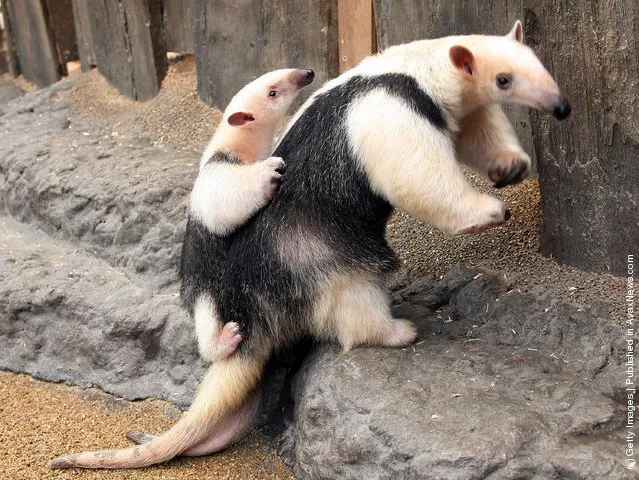
“The Southern Tamandua, Collared Anteater or Lesser Anteater (Tamandua tetradactyla) is a species of anteater from South America. It is a solitary animal, found in many habitats from mature to highly disturbed secondary forests and arid savannas. It feeds on ants, termites and bees. It has very strong foreclaws that can be used to break insect nests or to defend itself”. – Wikipedia

Photo: A three-month-old baby Southern Tamandua “Konbu” lies on its mother Tae's back at Sunshine International Aquarium on July 7, 2009 in Tokyo, Japan. Baby Southern Tamandua feels safe and comfortable holding onto something and normally stays on the mother's back until around 3 months old. (Photo by Junko Kimura/Getty Images)
Details
19 May 2011 10:31:00
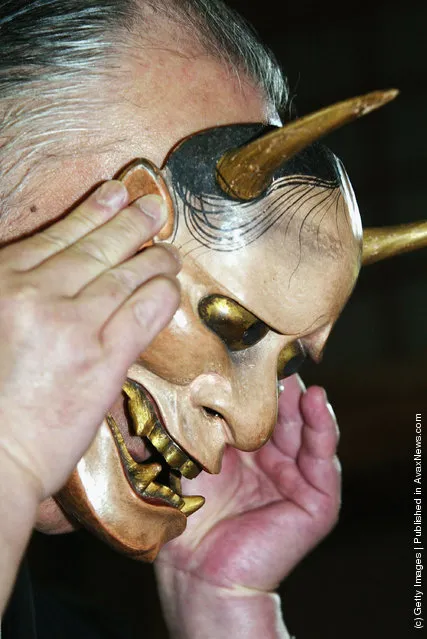
A renowned Noh actor, Otoshige Sakai, demostrates how to put on a Noh mask

“Noh, or Nogaku – derived from the Japanese word for “skill” or “talent” – is a major form of classical Japanese musical drama that has been performed since the 14th century. Many characters are masked, with men playing male and female roles. Traditionally, a Noh “performance day” lasts all day and consists of five Noh plays interspersed with shorter, humorous kyōgen pieces. However, present-day Noh performances often consist of two Noh plays with one Kyōgen play in between”. – Wikipedia

Photo: A renowned Noh actor, Otoshige Sakai, demostrates how to put on a Noh mask, on May 17, 2004 in Tokyo, Japan. (Photo by Koichi Kamoshida/Getty Images)
Details
02 Aug 2011 14:09:00
Baby Fennec Fox

“The fennec fox is a small nocturnal fox found in the Sahara of North Africa. Its most distinctive feature is unusually large ears. The name “fennec” comes from the Arabic word for fox, and the species name zerda has a Greek origin that refers to its habitat. The fennec is the smallest species of canid in the world; coat, ears and kidney functions have adapted to a high-temperature, low-water, desert environment. In addition, its hearing is sensitive enough to hear prey moving underground”. – Wikipedia

Photo: A Baby Fennec is seen at Sunshine International Aquarium on June 24, 2009 in Tokyo, Japan. The small nocturnal fox babies were born on May 17 2009. (Photo by Junko Kimura/Getty Images)
Details
16 Sep 2011 12:02:00