Loading...
Done


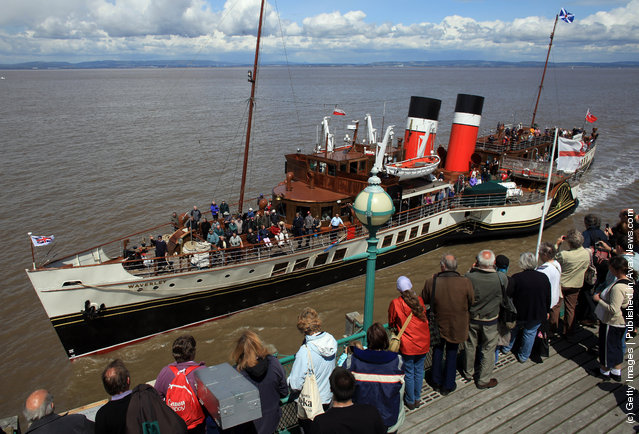
Passengers watch as The Waverley, the world's last remaining seagoing passenger paddle steamer arrives at Clevedon Pier on June 10, 2011 in Clevedon, England. Built in 1946, the trust which owns and operates the Waverley, is warning that this could be the last season for the vessel and is appealling for more public funding saying it is struggling to make ends meet in the current financial climate due in part to rising fuel costs. Restored in 1973 after service on Loch Long in Scotland, since 2003, Waverley has been listed in the British National Register of Historic Ships core collection as 'a vessel of pre-eminent national importance'. (Photo by Matt Cardy/Getty Images)
Details
11 Jun 2011 12:02:00
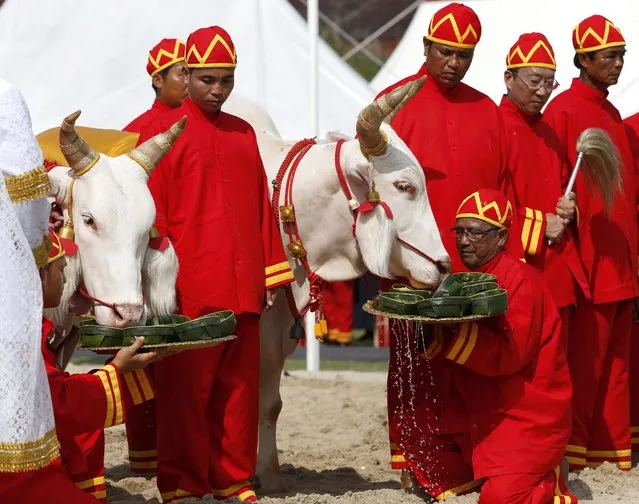
Royal sacred white oxen are offered food to consult the oracles during the Royal Ploughing Ceremony at the Royal Ground, Sanam Luang near the Grand Palace in Bangkok, Thailand, 09 May 2016. The ancient Brahmin rite is of great importance to the country's farmers. Thousands of farmers converge in Bangkok for the annual event, which is believed to assure a successful planting season and an abundance of crops. (Photo by Rungroj Yongrit/EPA)

Royal sacred white oxen are offered food to consult the oracles during the Royal Ploughing Ceremony at the Royal Ground, Sanam Luang near the Grand Palace in Bangkok, Thailand, 09 May 2016. The ancient Brahmin rite is of great importance to the country's farmers. Thousands of farmers converge in Bangkok for the annual event, which is believed to assure a successful planting season and an abundance of crops. This year the sacred oxen ate paddy, sesame seeds, water and liquor which according to traditional soothsayers predicts that the country will have abundant food, sufficient water for agriculture as well as communication and foreign trade will improve leading to the prosperous economy. (Photo by Rungroj Yongrit/EPA)
Details
10 May 2016 13:11:00
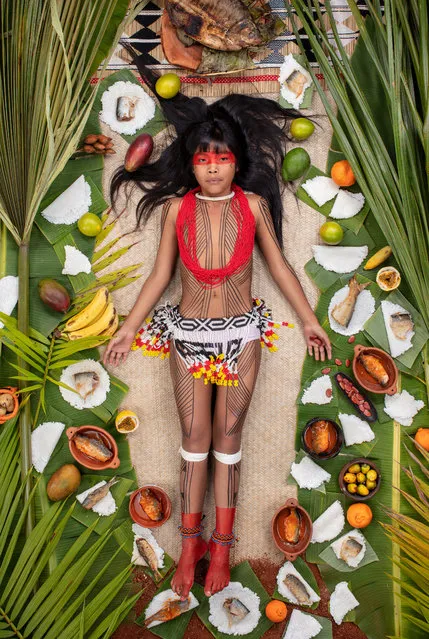
Kawakanih Yawalapiti, 9, Upper Xingu region of Mato Grosso, Brazil, 2018: Kawakanih lives with her tribe, the Yawalapiti, in Xingu national park, a preserve in the Amazon basin of Brazil. The Yawalapiti collect seeds to preserve species unique to their ecosystem, which lies between the rain forest and savannah. Kawakanih’s diet is simple, consisting mainly of fish, cassava, porridge, fruit and nuts. “It takes five minutes to catch dinner”, says Kawakanih. “When you’re hungry, you just go to the river with your net”. (Photo by Gregg Segal/The Guardian)

Photographer Gregg Segal travelled the world to document children and the food they eat in a week. Partly inspired by the increasing problems of childhood obesity, he tracked traditional regional diets as yet unaffected by globalisation, and ironically, found that the healthiest diets were often eaten by the least well off. (Photo by Gregg Segal/The Guardian)
Details
03 Jul 2019 00:03:00
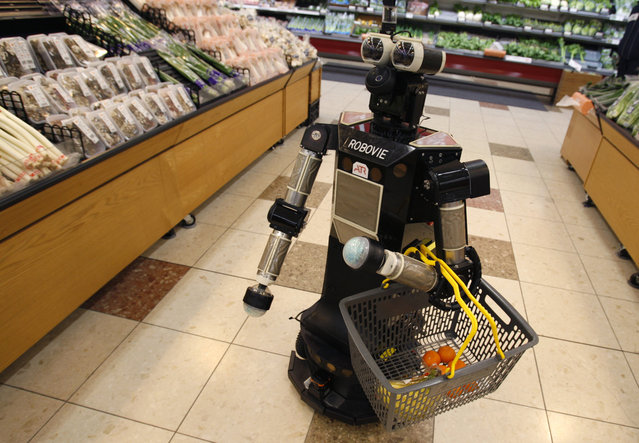
A robot named “Robovie-II”, developed by Japanese robotics research institution ATR, moves around at a grocery store during a shopping assisting experiment by utilizing the robot in an ubiquitous network technology platform in Kyoto, western Japan January 6, 2010. The robot greets the shopper at the entrance of the store, follows him to the shelves while holding a grocery basket and reminds him of the items on a shopping list, which the shopper would have entered beforehand in a specialized mobile device. The experiment is aimed to gather data in order to provide livelihood support for the elderly by using robots and network technologies, ATR's researcher Satoshi Koizumi said. (Photo by Yuriko Nakao/Reuters)

A robot named “Robovie-II”, developed by Japanese robotics research institution ATR, moves around at a grocery store during a shopping assisting experiment by utilizing the robot in an ubiquitous network technology platform in Kyoto, western Japan January 6, 2010. (Photo by Yuriko Nakao/Reuters)
Details
02 Feb 2018 06:54:00
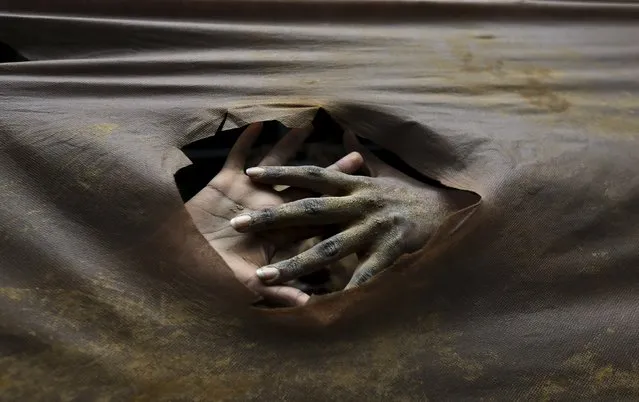
An environmental activist performs during a protest in front of the headquarters of Brazilian mining company Vale SA in downtown Rio de Janeiro, Brazil, November 16, 2015. (Photo by Sergio Moraes/Reuters)

An environmental activist performs during a protest in front of the headquarters of Brazilian mining company Vale SA in downtown Rio de Janeiro, Brazil, November 16, 2015. The collapse of two dams at a Brazilian mine, owned by Vale SA and BHP Billiton Ltd, has cut off drinking water for quarter of a million people and saturated waterways downstream with dense orange sediment that could wreck the ecosystem for years to come. Nine people were killed, 19 are still listed as missing and 500 people were displaced from their homes when the dams burst at an iron ore mine in southeastern Brazil on November 5. (Photo by Sergio Moraes/Reuters)
Details
18 Nov 2015 08:00:00
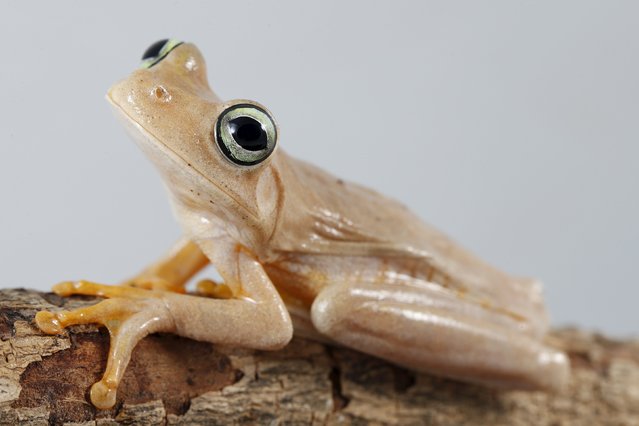
A Hypsiboas crepitans frog is pictured at a terrarium in Caracas November 30, 2015. Venezuelan frogs and toads are in critical danger due to climate change as rising temperatures complicate reproduction and spread a deadly fungus, say scientists, who liken the species to canaries in a coalmine warning of imminent danger. (Photo by Carlos Garcia Rawlins/Reuters)

A Hypsiboas crepitans frog is pictured at a terrarium in Caracas November 30, 2015. Venezuelan frogs and toads are in critical danger due to climate change as rising temperatures complicate reproduction and spread a deadly fungus, say scientists, who liken the species to canaries in a coalmine warning of imminent danger. The survival of a group of nearly 20 frog and toad species, which top Venezuela's list of endangered species, may rest on a small group of academics in a Caracas laboratory attempting to recreate the amphibians' natural reproductive conditions. (Photo by Carlos Garcia Rawlins/Reuters)
Details
17 Dec 2015 08:04:00


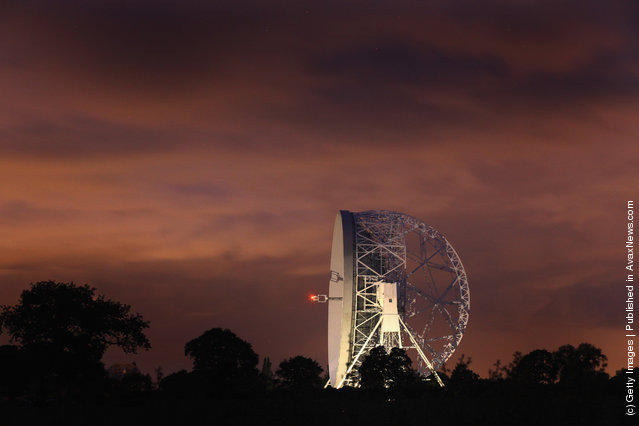
“The Lovell Telescope is a radio telescope at Jodrell Bank Observatory, near Goostrey, Cheshire in the north-west of England. When it was constructed in 1955, the telescope was the largest steerable dish radio telescope in the world at 76.2 m (250 ft) in diameter; it is now the third largest, after the Green Bank telescope in West Virginia, USA, and the Effelsberg telescope in Germany. It was originally known as the 250 ft (76 m) telescope or the Radio Telescope at Jodrell Bank, before becoming the Mark I telescope around 1961 when future telescopes (the Mark II, III, and IV) were being discussed. It was renamed to the Lovell Telescope in 1987 after Bernard Lovell, and became a Grade I listed building in 1988. The telescope forms part of the MERLIN and European VLBI Network arrays of radio telescopes”. – Wikipedia

Photo: The Lovell Telescope listens to the night sky for radio signals from space at Jodrell Bank on June 22, 2011 in Holmes Chapel, England. Jodrell Bank Centre for Astrophysics and it's world famous Lovell Telescope is on the shortlist of Britain's submission for Unesco World Heritage Site status. (Photo by Christopher Furlong/Getty Images)
Details
24 Jun 2011 09:34:00
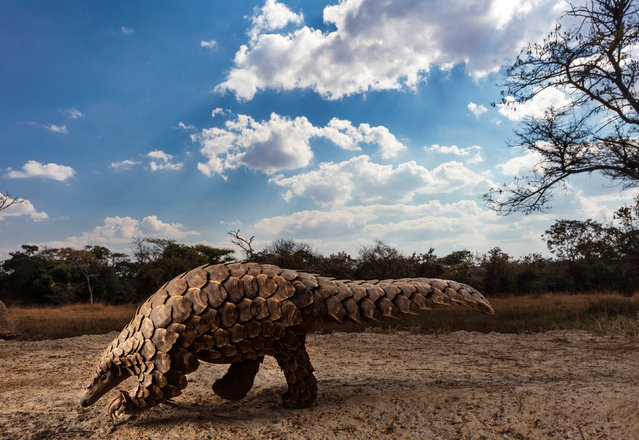
Pangolins in Crisis: Brent Stirton, South Africa; 1st place, Natural world and wildlife. “Pangolins are the world’s most illegally trafficked mammals, with an estimated one million trafficked to Asia in the last 10 years. Their scales are used in traditional Chinese and Vietnamese medicine, and their meat is sold as a high-priced delicacy. As a result, pangolins are listed as critically endangered and anyone who trades or consumes them is breaking the law. This body of work exposes the trade, while exploring aspects of illegality and celebrating the people who are trying to save these animals”. (Photo by Brent Stirton/Sony World Photography Awards 2020)

Pangolins in Crisis: Brent Stirton, South Africa; 1st place, Natural world and wildlife. “Pangolins are the world’s most illegally trafficked mammals, with an estimated one million trafficked to Asia in the last 10 years. Their scales are used in traditional Chinese and Vietnamese medicine, and their meat is sold as a high-priced delicacy. As a result, pangolins are listed as critically endangered and anyone who trades or consumes them is breaking the law. This body of work exposes the trade, while exploring aspects of illegality and celebrating the people who are trying to save these animals”. (Photo by Brent Stirton/Sony World Photography Awards 2020)
Details
11 Jun 2020 00:05:00