Loading...
Done
Emilia Pechinkova, a 24-years-old Bulgarian Pomak (Bulgarian speaking Muslims) bride poses for a photograph following the “gelina” or face painting ceremony carried out by female guests and relatives in preparation for her three-day wedding ceremony in the village of Draginovo, 100 kms southeast of Sofia on April 22, 2016. Bulgaria's Muslim population is one of the highest in the European Union. (Photo by Nikolay Doychinov/AFP Photo)

Emilia Pechinkova, a 24-years-old Bulgarian Pomak (Bulgarian speaking Muslims) bride poses for a photograph following the “gelina” or face painting ceremony carried out by female guests and relatives in preparation for her three-day wedding ceremony in the village of Draginovo, 100 kms southeast of Sofia on April 22, 2016. Bulgaria's Muslim population is one of the highest in the European Union. During the Communist regime religious rituals were not tolerated, and Muslims were forced to abandon wearing their traditional wedding outfits. Recently, more young Pomak women want to include traditional wedding customs that were forbidden during the regime, regardless of their secular lifestyles and the high cost of such a wedding. (Photo by Nikolay Doychinov/AFP Photo)
Details
25 Apr 2016 09:55:00
Cuban-American artist Jorge Rodriguez-Gerada's six-acre sand and soil “facescape” stretches across the JFK Hockey Field on the north side of the Reflecting Pool along the National Mall October 1, 2014 in Washington, DC. Titled “Out of Many, One” and composed of 2,500 tons of sand, 800 tons of top soil and eight miles of string, the piece is the artist's interpreative blending of 30 different men's faces. (Photo by Chip Somodevilla/Getty Images)

Cuban-American artist Jorge Rodriguez-Gerada's six-acre sand and soil “facescape” stretches across the JFK Hockey Field on the north side of the Reflecting Pool along the National Mall October 1, 2014 in Washington, DC. Titled “Out of Many, One” and composed of 2,500 tons of sand, 800 tons of top soil and eight miles of string, the piece is the artist's interpreative blending of 30 different men's faces. Rodriguez-Gereda used high-precision global positioning satellites to place 10,000 wood pegs as waypoints for the giant face. The piece will be open to the public beginning October 4 and will eventually be tilled back into the earth. (Photo by Chip Somodevilla/Getty Images)
Details
04 Oct 2014 11:39:00
Life in lockdown: Schoolteacher Marzio Toniolo, 35, takes a picture of his two-year-old daughter Bianca painting his toenails as they while away time at home in San Fiorano, one of the original “red zone” towns in northern Italy that has now been extended to the whole country, as his wife, Bianca's mum Chiara Zuddas looks out from their balcony, March 20, 2020. Toniolo has been documenting how his family has dealt with being under quarantine since it began for them in February. (Photo by Marzio Toniolo via Reuters)

Life in lockdown: Schoolteacher Marzio Toniolo, 35, takes a picture of his two-year-old daughter Bianca painting his toenails as they while away time at home in San Fiorano, one of the original “red zone” towns in northern Italy that has now been extended to the whole country, as his wife, Bianca's mum Chiara Zuddas looks out from their balcony, March 20, 2020. Toniolo has been documenting how his family has dealt with being under quarantine since it began for them in February. (Photo by Marzio Toniolo via Reuters)
Details
09 Apr 2020 00:03:00
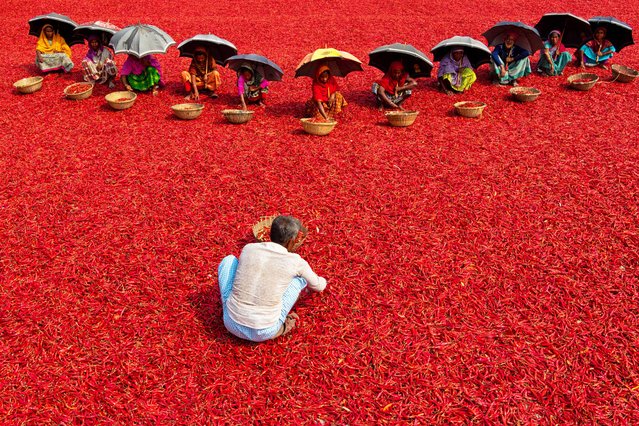
Rows of workers shelter under umbrellas from the scorching heat as they painstakingly sort through a red carpet of millions of chilli peppers in Bogra, Bangladesh on October 3, 2023. They sort the rotten and broken chilli peppers out to separate the poor quality ones which won't sell. In a line, the pickers who are paid less than £3 for a 10-hour shift slowly move forward with their baskets to separate the bad from the good after the chilies have been dried in the sun for a week. The dried & sorted chillies are then packaged and taken to the local market where they are brought mainly by companies to be made into chilli powder. The workers sort them in a warm environment, with temperatures reaching up to 45°C. More than 5,000 people work in almost 100 chilli farms in the Bogra district of Bangladesh to supply local spice companies with chillies for their recipes. Known as “Lal Morich” to the locals, chilli peppers are a major part of Bengali cuisine and are used as part of a combination of spices for various meat dishes, including chicken and beef. (Photo by Joy Saha/Rex Features/Shutterstock)

Rows of workers shelter under umbrellas from the scorching heat as they painstakingly sort through a red carpet of millions of chilli peppers in Bogra, Bangladesh on October 3, 2023. They sort the rotten and broken chilli peppers out to separate the poor quality ones which won't sell. In a line, the pickers who are paid less than £3 for a 10-hour shift slowly move forward with their baskets to separate the bad from the good after the chilies have been dried in the sun for a week. (Photo by Joy Saha/Rex Features/Shutterstock)
Details
21 Oct 2023 04:04:00


“Body blading (also known as buggy rollin') is an extreme sport that involves descending down a slope while wearing a flexible aerodynamic plastic roller suit that has wheels on the feet, knees, torso, and arms. This suit was created by Jean-Yves Blondeau, and he is one of the premier body bladers. Body blading is similar to roller blading, and in fact a body blader often starts out using the rollers on their feet in the same fashion as roller blades in order to gain initial speed, but then the rider generally assumes a position laying on the stomach facing down the hill. A body blader is capable of reaching very high speeds. Maneuverability is achieved by moving the body into various positions to change direction”. – Wikipedia

Photo: French designer Jean-Yves Blondeau demonstrates his “Buggy Rollin” suit during a performance on August 16, 2007 in Beijing, China. Blondeau is able to roll along in any position and can achieve high speeds wearing the suit. (Photo by China Photos/Getty Images)
Details
29 Jun 2011 11:00:00
Make Your Franklin By Martin Joubert Part 1

Having $100 in your pocket would be so much cooler if it was designed by Martin Joubert. He went all out and created a number of different designs for the 100 USD banknotes, ranging from silly to witty. We especially liked the one with “That’s right. This is real money” written on it, showing just how many cups of coffee, basketballs, and guns you can buy with 100 dollars. All in all, even the currency that we have today is nothing but paper, even though it looks official and strict. There is nothing backing it up except for our noble military that ensures that Gulf States sell their oil using only the “green” kind of currency. (Photo by Martin Joubert)
Details
17 Dec 2014 11:19:00
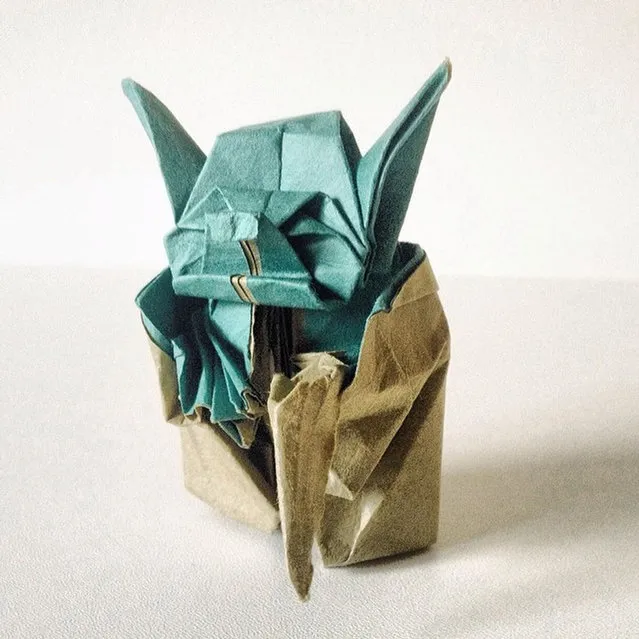
Origami By Ross Symons

As kids we have the natural desire to explore and to create. Whenever our parents would make for us a paper plane, we would become overjoyed seeing it fly across the room. However, planes are not the only thing that can be made from paper, and not only kids are fascinated by it. Some people master the art of origami and are able to create pretty much anything. You never know what’s going to come out when the artist twists and turns a piece of paper in meticulous ways. Finally, the figurine is complete, and you immediately see the striking resemblance of this piece of paper with an animal or some other creature. Ross Symons is one of those artists. He creates his figurines simply for the joy it brings him. Maybe, he uses this as a medium to enter his childhood, or maybe he has other motifs – we will never know. (Photo by Ross Symons)
Details
31 Oct 2014 12:12:00
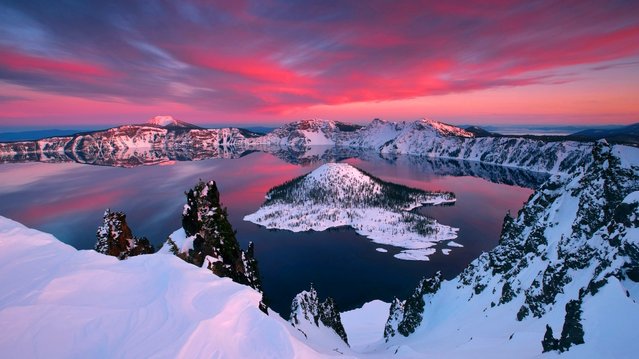
Crater Lake In Oregon

As you look at the majestic Crater Lake, located in south-central Oregon, United States, it is hard to imagine that thousands of years ago this place was one giant crater with scorching hot lava spilling over the sides. Those were the times of turmoil. Now, however, this place is the essence of tranquility. The lake that was formed, after the volcano died down, is amazingly clear due to the fact that the water isn’t moving at all. No rivers go in or out of the Crater Lake, and the water lost through evaporation is compensated by the rain and snowfall. This lake is also frighteningly deep – 1,943 feet (592 m) at its deepest point – making it the deepest lake in the United States. If you love nature and if you ever come to Oregon, this is truly a sight to behold.
Details
19 Nov 2014 14:14:00