Loading...
Done
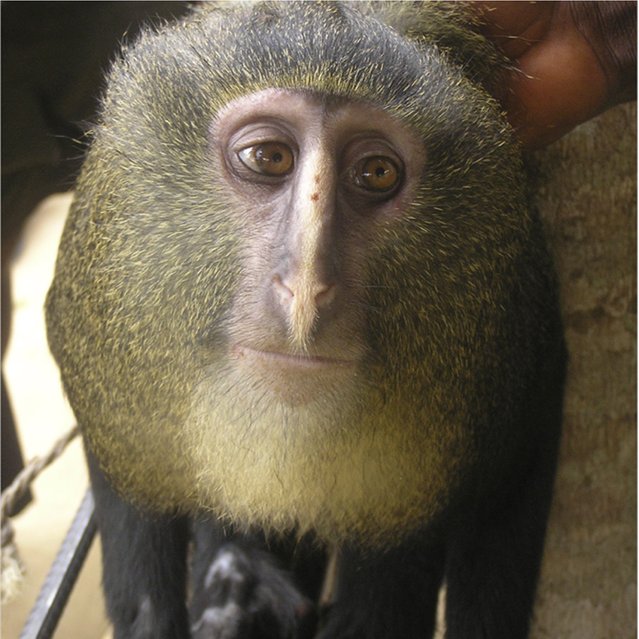
A new species of monkey found in the Democratic Republic of the Congo and identified as Lesula (Cercopithecus lomamiensis) is seen in this undated photograph from an article published September 12, 2012 in the science journal PLOS One. (Photo by Hart J. A., Detwiler K. M., Gilbert C. C./Reuters)

A new species of monkey found in the Democratic Republic of the Congo and identified as Lesula (Cercopithecus lomamiensis) is seen in this undated photograph from an article published September 12, 2012 in the science journal PLOS One. The monkey was first seen in 2007 by researchers John and Terese Hart of the Peabody Museum of Natural History at Yale Research Project. The finding of C. lomamiensis represents only the second new species of African monkey to be discovered in the past 28 years, according to the research article. (Photo by Hart J. A., Detwiler K. M., Gilbert C. C./Reuters)
Details
27 Sep 2012 08:17:00
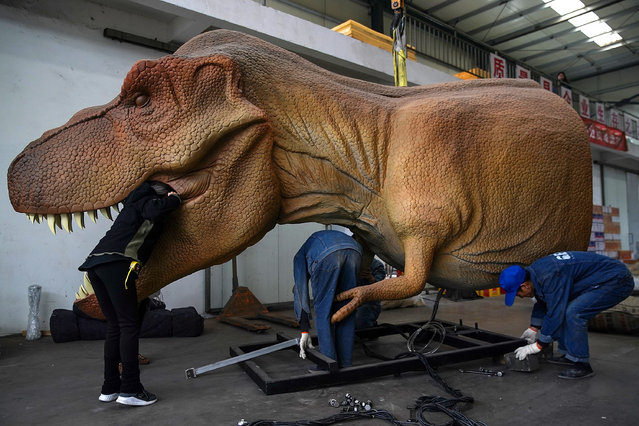
Chinese workers maintain an Animatronic Dinosaurs at Gengu Dinosaurs Science and Technology company on November 13, 2019 in Zigong, Sichuan Province, China. There are hundreds of simulated dinosaur manufacturers in Zigong City. It is the largest simulated dinosaur manufacturing in China. It accounts for 95% of mainland China's production and 85% of the world's total. Its products are exported to more than 100 countries. (Photo by Lintao Zhang/Getty Images)

Chinese workers maintain an Animatronic Dinosaurs at Gengu Dinosaurs Science and Technology company on November 13, 2019 in Zigong, Sichuan Province, China. There are hundreds of simulated dinosaur manufacturers in Zigong City. It is the largest simulated dinosaur manufacturing in China. It accounts for 95% of mainland China's production and 85% of the world's total. Its products are exported to more than 100 countries. (Photo by Lintao Zhang/Getty Images)
Details
03 Dec 2019 00:01:00
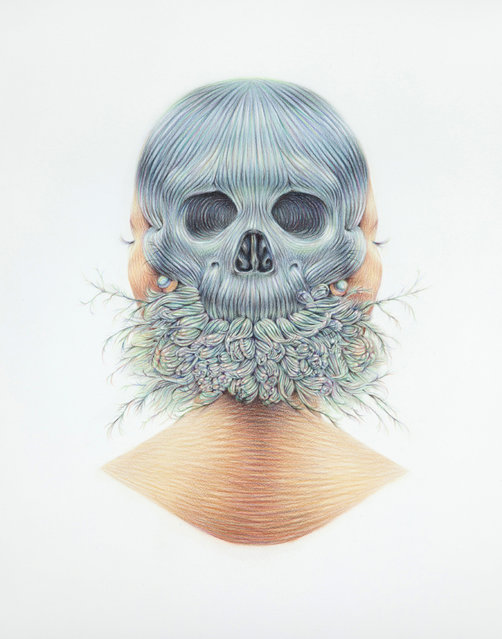
Portrait Drawings Of Winnie Truong

Winnie Truong was born in Toronto, where she still lives, and received her BFA in painting and drawing from Ontario College of Art and Design.

Using pencil, crayon, and chalk pastel on giant sheets of paper, Truong creates portraits with great detail. Her aim is to explore notions of beauty and discomfort and, inspired by science fiction, she portrays hair in all its ‘whiskery, wispy, curly, bristly’ brilliance.
Details
07 Jun 2015 10:44:00
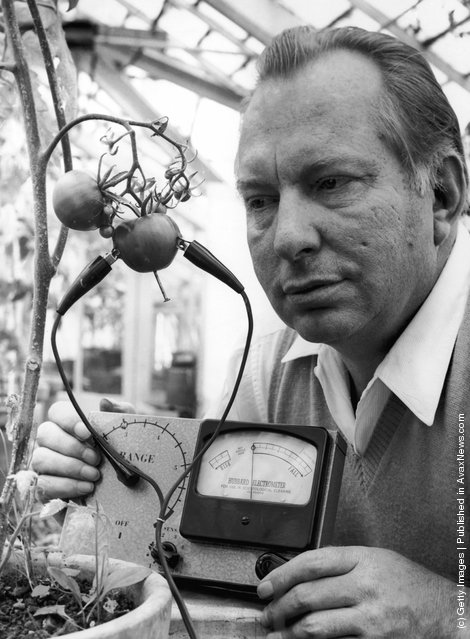
American science fiction writer L. Ron Hubbard, founder of the Church of Scientology, uses his Hubbard Electrometer

“Lafayette Ronald Hubbard (March 13, 1911 – January 24, 1986), better known as L. Ron Hubbard (and often referred to by his initials, LRH), was an American pulp fiction author and religious leader who founded the Church of Scientology. After establishing a career as a writer, becoming best known for his science fiction and fantasy stories, he developed a self-help system called Dianetics which was first published in May 1950. He subsequently developed his ideas into a wide-ranging set of doctrines and rituals as part of a new religious movement that he called Scientology. His writings became the guiding texts for the Church of Scientology and a number of affiliated organizations that address such diverse topics as business administration, literacy and drug rehabilitation”. – Wikipedia

Photo: American science fiction writer L. Ron Hubbard, founder of the Church of Scientology, uses his Hubbard Electrometer (patent pending) to determine whether tomatoes experience pain, 1959. His work led him to the conclusion that tomatoes “scream when sliced”. (Photo by Scott Lauder/Evening Standard/Hulton Archive/Getty Images)
Details
09 Sep 2011 09:34:00
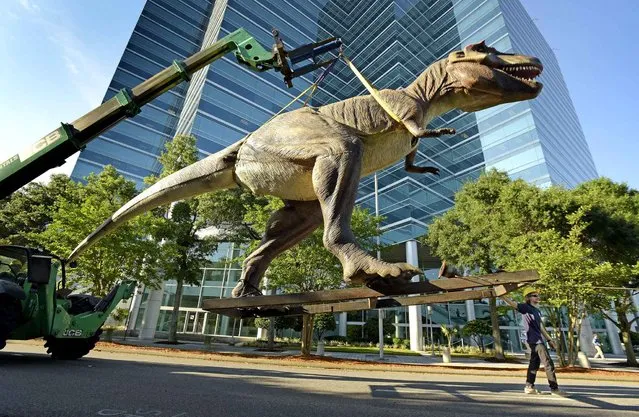
Crews move a 39 foot long, 16 foot tall, 2400 lbs. replica of a Tyrannosaurus Rex from behind the Museum Of Science And History in Jacksonville, Fla., to its new location in front of the entrance of the museum Wednesday morning, May 20, 2015, to kickoff the upcoming Dinosaurs Unearthed exhibit. (Photo by Bob Self/The Florida Times-Union via AP Photo)

Crews move a 39 foot long, 16 foot tall, 2400 lbs. replica of a Tyrannosaurus Rex from behind the Museum Of Science And History in Jacksonville, Fla., to its new location in front of the entrance of the museum Wednesday morning, May 20, 2015, to kickoff the upcoming Dinosaurs Unearthed exhibit. The exhibiti, which opens this week, includes animatronic dinosaurs as well as prehistoric fossils and runs through September 7. (Photo by Bob Self/The Florida Times-Union via AP Photo)
Details
23 May 2015 11:22:00
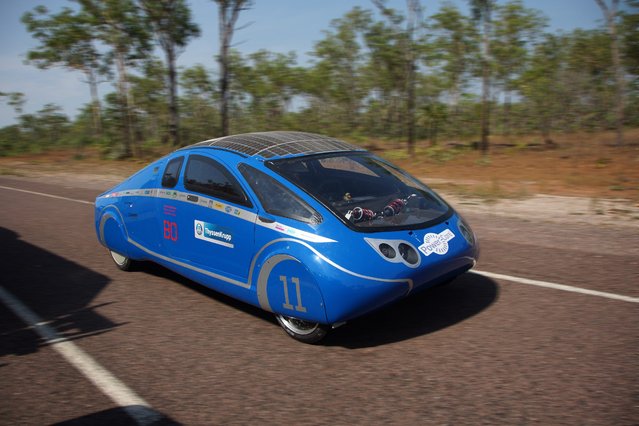
A undated handout image provided by the Bochum University of Applied Sciences (Hochschule Bochum) on 04 October 2013 shows the German team Bochum's Cruiser class solar car during a test drive in the Northern Territoty, Australia, 16 September 2013. The Dutch vehicle is competing in the World Solar Challenge, driving from Darwin to Adelaide starting on 06 October 2013. (Photo by Hochschule Bochum/EPA)

A undated handout image provided by the Bochum University of Applied Sciences (Hochschule Bochum) on 04 October 2013 shows the German team Bochum's Cruiser class solar car during a test drive in the Northern Territoty, Australia, 16 September 2013. The Dutch vehicle is competing in the World Solar Challenge, driving from Darwin to Adelaide starting on 06 October 2013. (Photo by Hochschule Bochum/EPA)
Details
29 Oct 2013 12:37:00
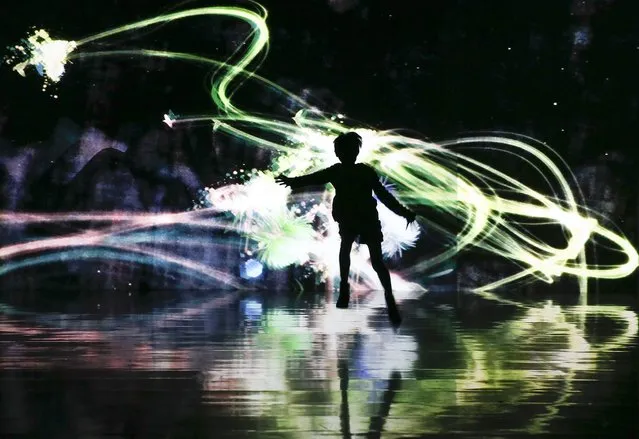
A girl dances in front of the digital art installation “Light in Dark” created by teamLab, a collaborative of Japanese digital artists, during a special exhibition of “Shake! Art Exhibition! and Learn and Play! teamLab Future Park” at National Museum of Emerging Science and Innovation (or Miraikan) in Tokyo, Japan, 19 January 2015. The exhibition is held through 01 March 2015. (Photo by Kimimasa Mayama/EPA)

A girl dances in front of the digital art installation “Light in Dark” created by teamLab, a collaborative of Japanese digital artists, during a special exhibition of “Shake! Art Exhibition! and Learn and Play! teamLab Future Park” at National Museum of Emerging Science and Innovation (or Miraikan) in Tokyo, Japan, 19 January 2015. The exhibition is held through 01 March 2015. (Photo by Kimimasa Mayama/EPA)
Details
06 Feb 2015 12:51:00
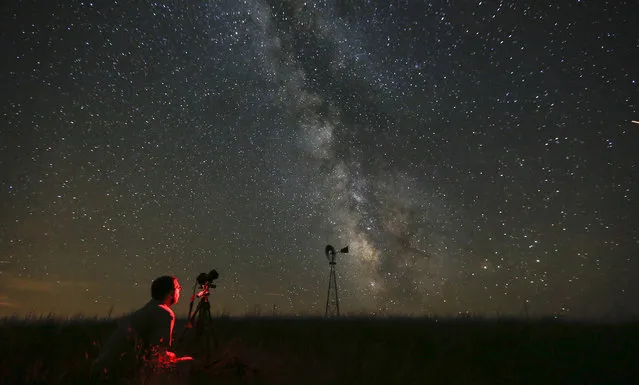
In this Wednesday, July 23, 2014 file photo, Omaha photographer Lane Hickenbottom photographs the night sky in a pasture near Callaway, Neb. With no moon in the sky, the Milky Way was visible to the naked eye. More than one-third of the world’s population can no longer see the Milky Way because of man-made lights, according to a scientific paper by Light Pollution Science and Technology Institute's Fabio Falchi and his team members, published on Friday, June 10, 2016. (Photo by Travis Heying/The Wichita Eagle via AP Photo)

In this Wednesday, July 23, 2014 file photo, Omaha photographer Lane Hickenbottom photographs the night sky in a pasture near Callaway, Neb. With no moon in the sky, the Milky Way was visible to the naked eye. More than one-third of the world’s population can no longer see the Milky Way because of man-made lights, according to a scientific paper by Light Pollution Science and Technology Institute's Fabio Falchi and his team members, published on Friday, June 10, 2016. (Photo by Travis Heying/The Wichita Eagle via AP Photo)
Details
11 Jun 2016 12:37:00