Loading...
Done
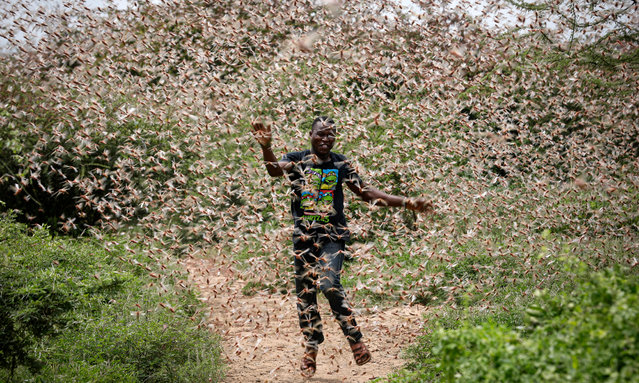
A local farmer Theophilus Mwendwa runs through a swarm of desert locusts to chase them away in the bush near Enziu, Kitui County, some 200km east of the capital Nairobi, Kenya, 24 January 2020. Large swarms of desert locusts have been invading Kenya for weeks, after having infested some 70 thousand hectares of land in Somalia which the United Nations Food and Agriculture Organisation (FAO) has termed the “worst situation in 25 years” in the Horn of Africa. FAO cautioned that it poses an “unprecedented threat” to food security and livelihoods in the region. (Photo by Dai Kurokawa/EPA/EFE)

A local farmer Theophilus Mwendwa runs through a swarm of desert locusts to chase them away in the bush near Enziu, Kitui County, some 200km east of the capital Nairobi, Kenya, 24 January 2020. Large swarms of desert locusts have been invading Kenya for weeks, after having infested some 70 thousand hectares of land in Somalia which the United Nations Food and Agriculture Organisation (FAO) has termed the “worst situation in 25 years” in the Horn of Africa. FAO cautioned that it poses an “unprecedented threat” to food security and livelihoods in the region. (Photo by Dai Kurokawa/EPA/EFE)
Details
22 Feb 2020 00:01:00
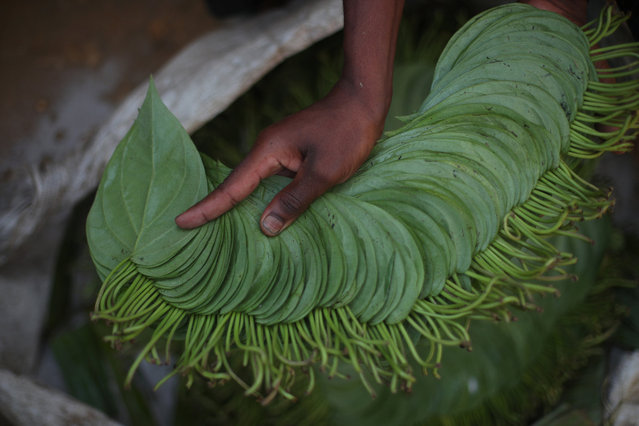
Faruk, 17, a Rohingya refugee trader holds betel leaves which are on sale at a stall in Palong Khali refugee camp near Cox's Bazar, Bangladesh, November 3, 2017. He left his village in Myanmar when the military opened fire towards the Rohingya. “I buy this betel leaf from Palong Khali market, in one bundle there are 160 pieces, I buy it for 80 taka and I sell it for 100 taka. Bangladeshi's and I sell for the same rate in the camp. Outside in the local market it is 80 taka per bundle. My problem is that I don't have money so I can't buy anything to eat, I can't buy fish to eat”, he said. (Photo by Hannah McKay/Reuters)

Faruk, 17, a Rohingya refugee trader holds betel leaves which are on sale at a stall in Palong Khali refugee camp near Cox's Bazar, Bangladesh, November 3, 2017. He left his village in Myanmar when the military opened fire towards the Rohingya. “I buy this betel leaf from Palong Khali market, in one bundle there are 160 pieces, I buy it for 80 taka and I sell it for 100 taka (1 Bangladeshi Taka = 0.012 US Dollar). Bangladeshi's and I sell for the same rate in the camp. Outside in the local market it is 80 taka per bundle. My problem is that I don't have money so I can't buy anything to eat, I can't buy fish to eat”, he said. (Photo by Hannah McKay/Reuters)
Details
27 Nov 2017 08:54:00
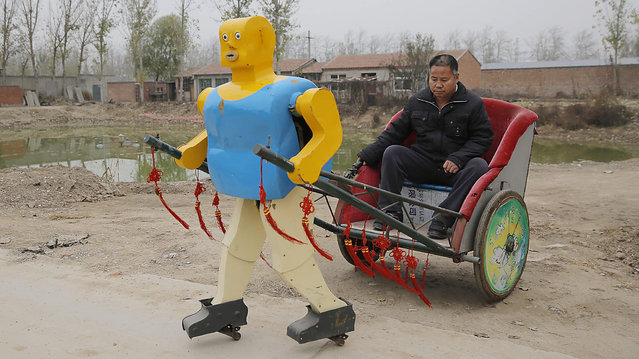
Robot inventor Wu Yulu sits on a rickshaw driven by a robot which he invented in his village in rural Beijing's Tongzhou district, China, 17 November 2016. The 54-year-old Chinese farmer living in rural Beijing's Tongzhou district invented 63 robots in the past 30 years. Wu, who only received primary school education, plans to give up the agricultural work for his robot products. He regularly participates in exhibitions, transfers patent rights and teaches at the university to earn money. (Photo by Wu Hong/EPA)

Robot inventor Wu Yulu sits on a rickshaw driven by a robot which he invented in his village in rural Beijing's Tongzhou district, China, 17 November 2016. The 54-year-old Chinese farmer living in rural Beijing's Tongzhou district invented 63 robots in the past 30 years. Wu, who only received primary school education, plans to give up the agricultural work for his robot products. He regularly participates in exhibitions, transfers patent rights and teaches at the university to earn money. (Photo by Wu Hong/EPA)
Details
21 Nov 2016 10:41:00
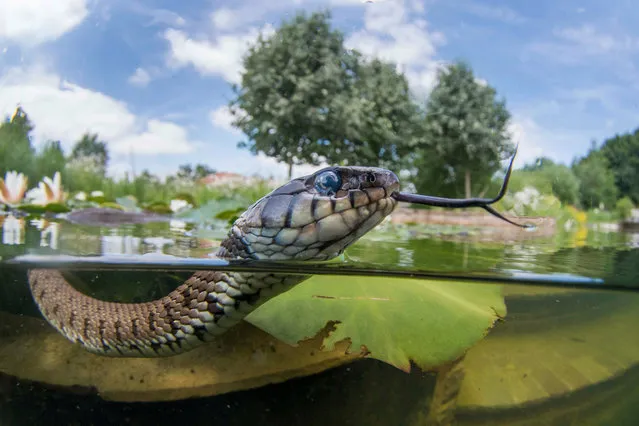
British Waters Wide Angle category runner-up. Grass snake swimming along a garden pond by Jack Perks (UK)in Nottinghamshire, UK. “I’m always on the lookout for unusual freshwater subjects and grass snakes are a species I’ve been after for years. I was told about a pond where the odd grass snake hangs around the lilly pads for frogs. I put my drysuit on and got into the water and could see one slithering along the surface. Slowly making my way towards it with my head only just poking above I got the spilt shot”. (Photo by Jack Perks/Underwater Photographer of the Year 2019)

British Waters Wide Angle category runner-up. Grass snake swimming along a garden pond by Jack Perks (UK)in Nottinghamshire, UK. “I’m always on the lookout for unusual freshwater subjects and grass snakes are a species I’ve been after for years. I was told about a pond where the odd grass snake hangs around the lilly pads for frogs. I put my drysuit on and got into the water and could see one slithering along the surface. Slowly making my way towards it with my head only just poking above I got the spilt shot”. (Photo by Jack Perks/Underwater Photographer of the Year 2019)
Details
28 Feb 2019 00:03:00
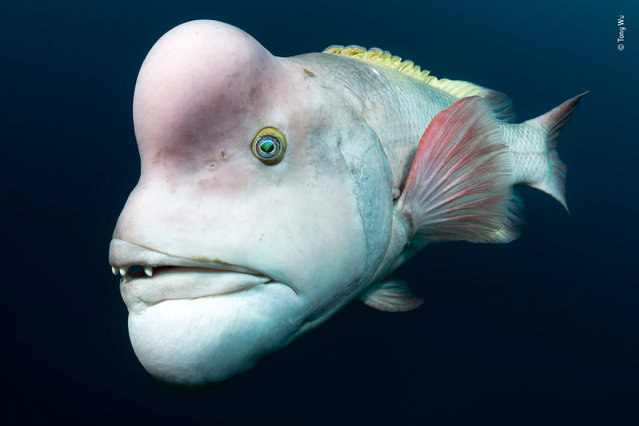
Looking for love by Tony Wu, USA. Highly commended, Animal Portraits. “Accentuating his mature appearance with pastel colours, protruding lips and an outstanding pink forehead, this Asian sheepshead wrasse sets out to impress females and see off rivals, which he will head-butt and bite, near Japan’s remote Sado Island. Individuals start out as females, and when they reach a certain age and size – up to a metre (more than 3 feet) long – can transform into males. Long-lived and slow-growing, the species is intrinsically vulnerable to overfishing”. (Photo by Tony Wu/2018 Wildlife Photographer of the Year)

Looking for love by Tony Wu, USA. Highly commended, Animal Portraits. “Accentuating his mature appearance with pastel colours, protruding lips and an outstanding pink forehead, this Asian sheepshead wrasse sets out to impress females and see off rivals, which he will head-butt and bite, near Japan’s remote Sado Island. Individuals start out as females, and when they reach a certain age and size – up to a metre (more than 3 feet) long – can transform into males. Long-lived and slow-growing, the species is intrinsically vulnerable to overfishing”. (Photo by Tony Wu/2018 Wildlife Photographer of the Year)
Details
03 Sep 2018 08:17:00
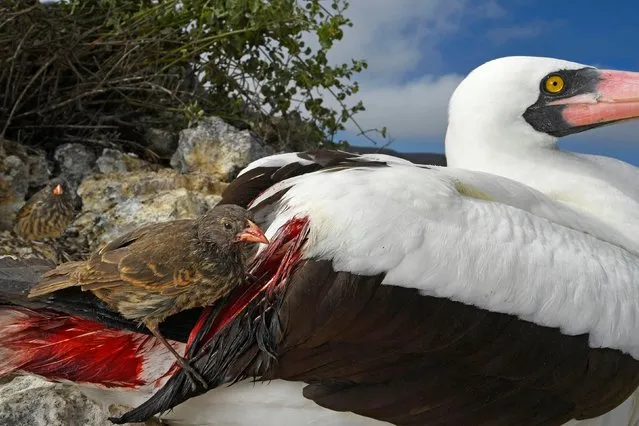
Bloodthirsty by Thomas P Peschak, Germany/South Africa — winner, Behaviour: birds. When rations run short on Wolf Island, in the remote northern Galápagos, the sharp-beaked ground finches become vampires. Their sitting targets are Nazca boobies and other large birds. The finches rely on a scant diet of seeds and insects, which regularly dries up, so they drink blood to survive. ‘I’ve seen more than half a dozen finches drinking from a single Nazca booby,’ says Tom. Rather than leave their nests the boobies tolerate the vampires, and the blood loss doesn’t seem to cause permanent harm. (Photo by Thomas P Peschak/2018 Wildlife Photographer of the Year)

Bloodthirsty by Thomas P. Peschak, Germany/South Africa — winner, Behaviour: birds. When rations run short on Wolf Island, in the remote northern Galápagos, the sharp-beaked ground finches become vampires. Their sitting targets are Nazca boobies and other large birds. The finches rely on a scant diet of seeds and insects, which regularly dries up, so they drink blood to survive. ‘I’ve seen more than half a dozen finches drinking from a single Nazca booby,’ says Tom. Rather than leave their nests the boobies tolerate the vampires, and the blood loss doesn’t seem to cause permanent harm. (Photo by Thomas P. Peschak/2018 Wildlife Photographer of the Year)
Details
19 Oct 2018 00:05:00
A young girl plays on the glass bottom platform of the Oriental Pear TV Tower as she travels with her family on the second day of the Chinese Lunar New Year holiday, also known as Spring Festival, in Shanghai, China on February 18, 2018. Some 287 million tourists travelled in China during the first four days of the week-long Chinese Lunar New Year holiday, up 11.1 percent from the same period last year, new data showed Sunday (18 February 2018). Tourism revenue rose 11.6 percent to 352.7 billion yuan (55.61 billion U.S. dollars) in the four days, the China National Tourism Administration (CNTA) said. On Sunday alone, some 73 million tourist trips were made across the country, up 15.3 percent, while tourism revenue rose 16.6 percent to 94.4 billion yuan. (Photo by Imaginechina/Rex Features/Shutterstock)

A young girl plays on the glass bottom platform of the Oriental Pear TV Tower as she travels with her family on the second day of the Chinese Lunar New Year holiday, also known as Spring Festival, in Shanghai, China on February 18, 2018. Some 287 million tourists travelled in China during the first four days of the week-long Chinese Lunar New Year holiday, up 11.1 percent from the same period last year, new data showed Sunday. (Photo by Imaginechina/Rex Features/Shutterstock)
Details
21 Feb 2018 00:03:00
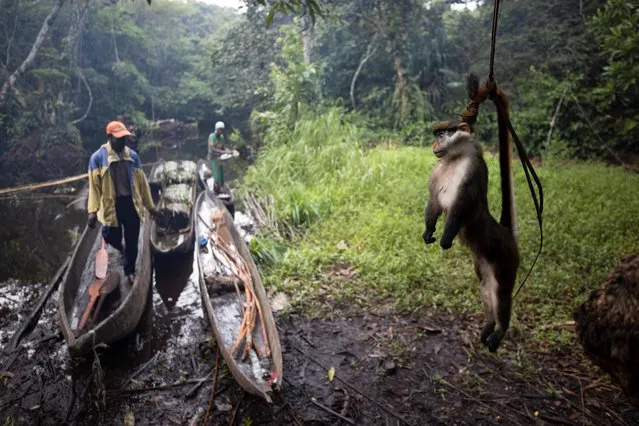
A dead red-tailed monkey hangs by its tail above the ground, in order to keep it away from ants, in the forest near the city of Mbandaka, Democratic Republic of the Congo, April 5, 2019. Bushmeat hunters are emptying Central Africa's forests at a high rate, researchers say. A growing appetite for wild meat in cities has ramped up the scale of hunting. Research shows around 6 million tonnes of bushmeat are sourced annually from the Congo Basin, whose forest spans across six countries and is second in size only to the Amazon. (Photo by Thomas Nicolon/Reuters)

A dead red-tailed monkey hangs by its tail above the ground, in order to keep it away from ants, in the forest near the city of Mbandaka, Democratic Republic of the Congo, April 5, 2019. Bushmeat hunters are emptying Central Africa's forests at a high rate, researchers say. A growing appetite for wild meat in cities has ramped up the scale of hunting. Research shows around 6 million tonnes of bushmeat are sourced annually from the Congo Basin, whose forest spans across six countries and is second in size only to the Amazon. (Photo by Thomas Nicolon/Reuters)
Details
14 Oct 2019 00:03:00