Loading...
Done
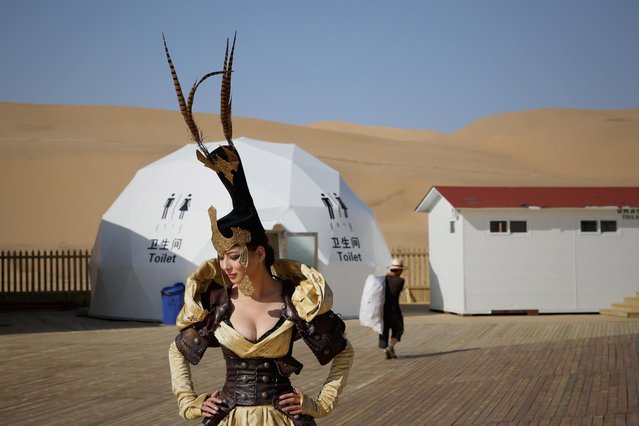
A model in Mongolia costumes prepares backstage in Xiangshawan Desert, also called Sounding Sand Desert on July 18, 2013 in Ordos of Inner Mongolia Autonomous Region, China. Xiangshawan is China's famous tourist resort in the desert. It is located along the middle section of Kubuqi Desert on the south tip of Dalate League under Ordos City. Sliding down from the 110-metre-high, 45-degree sand hill, running a course of 200 metres, the sands produce the sound of automobile engines, a natural phenomenon that nobody can explain. (Photo by Feng Li/Getty Images)

A model in Mongolia costumes prepares backstage in Xiangshawan Desert, also called Sounding Sand Desert on July 18, 2013 in Ordos of Inner Mongolia Autonomous Region, China. Xiangshawan is China's famous tourist resort in the desert. It is located along the middle section of Kubuqi Desert on the south tip of Dalate League under Ordos City. Sliding down from the 110-metre-high, 45-degree sand hill, running a course of 200 metres, the sands produce the sound of automobile engines, a natural phenomenon that nobody can explain. (Photo by Feng Li)
Details
26 Aug 2013 08:43:00
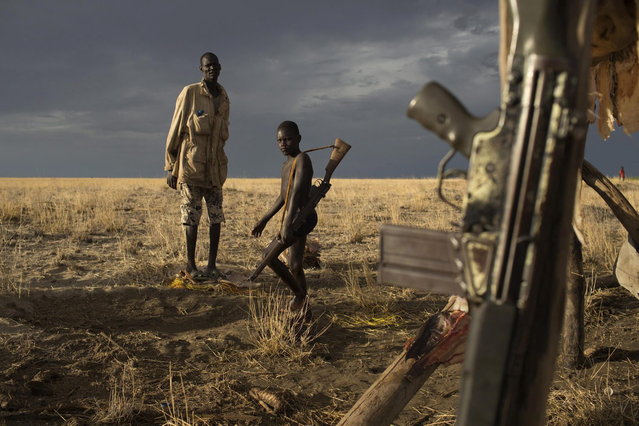
A Turkana man and a boy carrying a gun look on as a G3 battle rifle hangs from a structure used to dry fish at a fishing camp on the shores of Lake Turkana, some kilometres from Todonyang near the Kenya-Ethiopia border in northwestern Kenya October 12, 2013. (Photo by Siegfried Modola/Reuters)

A Turkana man and a boy carrying a gun look on as a G3 battle rifle hangs from a structure used to dry fish at a fishing camp on the shores of Lake Turkana, some kilometres from Todonyang near the Kenya-Ethiopia border in northwestern Kenya October 12, 2013The Turkana are traditionally nomadic pastoralists, but they have seen the pasture that they need to feed their herds suffer from recurring droughts and many have turned to fishing. However, Lake Turkana is overfished, and scarcity of food and pastureland is fuelling long-standing conflict with Ethiopian indigenous Dhaasanac, who have seen grazing grounds squeezed by large-scale government agricultural schemes in southern Ethiopia. The Dhaasanac now venture ever deeper into Kenyan territory in search of fish and grass, clashing with neighbours. Fighting between the communities has a long history, but the conflict has become ever more fatal as automatic weapons from other regional conflicts seep into the area. While the Turkana region is short of basics like grass and ground-water, it contains other resources including oil reserves and massive, newly discovered underground aquifers. (Photo by Siegfried Modola/Reuters)
Details
05 Dec 2013 12:08:00
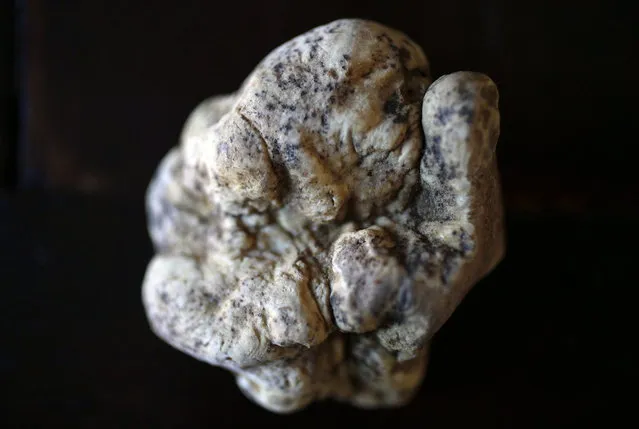
A truffle is seen on a table in Alba, north-western Italy November 11, 2013. Located in the heart of the Langhe – the hilly southern area of Italy's northwestern Piedmont region – Alba is the country's capital of white truffles, a variety of the prized fungus which grows underground. Truffles are found two to eight inches (5-20cm) below the ground near the roots of trees. (Photo by Stefano Rellandini/Reuters)

A truffle is seen on a table in Alba, north-western Italy November 11, 2013. Located in the heart of the Langhe – the hilly southern area of Italy's northwestern Piedmont region – Alba is the country's capital of white truffles, a variety of the prized fungus which grows underground. Truffles are found two to eight inches (5-20cm) below the ground near the roots of trees. They give off an odour which lasts for a limited period of time and can be detected with the assistance of well-trained dogs and experienced hunters. Output of white truffles, which are not cultivated and only grow naturally in forests, has fallen in Italy over the past few years, largely because climate change has brought a damaging mix of drought and torrential rains. (Photo by Stefano Rellandini/Reuters)
Details
31 Dec 2013 11:22:00
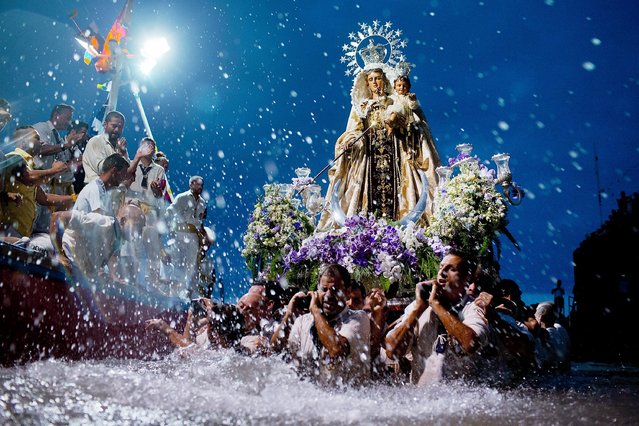
Carriers of the Great God Power brotherhood unload Virgen del Carmen statue after its journey on July 15, 2014 at Puerto de la Cruz dock on the Canary island of Tenerife, Spain. Since 1921, the statue of the Virgen del Carmen, patron saint of fishermen, has been carried with great fanfare annually as part of July Festivities to the Puerto de la Cruz dock where, at the end of its procession, it is hoisted aboard a decorated boat. (Photo by Gonzalo Arroyo Moreno/Getty Images)

Carriers of the Great God Power brotherhood unload Virgen del Carmen statue after its journey on July 15, 2014 at Puerto de la Cruz dock on the Canary island of Tenerife, Spain. Since 1921, the statue of the Virgen del Carmen, patron saint of fishermen, has been carried with great fanfare annually as part of July Festivities to the Puerto de la Cruz dock where, at the end of its procession, it is hoisted aboard a decorated boat. Weather permitting, the boat carrying the statue, accompanied by a flotilla of other boats, makes a short journey along the island coast before returning to the harbour. In recent years, attendance at the event has numbered more than 35,000 people. (Photo by Gonzalo Arroyo Moreno/Getty Images)
Details
21 Jul 2014 11:18:00
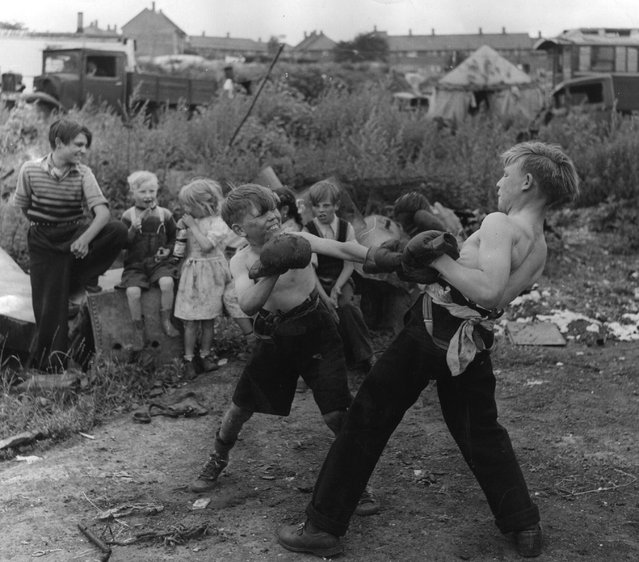
The unromantic gypsies. Children boxing in a gypsy camp in Kent, England on July 1, 1951. Like all boys these gypsy lads like to try their hand at boxing. Encouraged by their friends they fight it out on Corke's Meadow. Few Romanies now live a life of wandering romance. Most are like the three hundred squatters of Corke's Meadow, Kent, which is part of a “gypsy problem” that involves about 100,000 today. Of those about 25,000 can be rightly called gypsies, the rest are Mumpers and Posh-rats and Hobos. Corke's Meadow has both kinds. “Picture Post” cameraman Bert Hardy photographs the Corke's Meadow gypsies in their encampment. (Photo by Hulton-Deutsch Collection/Corbis via Getty Images)

The unromantic gypsies. Children boxing in a gypsy camp in Kent, England on July 1, 1951. Like all boys these gypsy lads like to try their hand at boxing. Encouraged by their friends they fight it out on Corke's Meadow. Few Romanies now live a life of wandering romance. Most are like the three hundred squatters of Corke's Meadow, Kent, which is part of a “gypsy problem” that involves about 100,000 today. Of those about 25,000 can be rightly called gypsies, the rest are Mumpers and Posh-rats and Hobos. Corke's Meadow has both kinds. “Picture Post” cameraman Bert Hardy photographs the Corke's Meadow gypsies in their encampment. (Photo by Hulton-Deutsch Collection/Corbis via Getty Images)
Details
12 Mar 2017 00:01:00
Festival goer with phallus logo t-shirt during the Kanamara Matsuri Steel Phallus Festival at Kawasaki, Japan on April 2, 2017. The Kanamara Matsuri or Festival of the Steel Phallus is held on the first Sunday of April at the Kanayama shrine. The shrine celebrates a legend of a steel pen*s and was frequented by prostitutes who wished to pray for protection from sexually transmitted diseases. Visitors now wish for easy delivery, marriage and matrimonial harmony. Because of the large steel phallus the unusual festival has become a tourist attraction attracting many overseas visitors and is used to raise money for HIV charities. Phallus shaped candy, carved vegetables, decorations, and a big parade are all part of the festival. (Photo by DELETREE/SIPA Press/Rex Features/Shutterstock)

Festival goer with phallus logo t-shirt during the Kanamara Matsuri Steel Phallus Festival at Kawasaki, Japan on April 2, 2017. The Kanamara Matsuri or Festival of the Steel Phallus is held on the first Sunday of April at the Kanayama shrine. The shrine celebrates a legend of a steel pen*s and was frequented by prostitutes who wished to pray for protection from sexually transmitted diseases. Visitors now wish for easy delivery, marriage and matrimonial harmony. Because of the large steel phallus the unusual festival has become a tourist attraction attracting many overseas visitors and is used to raise money for HIV charities. Phallus shaped candy, carved vegetables, decorations, and a big parade are all part of the festival. (Photo by DELETREE/SIPA Press/Rex Features/Shutterstock)
Details
04 Apr 2017 09:48:00
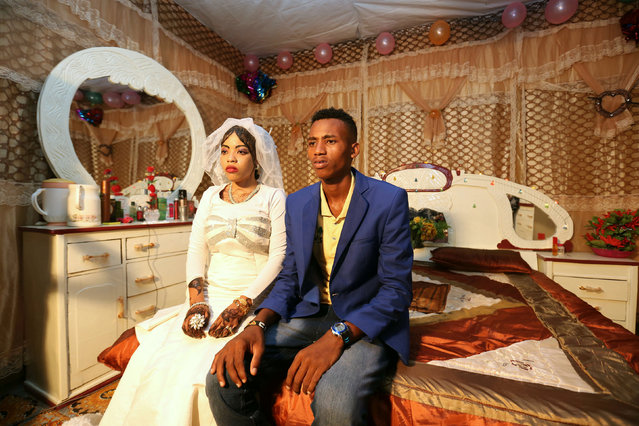
Somali couple Mohamed Noor (L) and Huda Omar pose for a photograph at their makeshift home during their wedding ceremony in Mogadishu's Rajo camp, Somalia August 17, 2016. Having met two years ago, the pair have just married at Rajo camp, where some 400 families live. Most, like Noor's parents, came here in the early 1990s to flee famine. They stayed on as years of conflict ravaged the Horn of Africa nation. As at any wedding, there is plenty of dancing and sweet treats for the young couple as they start married life in Noor's simple home, made of iron and plastic sheets. Noor works as a mason with his father. Others here are builders or sell sweets, nuts and stick toothbrushes to make money. Some beg around the seaside city, which like the rest of Somalia has been gripped by violence since the toppling of dictator Mohamed Siad Barre in 1991. (Photo by Feisal Omar/Reuters)

Somali couple Mohamed Noor (L) and Huda Omar pose for a photograph at their makeshift home during their wedding ceremony in Mogadishu's Rajo camp, Somalia August 17, 2016. Having met two years ago, the pair have just married at Rajo camp, where some 400 families live. Most, like Noor's parents, came here in the early 1990s to flee famine. (Photo by Feisal Omar/Reuters)
Details
14 Sep 2016 10:35:00
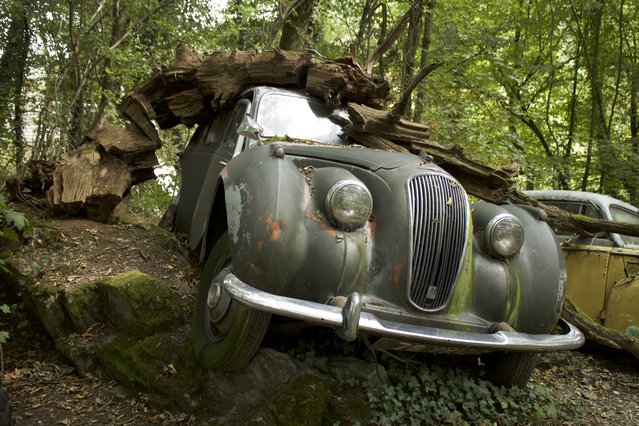
Michael Fröhlich's Jowett Javelin rotting car in his forest sculpture park in Neandertal Germany, September 11, 2016. An eccentric artist has collected fifty vintage cars and left them to rot in a forest – and now they're worth over $1 million. Former racing driver Michael Fröhlich, from Dusseldorf, Germany, has purposely crashed the cars into trees, buried them in mud and parked them on cliff faces in his estate's garden in the middle of the German Neanderthal. His collections includes a Jaguar XK120 worth $170,000, a Porsche 356 racer and a Buick worth $17,000. Perhaps his most interesting collectable is a Rolls Royce, with a purposefully misspelt “Buckingham Palace” – replacing the B with an F – emblazoned on the side with a replica of the Queen Elizabeth at the wheel. (Photo by Christoph Hagen/Barcroft Images)

Michael Fröhlich's Jowett Javelin rotting car in his forest sculpture park in Neandertal Germany, September 11, 2016. An eccentric artist has collected fifty vintage cars and left them to rot in a forest – and now they're worth over $1 million. Former racing driver Michael Fröhlich, from Dusseldorf, Germany, has purposely crashed the cars into trees, buried them in mud and parked them on cliff faces in his estate's garden in the middle of the German Neanderthal. His collections includes a Jaguar XK120 worth $170,000, a Porsche 356 racer and a Buick worth $17,000. (Photo by Christoph Hagen/Barcroft Images)
Details
24 Sep 2016 10:56:00