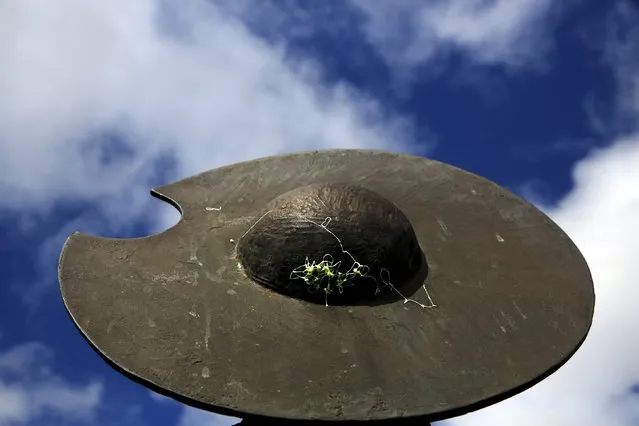
A sculpture of Don Quixote shows him wearing the basin he mistook for the enchanted helmet of the fictional Moorish king Mambrino in Alcazar de San Juan, Spain, April 5, 2016. The arid central Spanish region of La Mancha is the setting for “Don Quixote”, the seventeenth-century novel by Miguel de Cervantes. Four hundred years after his death, references to the characters of Don Quixote, his loyal squire Sancho Panza and his beautiful lady Dulcinea abound in the surrounding villages from sweet treats to theatre productions involving livestock. Cervantes did not give away the name of the birthplace of Don Quixote, a middle-aged gentleman who becomes obsessed with chivalrous ideals. But many identify the village of Argamasilla de Alba as his hometown. The anniversary of Cervantes’ death is marked on the 23 April. (Photo by Susana Vera/Reuters)
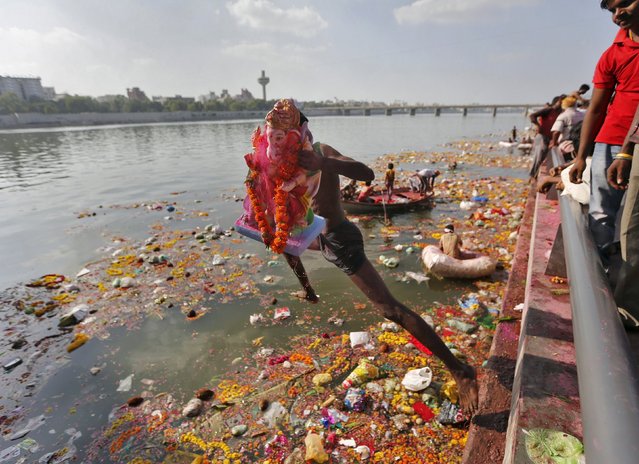
A devotee carrying an idol of the Hindu god Ganesh, the deity of prosperity, jumps into the Sabarmati river to immerse the idol on the last day of the 10-day-long Ganesh Chaturthi festival in Ahmedabad, India, September 27, 2015. (Photo by Amit Dave/Reuters)
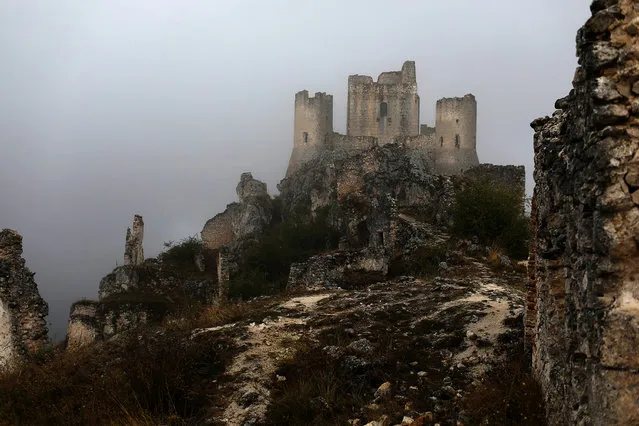
The ruins of a castle stand above the town of Rocca Calascio, close to Santo Stefano di Sessanio in the province of L'Aquila in Abruzzo, inside the national park of the Gran Sasso e Monti della Laga, Italy, September 7, 2016. (Photo by Siegfried Modola/Reuters)
India's Border Security Force (BSF) “Daredevils” motorcycle riders perform during a rehearsal for the Republic Day parade on a foggy winter morning in New Delhi January 8, 2015. India will celebrate its annual Republic Day on January 26. (Photo by Ahmad Masood/Reuters)
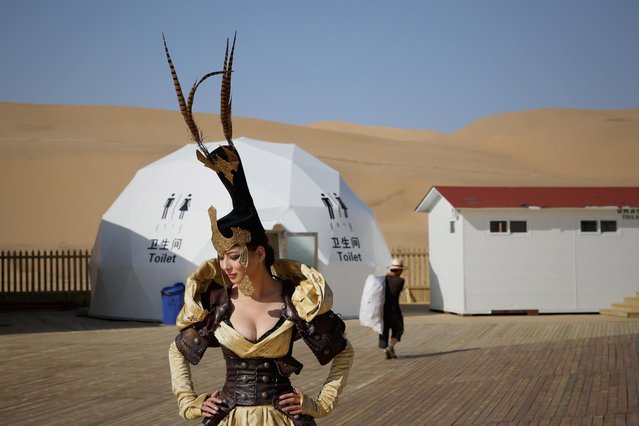
A model in Mongolia costumes prepares backstage in Xiangshawan Desert, also called Sounding Sand Desert on July 18, 2013 in Ordos of Inner Mongolia Autonomous Region, China. Xiangshawan is China's famous tourist resort in the desert. It is located along the middle section of Kubuqi Desert on the south tip of Dalate League under Ordos City. Sliding down from the 110-metre-high, 45-degree sand hill, running a course of 200 metres, the sands produce the sound of automobile engines, a natural phenomenon that nobody can explain. (Photo by Feng Li)
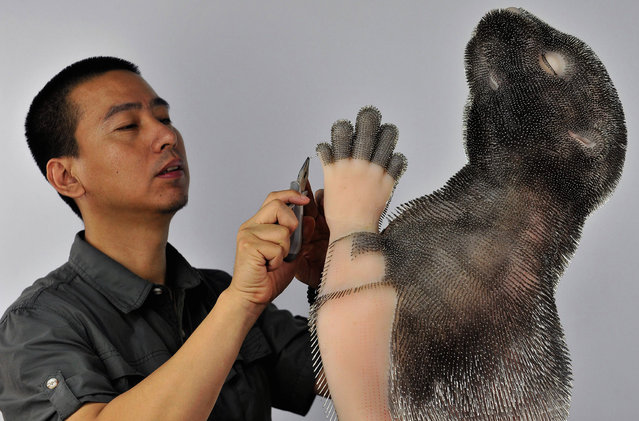
Professor Xie Yong works on an art installation of a beaver, which is made out of plastic and around 300,000 needles, in Shenyang, Liaoning province, July 23, 2013. The needles, according to Xie, represent the pain felt by animals when their fur is taken off to produce clothing. (Photo by Reuters/Stringer)