Loading...
Done
A Hawker Hurricane Mk XIIa 5711 (G-HURI) fighter aircraft prepares to perform an aerobatic display at the IWM Duxford on October 18, 2012 in Duxford, England. The aeroplane, similar to those that defended British shores during the Battle of Britain in World War II, is due to be auctioned by Bonhams in their sale of “Collectors' Motor Cars and Automobilia” at Mercedes-Benz World Brooklands on December 3, 2012. The plane was built in 1942 and joined the Royal Canadian Air Force the following year, where it remained for the duration of the war, it is expected to fetch up to 17 million GBP.  (Photo by Oli Scarff)

A Hawker Hurricane Mk XIIa 5711 (G-HURI) fighter aircraft prepares to perform an aerobatic display at the IWM Duxford on October 18, 2012 in Duxford, England. The aeroplane, similar to those that defended British shores during the Battle of Britain in World War II, is due to be auctioned by Bonhams in their sale of “Collectors' Motor Cars and Automobilia” at Mercedes-Benz World Brooklands on December 3, 2012. The plane was built in 1942 and joined the Royal Canadian Air Force the following year, where it remained for the duration of the war, it is expected to fetch up to 17 million GBP. (Photo by Oli Scarff)
Details
20 Oct 2012 09:11:00
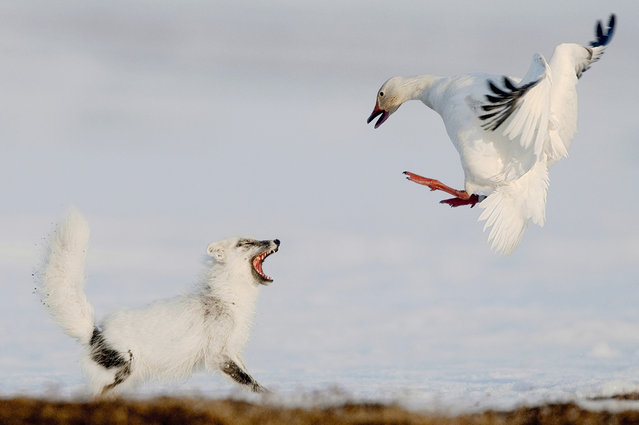
Commended. In late May, about a quarter of a million snow geese arrive from North America to nest on Wrangel Island, in northeastern Russia. They form the world's largest breeding colony of snow geese. Photographer Sergey Gorshkov spent two months on the remote island photographing the unfolding dramas. (Photo by Sergey Gorshkov/Veolia Environnement Wildlife Photographer)

Commended. In late May, about a quarter of a million snow geese arrive from North America to nest on Wrangel Island, in northeastern Russia. They form the world's largest breeding colony of snow geese. Photographer Sergey Gorshkov spent two months on the remote island photographing the unfolding dramas. Arctic foxes take advantage of the abundance of eggs, caching surplus eggs for leaner times. But a goose (here the gander) is easily a match for a fox, which must rely on speed and guile to steal eggs. “The battles were fairly equal”, notes Sergey, “and I only saw a fox succeed in grabbing an egg on a couple of occasions, despite many attempts”. Surprisingly, “the geese lacked any sense of community spirit”, he adds, “and never reacted when a fox harassed a neighboring pair nesting close by”. (Photo by Sergey Gorshkov/Veolia Environnement Wildlife Photographer)
Details
16 Jun 2015 12:30:00


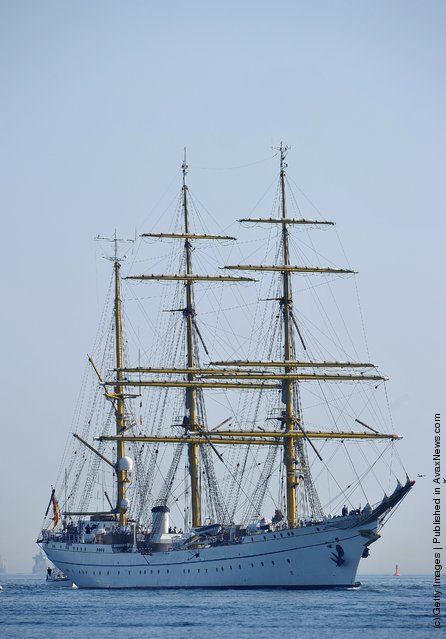
“The Gorch Fock is a tall ship of the German Navy (Deutsche Marine). She is the second ship of that name and a sister ship of the Gorch Fock built in 1933. Both ships are named in honor of the German writer Johann Kinau who wrote under the pseudonym "Gorch Fock" and died in the battle of Jutland/Skagerrak in 1916. The modern-day Gorch Fock was built in 1958 and has since then undertaken 146 cruises (as of October 2006), including one tour around the world in 1988. She is sometimes referred to (unofficially) as the Gorch Fock II to distinguish her from her older sister ship”. – Wikipedia

Photo: The “Gorch Fock” German Navy tall ship sails towards Kiel on May 6, 2011 in Kiel, Germany. The ship returns to Germany following investigations in January while it was in port in Ushuia, Argentina, into allegations of attempted mutiny following the death of a female crew member. German Defense Minister at the time Karl-Theodor zu Guttenberg suspended Captain Norbert Schatz, and though investigators absolved Schatz of wrongdoing, critics charge the investigation was inadequate. The "Gorch Fock" is the German Navy's flagship training vessel. (Photo by Stuart Franklin/Getty Images)
Details
06 May 2011 11:38:00


“The Trabant is a car that was produced by former East German auto maker VEB Sachsenring Automobilwerke Zwickau in Zwickau, Sachsen. It was the most common vehicle in East Germany, and was also exported to countries both inside and outside the communist bloc. The main selling points was that it had room for four adults and luggage in a compact, light and durable shell and that it was fast (when introduced) and durable. With its mediocre performance, smoky two-stroke engine, and production shortages, the Trabant is often cited as an example of the disadvantages of centralized planning; on the other hand, it is regarded with derisive affection as a symbol of the failed former East Germany and of the fall of communism (in former West Germany, as many East Germans streamed into West Berlin and West Germany in their Trabants after the opening of the Berlin Wall in 1989). It was in production without any significant changes for nearly 30 years with 3,096,099 Trabants produced in total”. – Wikipedia

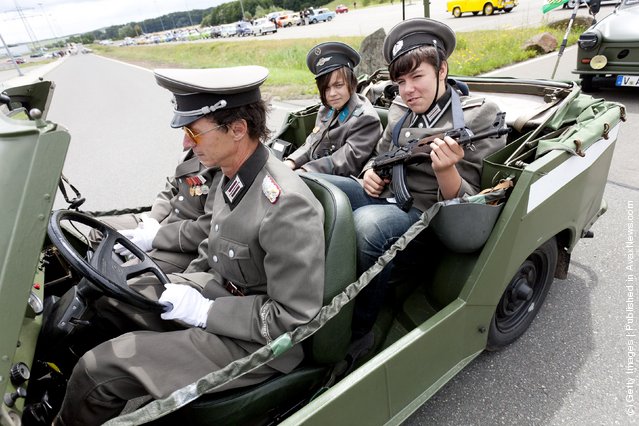
Photo: Enthusiasts weared in uniforms of the former eastern german army trive in a military Trabant car as fans and owners of East German-era Trabant cars gather at the 2011 International Trabantfahrer Treffen (International Trabant Drivers Meeting) on June 26, 2011 in Zwickau, Germany. The Trabant, also known as the Trabi, was among the main cars produced in communist East Germany and built by VEB Sachsenring Automobilwerke in Zwickau for 30 years until 1989. Today the car has cult status for many followers and one company, IndiKar, is even seeking to revive the brand in a modern, electric version. (Photo by Carsten Koall/Getty Images)

Details
27 Jun 2011 12:21:00
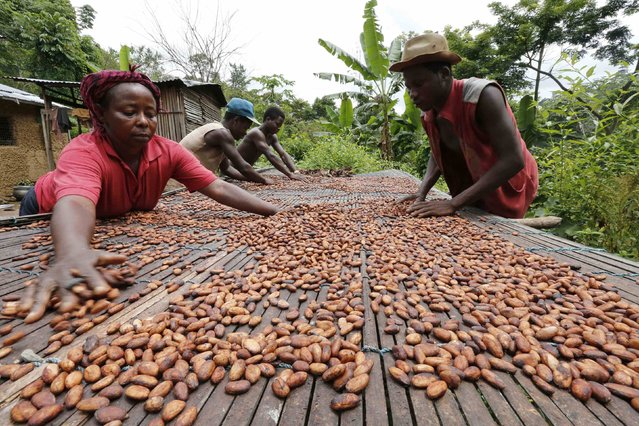
People work with cocoa beans in Enchi June 17, 2014. Picture taken June 17, 2014. Ghana emerged as a success story during the 2000s, when war, political instability and a disastrous liberalization brought Ivory Coast's cocoa sector to its knees. Ghana's output more than tripled from 340,000 tons in the 2001/02 season to a record 1,025,000 tons a decade later. Strict controls cemented its reputation as a producer of top quality beans, establishing a brand that fetches a premium. (Photo by Thierry Gouegnon/Reuters)

People work with cocoa beans in Enchi June 17, 2014. Picture taken June 17, 2014. Ghana emerged as a success story during the 2000s, when war, political instability and a disastrous liberalization brought Ivory Coast's cocoa sector to its knees. Ghana's output more than tripled from 340,000 tons in the 2001/02 season to a record 1,025,000 tons a decade later. Strict controls cemented its reputation as a producer of top quality beans, establishing a brand that fetches a premium. (Photo by Thierry Gouegnon/Reuters)
Details
03 Aug 2014 07:17:00
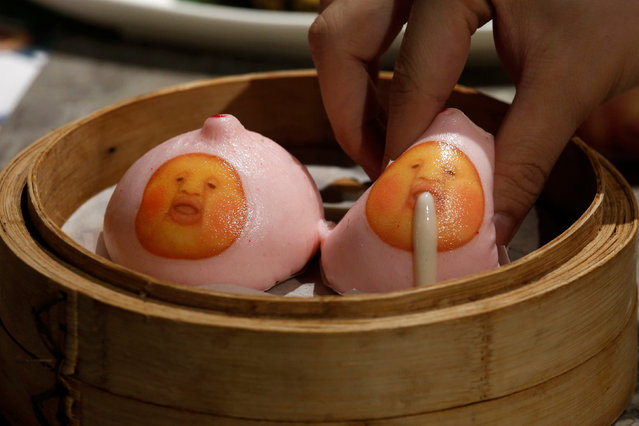
A milk custard bun made to resemble one of the popular Japanese “Kobitos” characters is squeezed during a display for the photographer at Dim Sum Icon restaurant in Hong Kong, China July 25, 2016. A dim sum restaurant in Hong Kong encourages diners to play with their food, and the result will either disgust or delight you. At Dim Sum Icon customers can squeeze a strange creature to poo or vomit on their plate before eating it. Hungry punters poke a hole into the mouth – or the rear – of the dim sum with a chopstick, squeeze it and watch the brown or white cream ooze out. (Photo by Bobby Yip/Reuters)

A milk custard bun made to resemble one of the popular Japanese “Kobitos” characters is squeezed during a display for the photographer at Dim Sum Icon restaurant in Hong Kong, China July 25, 2016. A dim sum restaurant in Hong Kong encourages diners to play with their food, and the result will either disgust or delight you. At Dim Sum Icon customers can squeeze a strange creature to poo or vomit on their plate before eating it. Hungry punters poke a hole into the mouth – or the rear – of the dim sum with a chopstick, squeeze it and watch the brown or white cream ooze out. The unique dim sums are made with a face to resemble Japanese Kobitos characters. (Photo by Bobby Yip/Reuters)
Details
31 Jul 2016 11:25:00
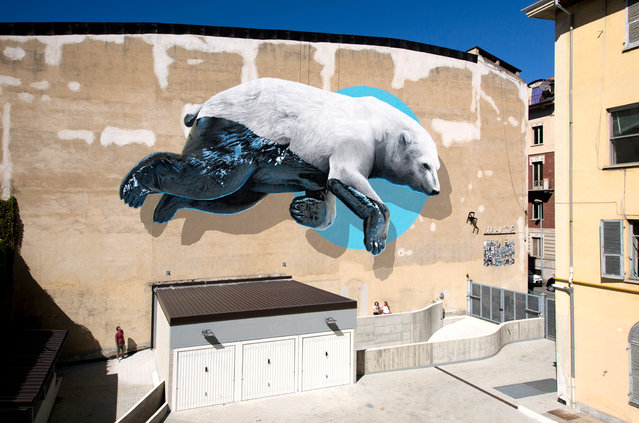
A polar bear whose bottom half is caked in oily black gunk. A whale wrapped in striped fabric: a pseudo straightjacket. These are the messes climate change leaves behind, the things we know are happening but often don’t have the opportunity to see with our own eyes. Swiss street art duo Christian Rebecchi and Pablo Togni, otherwise known as NeverCrew, met in art school when they were 15 and started making work together soon after. As a team, the artists adorn the world with eye-popping and gut-wrenching images depicting the consequences of humanity’s actions on earth. Here: “Black machine” mural painting and installation on the Colosseo theater in Turin, Italy, in September 2015. (Photo by NeverCrew/The Huffington Post)

A polar bear whose bottom half is caked in oily black gunk. A whale wrapped in striped fabric: a pseudo straightjacket. These are the messes climate change leaves behind, the things we know are happening but often don’t have the opportunity to see with our own eyes. Swiss street art duo Christian Rebecchi and Pablo Togni, otherwise known as NeverCrew, met in art school when they were 15 and started making work together soon after. As a team, the artists adorn the world with eye-popping and gut-wrenching images depicting the consequences of humanity’s actions on earth. (Photo by NeverCrew/The Huffington Post)
Details
13 Aug 2016 11:09:00
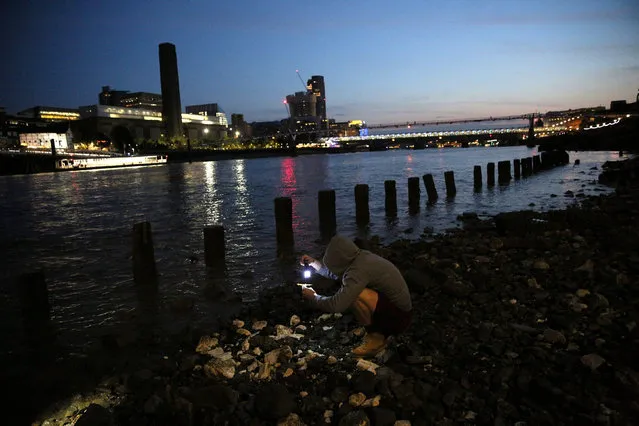
A mudlark uses a torch to look for items on the bank of the River Thames in London, Britain June 06, 2016. Mudlarking is believed to trace its origins to the 18th and 19th century, when scavengers searched the Thames' shores for items to sell. These days, history and archaeology fans are the ones hoping to find old relics such as coins, ceramics, artifacts or everyday items from across centuries. They wait for the low tide and then scour specific areas of exposed shores. "If you're in a field you could be out all day long, with the river you're restricted to about two or three hours," mudlark Nick Stevens said. While many just use the naked eye for their searches, others rely on metal detectors for which a permit from the Port of London Authority is needed. Digging also requires consent. (Photo by Neil Hall/Reuters)

A mudlark uses a torch to look for items on the bank of the River Thames in London, Britain June 06, 2016. Mudlarking is believed to trace its origins to the 18th and 19th century, when scavengers searched the Thames' shores for items to sell. These days, history and archaeology fans are the ones hoping to find old relics such as coins, ceramics, artifacts or everyday items from across centuries. their finds with the Portable Antiquities Scheme. Any item over 300 years old must be recorded. (Photo by Neil Hall/Reuters)
Details
27 Aug 2016 10:43:00