Loading...
Done
A young girl plays on the glass bottom platform of the Oriental Pear TV Tower as she travels with her family on the second day of the Chinese Lunar New Year holiday, also known as Spring Festival, in Shanghai, China on February 18, 2018. Some 287 million tourists travelled in China during the first four days of the week-long Chinese Lunar New Year holiday, up 11.1 percent from the same period last year, new data showed Sunday (18 February 2018). Tourism revenue rose 11.6 percent to 352.7 billion yuan (55.61 billion U.S. dollars) in the four days, the China National Tourism Administration (CNTA) said. On Sunday alone, some 73 million tourist trips were made across the country, up 15.3 percent, while tourism revenue rose 16.6 percent to 94.4 billion yuan. (Photo by Imaginechina/Rex Features/Shutterstock)

A young girl plays on the glass bottom platform of the Oriental Pear TV Tower as she travels with her family on the second day of the Chinese Lunar New Year holiday, also known as Spring Festival, in Shanghai, China on February 18, 2018. Some 287 million tourists travelled in China during the first four days of the week-long Chinese Lunar New Year holiday, up 11.1 percent from the same period last year, new data showed Sunday. (Photo by Imaginechina/Rex Features/Shutterstock)
Details
21 Feb 2018 00:03:00
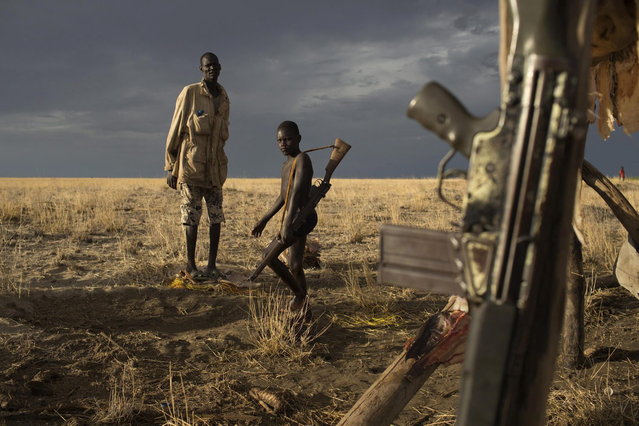
A Turkana man and a boy carrying a gun look on as a G3 battle rifle hangs from a structure used to dry fish at a fishing camp on the shores of Lake Turkana, some kilometres from Todonyang near the Kenya-Ethiopia border in northwestern Kenya October 12, 2013. (Photo by Siegfried Modola/Reuters)

A Turkana man and a boy carrying a gun look on as a G3 battle rifle hangs from a structure used to dry fish at a fishing camp on the shores of Lake Turkana, some kilometres from Todonyang near the Kenya-Ethiopia border in northwestern Kenya October 12, 2013The Turkana are traditionally nomadic pastoralists, but they have seen the pasture that they need to feed their herds suffer from recurring droughts and many have turned to fishing. However, Lake Turkana is overfished, and scarcity of food and pastureland is fuelling long-standing conflict with Ethiopian indigenous Dhaasanac, who have seen grazing grounds squeezed by large-scale government agricultural schemes in southern Ethiopia. The Dhaasanac now venture ever deeper into Kenyan territory in search of fish and grass, clashing with neighbours. Fighting between the communities has a long history, but the conflict has become ever more fatal as automatic weapons from other regional conflicts seep into the area. While the Turkana region is short of basics like grass and ground-water, it contains other resources including oil reserves and massive, newly discovered underground aquifers. (Photo by Siegfried Modola/Reuters)
Details
05 Dec 2013 12:08:00
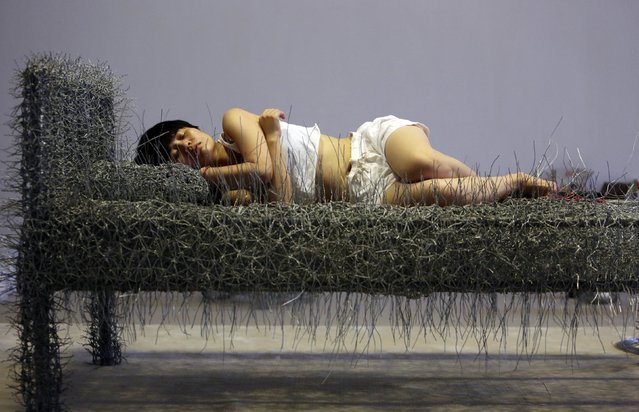
Chinese artist Zhou Jie takes a nap on an unfinished iron wire bed, one of her sculpture works, after lunch at Beijing Now Art Gallery, in Beijing August 11, 2014. Zhou started her art project titled “36 Days” on August 9, in which she would live inside an exhibition hall with an unfinished iron wire bed, some iron wire sculptures in the shape of stuffed animal dolls, a certain amount of food and her mobile phone, for 36 days. (Photo by Jason Lee/Reuters)

Chinese artist Zhou Jie takes a nap on an unfinished iron wire bed, one of her sculpture works, after lunch at Beijing Now Art Gallery, in Beijing August 11, 2014. Zhou started her art project titled “36 Days” on August 9, in which she would live inside an exhibition hall with an unfinished iron wire bed, some iron wire sculptures in the shape of stuffed animal dolls, a certain amount of food and her mobile phone, for 36 days. The entire process is open to visitors and she may also interact with them, according to Zhou. (Photo by Jason Lee/Reuters)
Details
22 Aug 2014 12:04:00
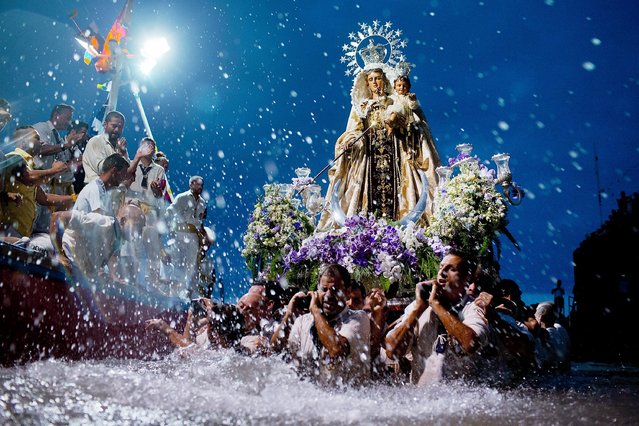
Carriers of the Great God Power brotherhood unload Virgen del Carmen statue after its journey on July 15, 2014 at Puerto de la Cruz dock on the Canary island of Tenerife, Spain. Since 1921, the statue of the Virgen del Carmen, patron saint of fishermen, has been carried with great fanfare annually as part of July Festivities to the Puerto de la Cruz dock where, at the end of its procession, it is hoisted aboard a decorated boat. (Photo by Gonzalo Arroyo Moreno/Getty Images)

Carriers of the Great God Power brotherhood unload Virgen del Carmen statue after its journey on July 15, 2014 at Puerto de la Cruz dock on the Canary island of Tenerife, Spain. Since 1921, the statue of the Virgen del Carmen, patron saint of fishermen, has been carried with great fanfare annually as part of July Festivities to the Puerto de la Cruz dock where, at the end of its procession, it is hoisted aboard a decorated boat. Weather permitting, the boat carrying the statue, accompanied by a flotilla of other boats, makes a short journey along the island coast before returning to the harbour. In recent years, attendance at the event has numbered more than 35,000 people. (Photo by Gonzalo Arroyo Moreno/Getty Images)
Details
21 Jul 2014 11:18:00
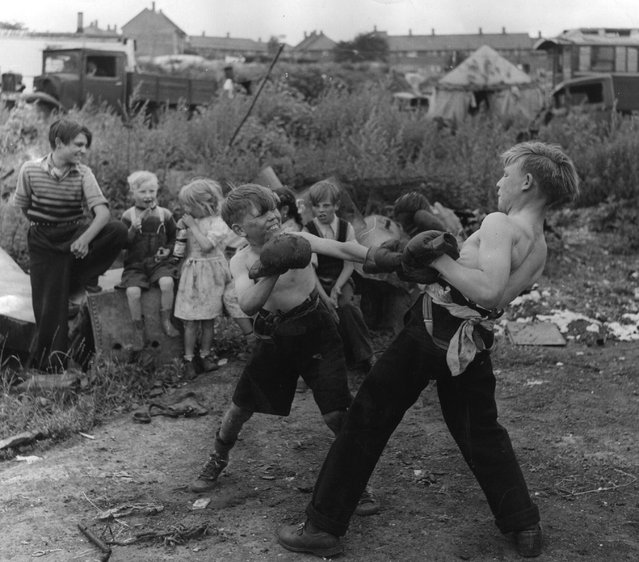
The unromantic gypsies. Children boxing in a gypsy camp in Kent, England on July 1, 1951. Like all boys these gypsy lads like to try their hand at boxing. Encouraged by their friends they fight it out on Corke's Meadow. Few Romanies now live a life of wandering romance. Most are like the three hundred squatters of Corke's Meadow, Kent, which is part of a “gypsy problem” that involves about 100,000 today. Of those about 25,000 can be rightly called gypsies, the rest are Mumpers and Posh-rats and Hobos. Corke's Meadow has both kinds. “Picture Post” cameraman Bert Hardy photographs the Corke's Meadow gypsies in their encampment. (Photo by Hulton-Deutsch Collection/Corbis via Getty Images)

The unromantic gypsies. Children boxing in a gypsy camp in Kent, England on July 1, 1951. Like all boys these gypsy lads like to try their hand at boxing. Encouraged by their friends they fight it out on Corke's Meadow. Few Romanies now live a life of wandering romance. Most are like the three hundred squatters of Corke's Meadow, Kent, which is part of a “gypsy problem” that involves about 100,000 today. Of those about 25,000 can be rightly called gypsies, the rest are Mumpers and Posh-rats and Hobos. Corke's Meadow has both kinds. “Picture Post” cameraman Bert Hardy photographs the Corke's Meadow gypsies in their encampment. (Photo by Hulton-Deutsch Collection/Corbis via Getty Images)
Details
12 Mar 2017 00:01:00
Festival goer with phallus logo t-shirt during the Kanamara Matsuri Steel Phallus Festival at Kawasaki, Japan on April 2, 2017. The Kanamara Matsuri or Festival of the Steel Phallus is held on the first Sunday of April at the Kanayama shrine. The shrine celebrates a legend of a steel pen*s and was frequented by prostitutes who wished to pray for protection from sexually transmitted diseases. Visitors now wish for easy delivery, marriage and matrimonial harmony. Because of the large steel phallus the unusual festival has become a tourist attraction attracting many overseas visitors and is used to raise money for HIV charities. Phallus shaped candy, carved vegetables, decorations, and a big parade are all part of the festival. (Photo by DELETREE/SIPA Press/Rex Features/Shutterstock)

Festival goer with phallus logo t-shirt during the Kanamara Matsuri Steel Phallus Festival at Kawasaki, Japan on April 2, 2017. The Kanamara Matsuri or Festival of the Steel Phallus is held on the first Sunday of April at the Kanayama shrine. The shrine celebrates a legend of a steel pen*s and was frequented by prostitutes who wished to pray for protection from sexually transmitted diseases. Visitors now wish for easy delivery, marriage and matrimonial harmony. Because of the large steel phallus the unusual festival has become a tourist attraction attracting many overseas visitors and is used to raise money for HIV charities. Phallus shaped candy, carved vegetables, decorations, and a big parade are all part of the festival. (Photo by DELETREE/SIPA Press/Rex Features/Shutterstock)
Details
04 Apr 2017 09:48:00
Somali couple Mohamed Noor (L) and Huda Omar pose for a photograph at their makeshift home during their wedding ceremony in Mogadishu's Rajo camp, Somalia August 17, 2016. Having met two years ago, the pair have just married at Rajo camp, where some 400 families live. Most, like Noor's parents, came here in the early 1990s to flee famine. They stayed on as years of conflict ravaged the Horn of Africa nation. As at any wedding, there is plenty of dancing and sweet treats for the young couple as they start married life in Noor's simple home, made of iron and plastic sheets. Noor works as a mason with his father. Others here are builders or sell sweets, nuts and stick toothbrushes to make money. Some beg around the seaside city, which like the rest of Somalia has been gripped by violence since the toppling of dictator Mohamed Siad Barre in 1991. (Photo by Feisal Omar/Reuters)

Somali couple Mohamed Noor (L) and Huda Omar pose for a photograph at their makeshift home during their wedding ceremony in Mogadishu's Rajo camp, Somalia August 17, 2016. Having met two years ago, the pair have just married at Rajo camp, where some 400 families live. Most, like Noor's parents, came here in the early 1990s to flee famine. (Photo by Feisal Omar/Reuters)
Details
14 Sep 2016 10:35:00
The Wildscreen festival is the world’s biggest celebration of screen-based natural history storytelling which takes place every two years in Bristol. Here: “Walrus in Midnight Sun”. Walrus feed mostly on bivalves in productive, shallow and often sandy habitats in the Arctic. This individual, though, arrived on a beach outside Tromsø, northern Norway, and found comfort on a stranded dead sperm whale. After two weeks he approached Audun, and only half a metre away he stretched his tusk forward and touched his hand gently. “This was one of the most memorable moments of my life”, Rikardsen says. He named the 500kg male Buddy. After two months, the dead whale was decomposed and Buddy suddenly disappeared. (Photo by Audun Rikardsen/Wildscreen 2016)

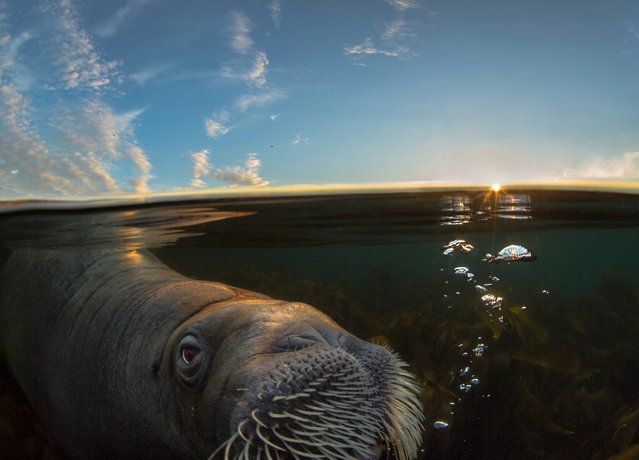
The Wildscreen festival is the world’s biggest celebration of screen-based natural history storytelling which takes place every two years in Bristol. Here: “Walrus in Midnight Sun”. Walrus feed mostly on bivalves in productive, shallow and often sandy habitats in the Arctic. This individual, though, arrived on a beach outside Tromsø, northern Norway, and found comfort on a stranded dead sperm whale. After two weeks he approached Audun, and only half a metre away he stretched his tusk forward and touched his hand gently. “This was one of the most memorable moments of my life”, Rikardsen says. He named the 500kg male Buddy. After two months, the dead whale was decomposed and Buddy suddenly disappeared. (Photo by Audun Rikardsen/Wildscreen 2016)
Details
07 Oct 2016 10:02:00