Loading...
Done
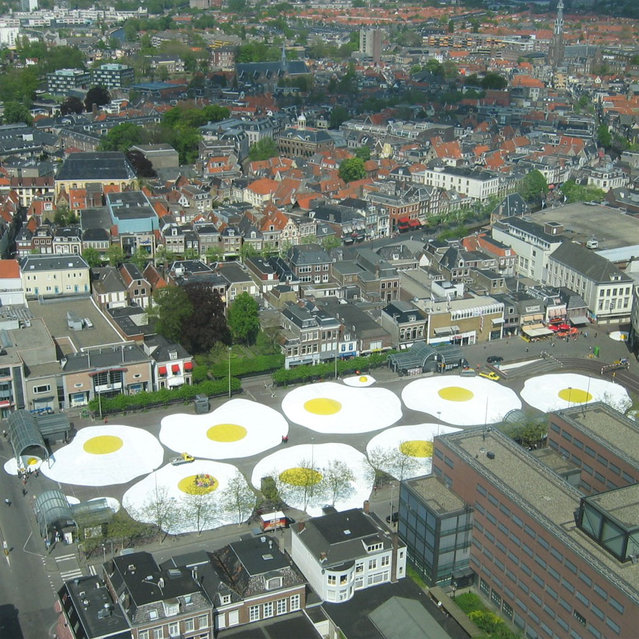
Art Eggcident By Henk Hofstra

With "Art Eggcident," Dutch artist Henk Hofstra demonstrates what it would look like if God threw giant eggs down at us. The eight large, sunny side up eggs measure almost 100 feet wide in diameter. The installation took place in Leeuwarden, a city in the north of the Netherlands.
"I hope it becomes a meeting place with room for art," says Henk. "Art that is different than a framed picture on the wall or a boring bronze sculpture. Art that shows us a different look, surprises us, or makes us angry or happy. Art that allows photographers to grab their cameras and arouses journalists. Art that evokes emotion, or provokes wild laughter."
Details
07 May 2014 10:54:00
Layers of breathtaking colour streak the rolling hills of this vast desert, making the landscape appear as though it has been tie-dyed. The natural phenomenon, nicknamed the “Painted Desert”, was formed when the area was once a river floodplain. (Photo by Mark Brodkin/Solent News/SIPA Press)

Layers of breathtaking colour streak the rolling hills of this vast desert, making the landscape appear as though it has been tie-dyed. The natural phenomenon, nicknamed the “Painted Desert”, was formed when the area was once a river floodplain. Each colour corresponds to a different underground geological feature – rocks which have seemingly dyed the layers of earth above. Formed from volcanic activity, the hills at the John Day Fossil Beds National Monument in East Central Oregon, USA, are almost bursting with colour. Pictured: The colourful hills at the John Day Fossil Beds National Monument in East Central Oregon, USA. (Photo by Mark Brodkin/Solent News/SIPA Press)
Details
30 Jul 2014 11:00:00
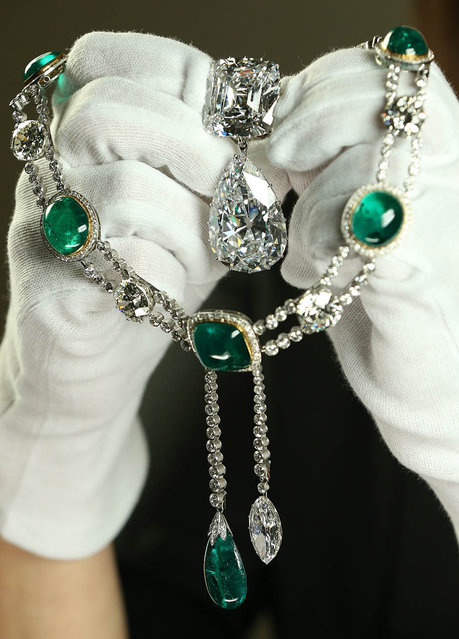
Caroline de Guitaut, Curator of Royal Collections, holds the Cullinan III and IV Broach and the Cullinan VII Delhi Durbar Necklace and Cullinan Pendant at The Queen's Gallery, Buckingham Palace

“A dazzling exhibition featuring jewelry made with the world’s largest diamond will be part of the celebrations marking the 60th anniversary of Queen Elizabeth II’s reign. The jewelry was made with a 3,106-carat diamond discovered in 1905 at the Cullinan Diamond Mine near Pretoria, the capital of South Africa. The diamond was so large that miners initially thought it was a worthless crystal and almost threw it away”... – Vidya Kauri via News.nationalpost.com

Photo: Caroline de Guitaut, Curator of Royal Collections, holds the Cullinan III and IV Broach and the Cullinan VII Delhi Durbar Necklace and Cullinan Pendant at The Queen's Gallery, Buckingham Palace on May 15, 2012 in London, England. (Photo by Peter Macdiarmid)
Details
17 May 2012 10:59:00
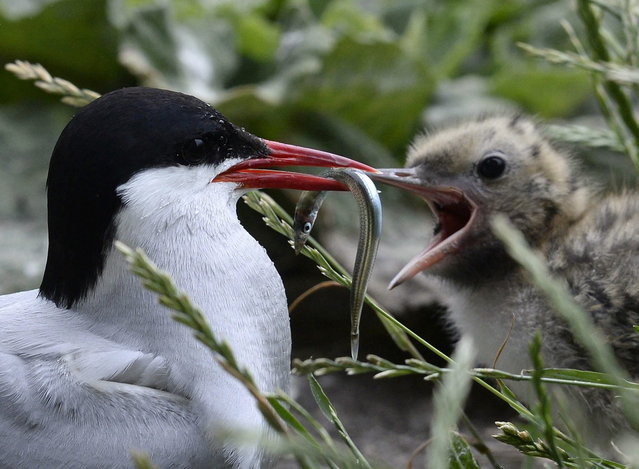
An arctic tern feeds its chick on the Farne Islands off the Northumberland coast, northern England July 8, 2013. (Photo by Nigel Roddis/Reuters)

An arctic tern feeds its chick on the Farne Islands off the Northumberland coast, northern England July 8, 2013. The Farne Islands, which lie off the coast of northeast England, are home to a huge array of wildlife. The islands are owned and protected by the British conservation charity, the National Trust, which says they host some 23 species of seabird, as well as a substantial colony of grey seals, who come to have their pups there in the autumn. Every five years the National Trust carries out a census of the islands' population of puffins, and this year's survey showed there were almost 40,000 nesting pairs on the islands – an 8 percent rise from 2008. (Photo by Nigel Roddis/Reuters)
Details
11 Dec 2013 09:21:00
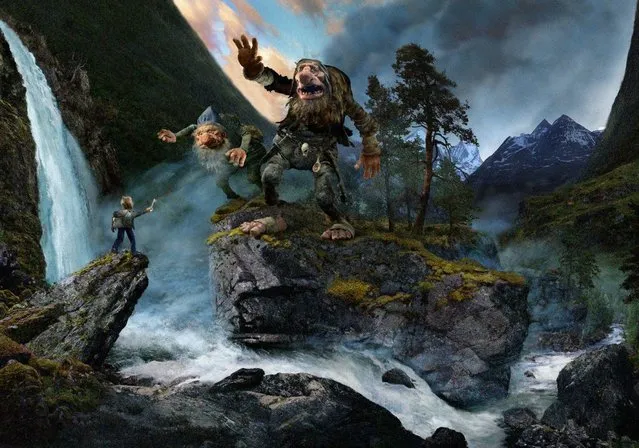
Norwegian Trolls By Ivar Rodningen Part 1

Ivar Rodningem is a professional illustrator, whose imaginative mind transports us into a parallel world where trolls roam the lands. These creatures might seem scary at first sight, but in reality they are very docile and friendly, help each other and humans that they happen to meet. One of their characteristic features is of course their large noses and long tails. They are one with the nature, which is why it is almost impossible to see a troll if he doesn’t want to be found. Just like you and I they love having fun, though it is hard thing to do, considering their size.


See also:Part 2
Details
26 Feb 2015 20:03:00
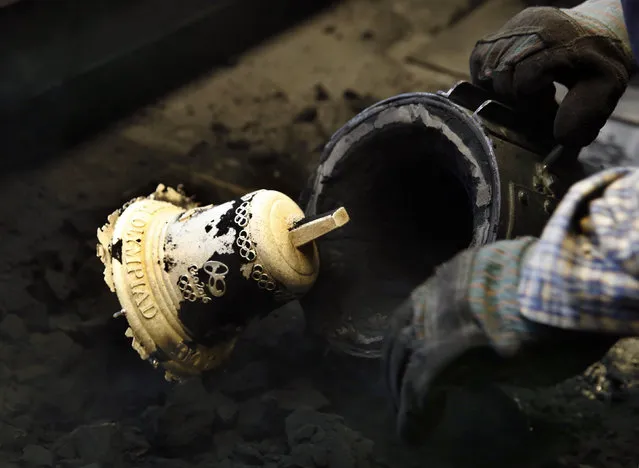
Serge Huguenin of the Blondeau foundry takes the newly melted bell out of the mould in La Chaux-de-Fonds, Switzerland January 21, 2016. At this year's Summer Olympics in Rio de Janeiro, no matter how elaborate the opening ceremony or how sophisticated the live broadcasts, the final lap of athletics races will be announced the traditional way by ringing an old-fashioned bell. (Photo by Denis Balibouse/Reuters)

Serge Huguenin of the Blondeau foundry takes the newly melted bell out of the mould in La Chaux-de-Fonds, Switzerland January 21, 2016. At this year's Summer Olympics in Rio de Janeiro, no matter how elaborate the opening ceremony or how sophisticated the live broadcasts, the final lap of athletics races will be announced the traditional way by ringing an old-fashioned bell. Omega, the official timekeeper of the event, has ordered 21 bells, forged almost entirely by hand by Blondeau's Bell Foundry in the Jura Mountains in Switzerland. Each last-lap bell is branded with the RIO 2016 logo and circled with the words “2016 GAMES OF THE XXXI OLYMPIAD”. (Photo by Denis Balibouse/Reuters)
Details
02 Feb 2016 13:51:00
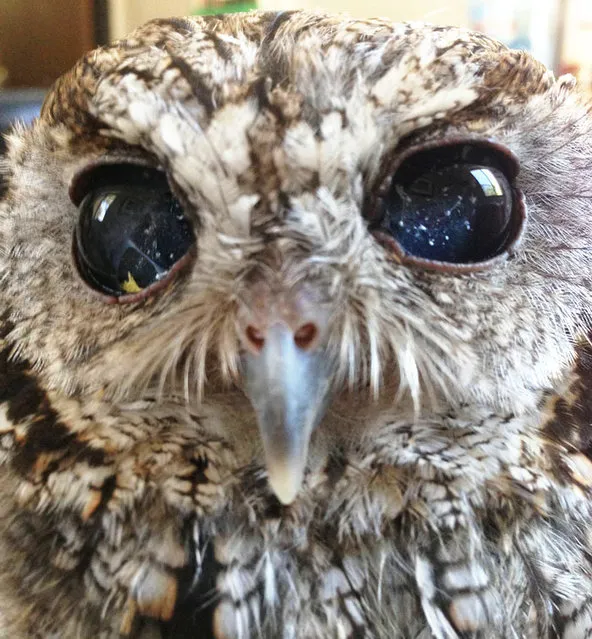
The Blind Owl With Stars Eyes

When you gaze into the eyes of this beautiful creature, you can almost make out constellations forming deep within. The name of this magnificent bird is Zeus, named after the Greek god of the sky for her one-of-a-kind eyes. The reason why she has such eyes is because she is blind. She was saved by a family in Southern California, when they found her injured on their front porch. After realizing that this poor creature is blind and unable to take care of itself, they took her to an animal hospital. After she healed up, everyone agreed that she should be sent to the Wildlife Learning Center. From that point on, Zeus has been happily living in the center. And though she cannot see, you can bet that her other senses are ten times as sharp. (Photo by Wildlife Learning Center)
Details
24 Nov 2014 13:31:00
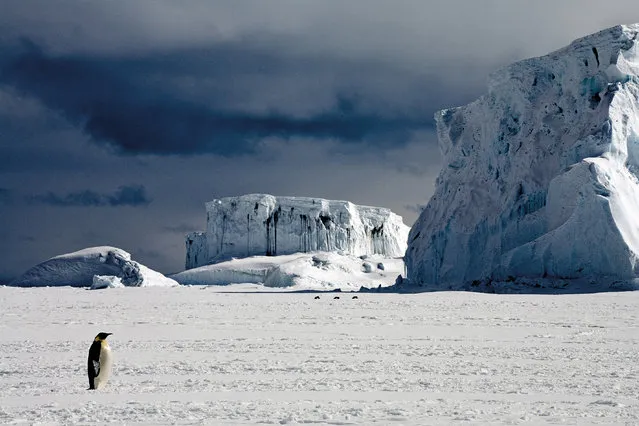
Image from Camille Seamans new book, “Melting Away”. (Photo by Camille Seaman/Barcroft Media)

Documenting the effects of climate change first hand over the past eight years, Camille Seaman fears we may be on the road to the last iceberg. Photographing the enormous frozen floats at both poles for the past eight years, the Californian adventurer has seen the receding ice shelves and experienced the changing warmer weather. Feeling that her intimate and emotional work documents a snapshot of history, Camille presents her series “The Last Iceberg” as a study of what she sees as the personality of each huge iceberg. Drawing parallels with the famous novel, “The Last of the Mohicans”, Camille, 42, wonders whether these unique, almost alien natural features will become a thing of the past or part of nature's renewal process. (Photo by Camille Seaman/Barcroft Media)
Details
02 Dec 2014 12:10:00