Loading...
Done
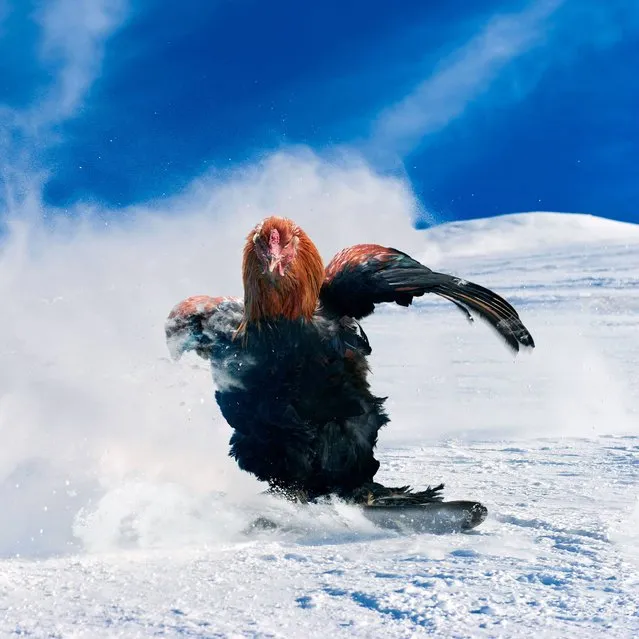
“Nice Pecks” calendar: Snowboarding. (Photo by The happy egg co.)

The happy egg co. has released its annual cockerel pin-up calendar: “Nice Pecks” – with an egg-streme sports edition. Taking inspiration from upcoming sporting events and the world of extreme sports, the 2015 calendar stars 12 rad roosters with a penchant for adrenaline highs in a range of high octane sporting scenarios including jumping off slopes, riding gnarly waves and snowboarding. Here: “Nice Pecks” calendar: Snowboarding. (Photo by The happy egg co.)
Details
09 Dec 2014 09:20:00
HellFest 2013

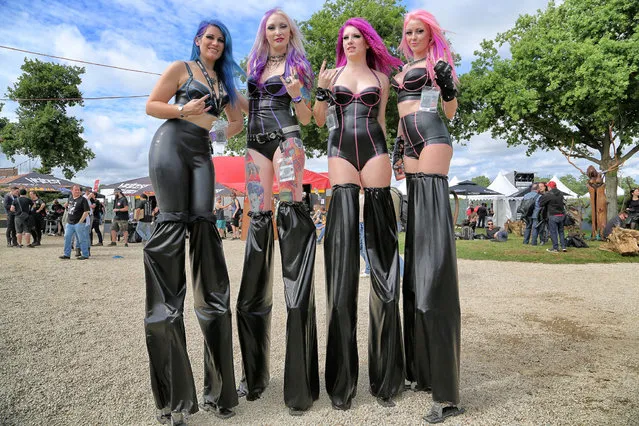
“Hellfest is an annual music festival which takes place in Clisson, France in mid-June. It is held within the Val de Moine sport complex in Clisson, approximately 35 km south-east of the city of Nantes, and approximately 400 km south-west of the nation's capital Paris. Billed as an “extreme music festival”, the programme features a variety of heavy metal, hard rock, punk and hardcore acts”. – Wikipedia. Photo: HellFest 2013. (Photo by Cesar Hernandez)
Details
21 Nov 2013 10:14:00
Photographer Nick Meek For Sony Bravia

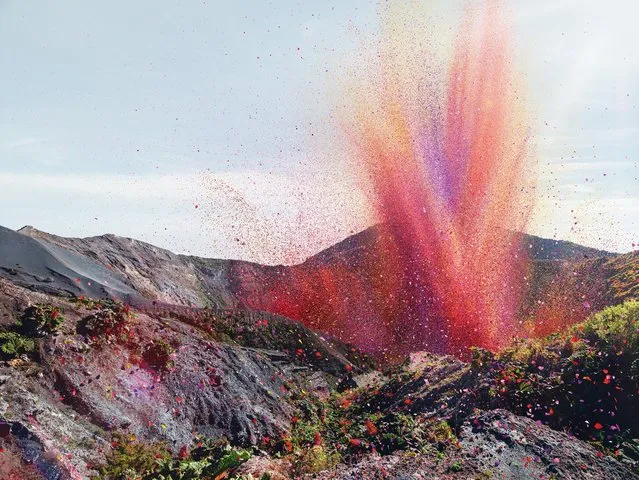
“Sony Bravia has been a bench mark in quality advertising for years now and I’m very happy to have been chosen by McCann Worldwide to shoot this campaign for them.
We flew to a volcano in Costa Rica where it took the inhabitants of an entire village a full week to pluck all the flower petals…. enough to fill two huge lorries!
With the help of a special effects team, the petals were blown and exploded through our landscapes creating hugely detailed vista which echoes the extreme detail of Sony’s new 4k tv.”
Details
22 Apr 2014 12:09:00
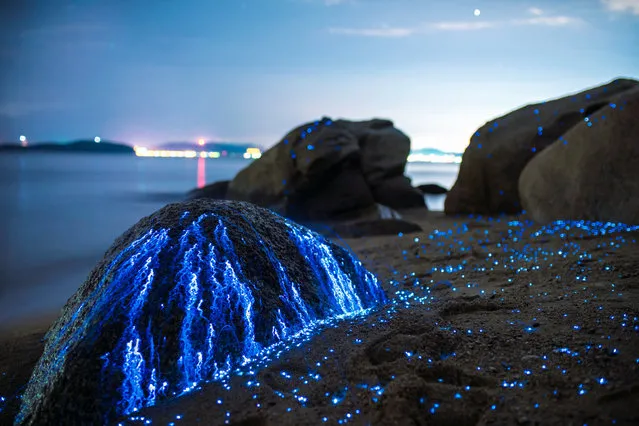
Bioluminescent sea fireflies glittering like diamonds on the rocks and sand. Okayama, Japan. July 2016. (Photo by Trevor Williams/Jonathan Galione/Getty Images)

Those lights are actually bioluminescent shrimp, better known as sea fireflies, or, in Japan, as “umibotaru”. Visible every year from May until the end of October, they live in the sand around very shallow sea water and are often seen floating between the extremes of high and low tides. Here: Bioluminescent sea fireflies glittering like diamonds on the rocks and sand. Okayama, Japan. July 2016. (Photo by Trevor Williams/Jonathan Galione/Getty Images)
Details
23 Aug 2016 10:13:00
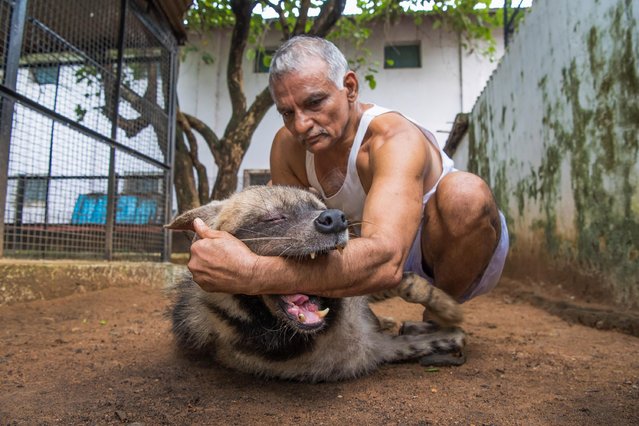
Prakash Amte is seen playing with a Hyena from his orphanage on September 19, 2017 in Maharashtra, India. (Photo by Haziq Qadri/Barcroft Media)

A couple have taken their love of animals to the extreme – by opening up their home to over 100 rescued animals. Dr Prakash Amte and his wife, Dr. Mandakini Amte have dedicated their lives to helping both the animals – and people – of Hemalkasa, Maharashtra in India. Here: Prakash Amte is seen playing with a Hyena from his orphanage on September 19, 2017 in Maharashtra, India. (Photo by Haziq Qadri/Barcroft Media)
Details
20 Oct 2017 06:38:00
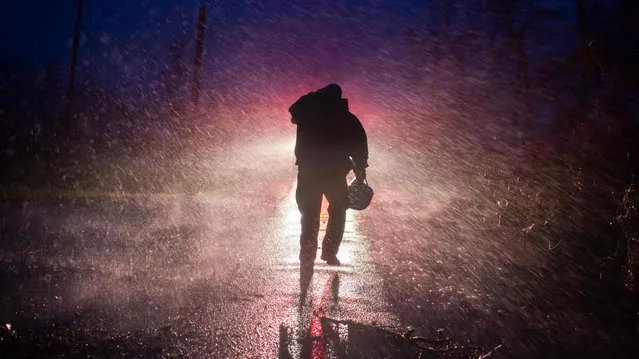
Montegut fire chief Toby Henry walks back to his fire truck in the rain as firefighters cut through trees on the road in Bourg, Louisiana as Hurricane Ida passes on August 29, 2021. Hurricane Ida struck the coast of Louisiana on August 29 as a powerful Category 4 storm, 16 years to the day after deadly Hurricane Katrina devastated the southern US city of New Orleans. “Extremely dangerous Category 4 Hurricane Ida makes landfall near Port Fourchon, Louisiana”, the National Hurricane Center wrote in an advisory. (Photo by Mark Felix/AFP Photo)

Montegut fire chief Toby Henry walks back to his fire truck in the rain as firefighters cut through trees on the road in Bourg, Louisiana as Hurricane Ida passes on August 29, 2021. Hurricane Ida struck the coast of Louisiana on August 29 as a powerful Category 4 storm, 16 years to the day after deadly Hurricane Katrina devastated the southern US city of New Orleans. “Extremely dangerous Category 4 Hurricane Ida makes landfall near Port Fourchon, Louisiana”, the National Hurricane Center wrote in an advisory. (Photo by Mark Felix/AFP Photo)
Details
28 Sep 2021 08:03:00
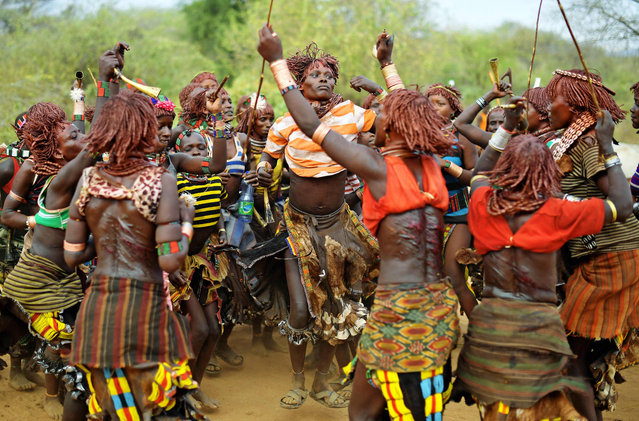
Hamar women dance before a bull jumping ceremony in Ethiopia's southern Omo Valley region near Turmi on September 19, 2016. The Hamar are a Nilotic ethnic group in Ethiopia. The construction of the Gibe III dam, the third largest hydroelectric plant in Africa, and large areas of very “thirsty” cotton and sugar plantations and factories along the Omo river are impacting heavily on the lives of tribes living in the Omo Valley who depend on the river for their survival and way of life. Human rights groups fear for the future of the tribes if they are forced to scatter, give up traditional ways through loss of land or ability to keep cattle as globalisation and development increases. (Photo by Carl De Souza/AFP Photo)

Hamar women dance before a bull jumping ceremony in Ethiopia's southern Omo Valley region near Turmi on September 19, 2016. The Hamar are a Nilotic ethnic group in Ethiopia. The construction of the Gibe III dam, the third largest hydroelectric plant in Africa, and large areas of very “thirsty” cotton and sugar plantations and factories along the Omo river are impacting heavily on the lives of tribes living in the Omo Valley who depend on the river for their survival and way of life. (Photo by Carl De Souza/AFP Photo)
Details
02 Oct 2016 08:45:00
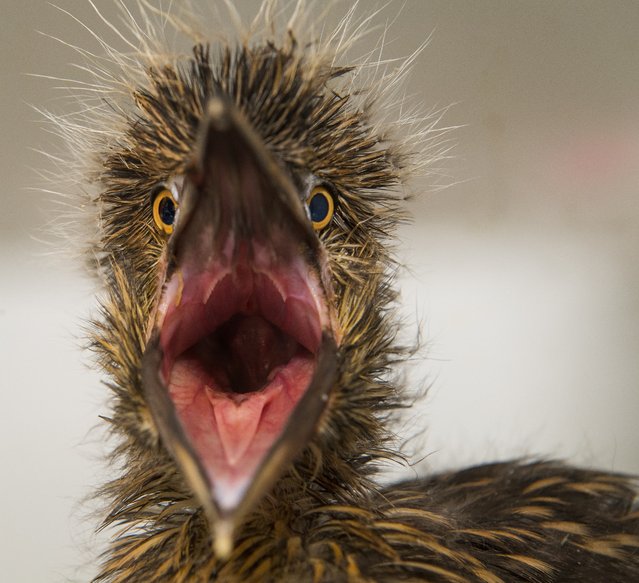
A baby Black-crowned Night Heron squawks in its incubator while being cared for at City Wildlife rescue and rehabilitation center in Washington, DC on May 31, 2017. The heron is one of several that have been brought to CW by the staff at The National Zoo over the past few years. The heron is a native bird and has made an established rookery inside the zoo grounds over a hundred years ago.  Every year at this time, some of the chicks get pushed or fall out of the nest and require human care.  Because the birds are native and not part of the Smithsonian collection, they partnered with CW to rehabilitate the herons for re-release back to the flock inside Zoo. They're reintroduced back to their flock so that they can migrate together in the Fall. The Black-crowned heron usually migrates from the DC area down to southeast North Carolina, some going as far as Jacksonville, FL in winter. The Black-crowned heron is the species of greatest conservation need in the District of Columbia because their numbers are in such rapid decline due to habitat loss. (Photo Linda Davidson/The Washington Post)

A baby Black-crowned Night Heron squawks in its incubator while being cared for at City Wildlife rescue and rehabilitation center in Washington, DC on May 31, 2017. The heron is one of several that have been brought to CW by the staff at The National Zoo over the past few years. (Photo Linda Davidson/The Washington Post)
Details
04 Jun 2017 08:04:00