Loading...
Done
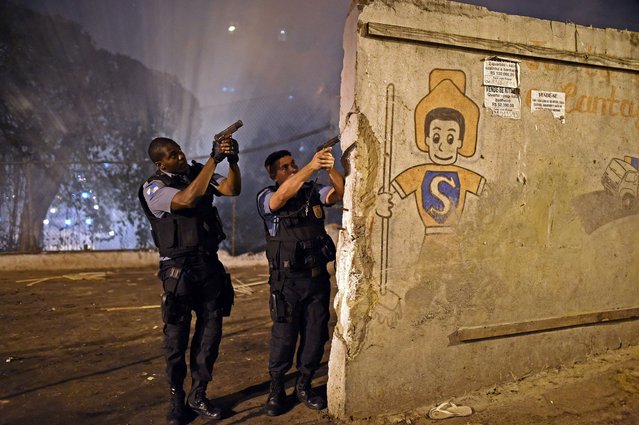
Rio de Janeiro's state military policemen aim their guns during a violent protest in a favela next to Copacabana, Rio de Janeiro on April 22, 2014. Violent protests broke out in Rio's landmark beachfront district, Copacabana, following the death of a resident last weekend during clashes with the Army in a nearby favela. (Photo by Christophe Simon/AFP Photo)

Rio de Janeiro's state military policemen aim their guns during a violent protest in a favela next to Copacabana, Rio de Janeiro on April 22, 2014. Violent protests broke out in Rio's landmark beachfront district, Copacabana, following the death of a resident last weekend during clashes with the Army in a nearby favela. (Photo by Christophe Simon/AFP Photo)
Details
24 Apr 2014 09:03:00
A decades-old television. (Photo by Mark C. O'Flaherty)

The official name for this tiny speck of land – the size of 12 football pitches – is Hashima, but few call it that. In English, its most commonly used name means “Battleship Island” and, viewed from a certain angle offshore, its silhouette is uncannily dreadnought in nature. It was a mining facility until 1974, when it was abandoned to the elements, before partially reopening as a tourist attraction in 2009. Photo: A decades-old television. (Photo by Mark C. O'Flaherty)
Details
15 Jun 2014 11:24:00
“A nocturnal Tokyo, Shinagawa”. (Satoshi Ohki)

“A nocturnal Tokyo, Shinagawa”. (Photo by Satoshi Ohki)
Details
31 May 2013 12:20:00
A miniature sculpture in the shape of a home, created by self-taught artist Jadranko Djordjevic on a graphite pencil, is seen in Tuzla, Bosnia and Herzegovina April 26, 2016. (Photo by Dado Ruvic/Reuters)

A miniature sculpture in the shape of a home, created by self-taught artist Jadranko Djordjevic on a graphite pencil, is seen in Tuzla, Bosnia and Herzegovina April 26, 2016. (Photo by Dado Ruvic/Reuters)
Details
27 Apr 2016 09:57:00
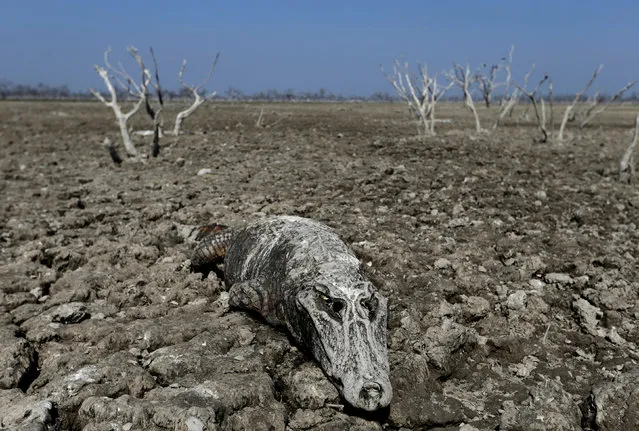
The carcass of a yacare caiman lies in the dried-up river bed of the Pilcomayo river in Boqueron, Paraguay, August 14, 2016. In Paraguay, alongside the Pilcomayo River, black vultures flew over a shrinking pond where a group of crocodilian reptiles known as yacare caimans sought refuge. Water from the river, which divides Paraguay and Argentina in the area of the Gran Chaco, was scarce. This is not an uncommon sight in the region of General Diaz, about 700 kilometres (435 miles) northwest of the country's capital Asuncion, where the Pilcomayo's waters form lakes and streams that give life to capybaras, birds and caimans. “The river's situation is critical. No water is forecast to enter the basin until December, as happens every year”, said Alcides Gonzalez, a resident of the area. (Photo by Jorge Adorno/Reuters)

The carcass of a yacare caiman lies in the dried-up river bed of the Pilcomayo river in Boqueron, Paraguay, August 14, 2016. In Paraguay, alongside the Pilcomayo River, black vultures flew over a shrinking pond where a group of crocodilian reptiles known as yacare caimans sought refuge. Water from the river, which divides Paraguay and Argentina in the area of the Gran Chaco, was scarce. This is not an uncommon sight in the region of General Diaz, about 700 kilometres (435 miles) northwest of the country's capital Asuncion, where the Pilcomayo's waters form lakes and streams that give life to capybaras, birds and caimans. (Photo by Jorge Adorno/Reuters)
Details
03 Nov 2016 12:40:00
Fans of the East German Trabant car gather for their 7th annual get-together on August 23, 2014 in Zwickau, Germany. Hundreds of Trabant enthusiasts arrived to spend the weekend admiring each others cars, trading stories and enjoying activities. The Trabant, dinky and small by modern standards, was the iconic car produced in former communist East Germany and today has a strong cult following. (Photo by Matthias Rietschel/Getty Images)

Fans of the East German Trabant car gather for their 7th annual get-together on August 23, 2014 in Zwickau, Germany. Hundreds of Trabant enthusiasts arrived to spend the weekend admiring each others cars, trading stories and enjoying activities. The Trabant, dinky and small by modern standards, was the iconic car produced in former communist East Germany and today has a strong cult following. (Photo by Matthias Rietschel/Getty Images)
Details
31 Aug 2014 09:06:00
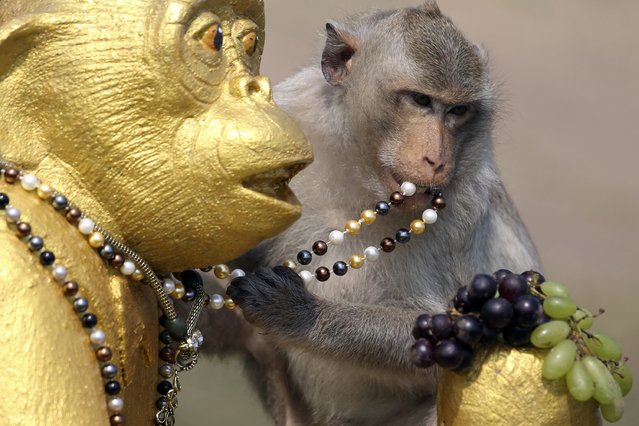
A long-tailed macaque grabs a necklace from a statue during the annual Monkey Buffet Festival at the Pra Prang Sam Yot temple in Lopburi, north of Bangkok November 30, 2014. The festival provides food and drinks to the local monkey population, which numbers more than 2,000, to thank them for drawing tourists to the town. (Photo by Damir Sagolj/Reuters)

A long-tailed macaque grabs a necklace from a statue during the annual Monkey Buffet Festival at the Pra Prang Sam Yot temple in Lopburi, north of Bangkok November 30, 2014. The festival provides food and drinks to the local monkey population, which numbers more than 2,000, to thank them for drawing tourists to the town. (Photo by Damir Sagolj/Reuters)
Details
01 Dec 2014 14:22:00
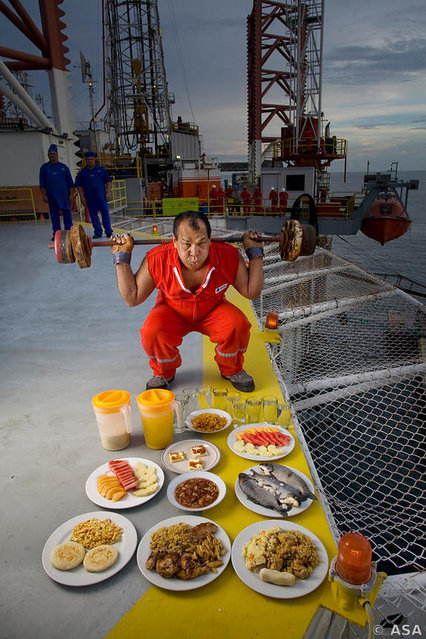
What the World Eats By Peter Menzel And Faith D'Aluisio Part 1

A stunning photographic collection featuring portraits of people from 30 countries and the food they eat in one day. In this fascinating study of people and their diets, 80 profiles are organized by the total number of calories each person puts away in a day. Featuring a Japanese sumo wrestler, a Massai herdswoman, world-renowned Spanish chef Ferran Adria, an American competitive eater, and more, these compulsively readable personal stories also include demographic particulars, including age, activity level, height, and weight. Essays from Harvard primatologist Richard Wrangham, journalist Michael Pollan, and others discuss the implications of our modern diets for our health and for the planet. This compelling blend of photography and investigative reportage expands our understanding of the complex relationships among individuals, culture, and food.
Details
23 Apr 2014 14:34:00