Loading...
Done
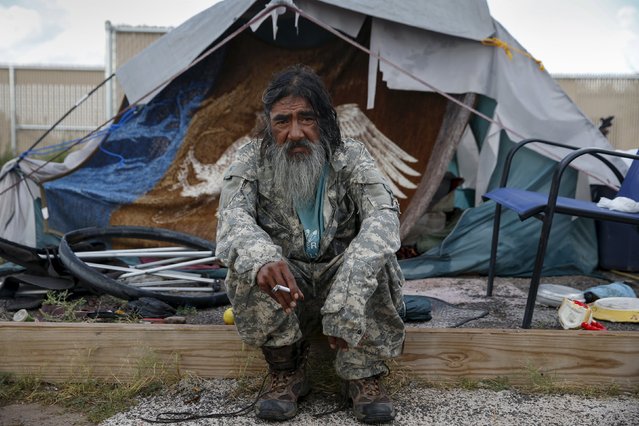
Daniel J. Wabsey, a 58-year-old war veteran, sits outside his tent at Camp Hope in Las Cruces, New Mexico October 6, 2015. “I've been traveling for 35 or 38 years. Getting inside would take a while to get used to. I just want to be able to eat, sleep and be safe. We all get along and understand in Camp Hope. We've all been there. With common sense you can survive out here”, Wabsey said. Camp Hope describe themselves as an “alternative transitional living project for the homeless”. Around 50 people live at the camp. (Photo by Shannon Stapleton/Reuters)

Daniel J. Wabsey, a 58-year-old war veteran, sits outside his tent at Camp Hope in Las Cruces, New Mexico October 6, 2015. “I've been traveling for 35 or 38 years. Getting inside would take a while to get used to. I just want to be able to eat, sleep and be safe. We all get along and understand in Camp Hope. We've all been there. With common sense you can survive out here”, Wabsey said. Camp Hope describe themselves as an “alternative transitional living project for the homeless”. Around 50 people live at the camp. (Photo by Shannon Stapleton/Reuters)
Details
19 Dec 2015 08:05:00


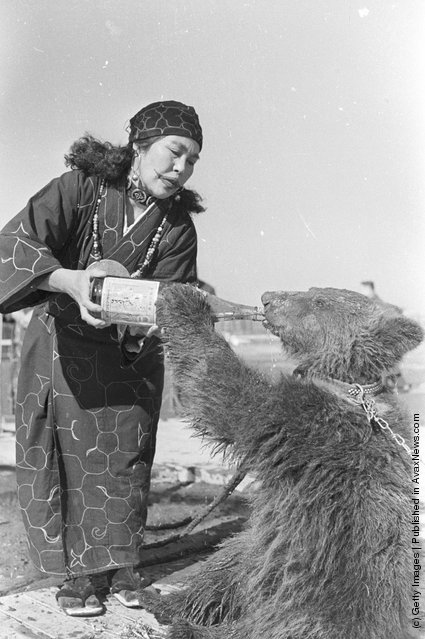
“The Ainu (アイヌ?), also called Aynu, Aino (アイノ), and in historical texts Ezo (蝦夷), are indigenous people or groups in Japan and Russia. Historically they spoke the Ainu language and related varieties and lived in Hokkaidō, the Kuril Islands, and much of Sakhalin. Most of those who identify themselves as Ainu still live in this same region, though the exact number of living Ainu is unknown. This is due to ethnic issues in Japan resulting in those with Ainu backgrounds hiding their identities and confusion over mixed heritages. In Japan, because of intermarriage over many years with Japanese, the concept of a 'pure Ainu' ethnic group is no longer feasible. Official estimates of the population are of around 25,000, while the unofficial number is upwards of 200,000 people”. – Wkipedia

Photo: A captive bear drinking from a large bottle held by an Ainu tribeswoman. (Photo by Evans/Three Lions/Getty Images). Circa 1955
Details
24 Mar 2011 14:01:00


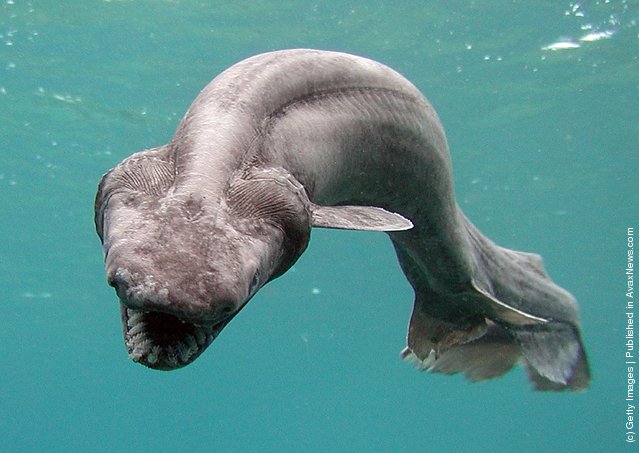
“The frilled shark (Chlamydoselachus anguineus) is one of two extant species of shark in the family Chlamydoselachidae, with a wide but patchy distribution in the Atlantic and Pacific Oceans. This uncommon species is found over the outer continental shelf and upper continental slope, generally near the bottom though there is evidence of substantial upward movements. It has been caught as deep as 1,570 m (5,150 ft), whereas in Suruga Bay, Japan it is most common at depths of 50–200 m (160–660 ft). Exhibiting several “primitive” features, the frilled shark has often been termed a «living fossil»”. – Wikipedia

Photo: A 1.6 meter long Frill shark swims in a tank after being found by a fisherman at a bay in Numazu, on January 21, 2007 in Numazu, Japan. The frill shark, also known as a Frilled shark usually lives in waters of a depth of 600 meters and so it is very rare that this shark is found alive at sea-level. It's body shape and the number of gill are similar to fossils of sharks which lived 350,000,000 years ago. (Photo by Awashima Marine Park/Getty Images)
Details
05 May 2011 10:01:00
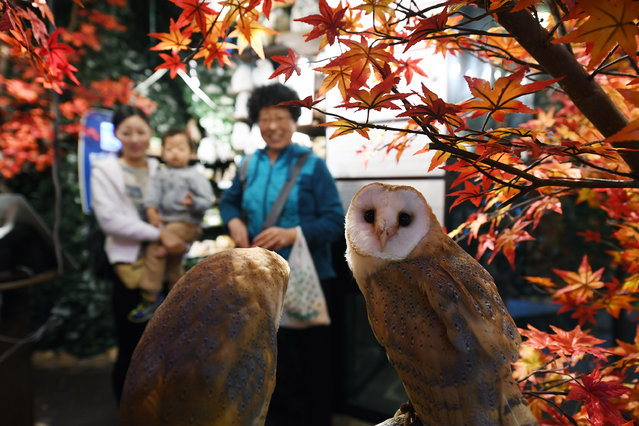
People view live owls at, Owl's Forest which is located on the bottom floor of a building along a bustling street in the Harajuku area on Friday November 04, 2016 in Tokyo, Japan. Visitors can pet owls at the business. It is located next to one of Tokyo's many cat cafes. (Photo by Matt McClain/The Washington Post)

People view live owls at, Owl's Forest which is located on the bottom floor of a building along a bustling street in the Harajuku area on Friday November 04, 2016 in Tokyo, Japan. Visitors can pet owls at the business. It is located next to one of Tokyo's many cat cafes. (Photo by Matt McClain/The Washington Post)
Details
04 Jan 2017 07:52:00
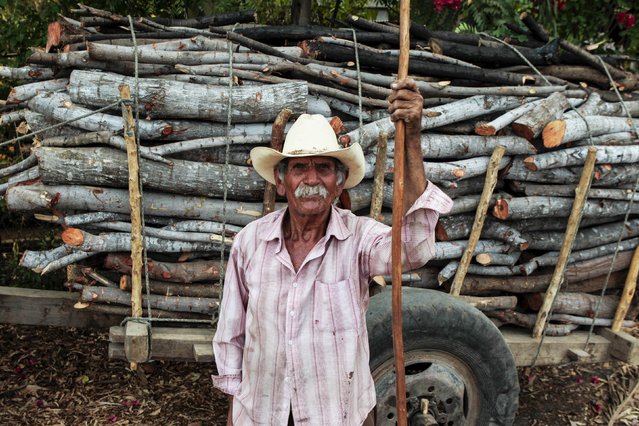
A man poses for a pictures, as he transport logs on his bull-cart to make charcoal at La Campanera village, NIcaragua, May 22, 2015. Around 300 families live off the sale of charcoal in this area located in the dry corridor of Nicaragua. Friday marks World Environment Day. Picture taken May 22, 2015. REUTERS/Oswaldo Rivas

A man poses for a pictures, as he transport logs on his bull-cart to make charcoal at La Campanera village, Nicaragua, May 22, 2015. Around 300 families live off the sale of charcoal in this area located in the dry corridor of Nicaragua. Friday marks World Environment Day. Picture taken May 22, 2015. REUTERS/Oswaldo Rivas
Details
18 Jun 2015 10:27:00
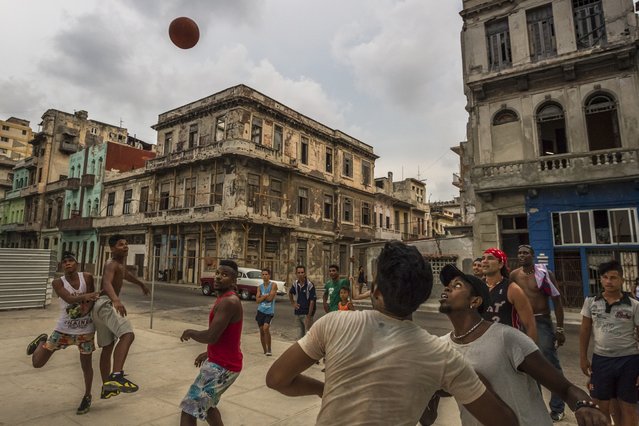
Young men play basketball on an improvised court wedged between a construction site and the shells of once grand colonial homes in Havana, July 20, 2015. As much as the young in Cuba welcome political opening and economic reform, such changes are unlikely to filter down to their lives anytime soon. (Photo by Meridith Kohut/The New York Times)

Young men play basketball on an improvised court wedged between a construction site and the shells of once grand colonial homes in Havana, July 20, 2015. As much as the young in Cuba welcome political opening and economic reform, such changes are unlikely to filter down to their lives anytime soon. (Photo by Meridith Kohut/The New York Times)
Details
07 Aug 2015 11:11:00
Extraordinary images of the cruise ship by Jonathan Danko Kielkowski from his book Concordia, published by White Press. The German photographer swam out to where the ship – which ran aground off Tuscany in 2012 with the loss of 32 lives – is moored. Francesco Schettino, the ship’s captain, was jailed for 16 years over the accident. (Photo by Jonathan Danko Kielkowski)

Extraordinary images of the cruise ship by Jonathan Danko Kielkowski from his book Concordia, published by White Press. The German photographer swam out to where the ship – which ran aground off Tuscany in 2012 with the loss of 32 lives – is moored. Francesco Schettino, the ship’s captain, was jailed for 16 years over the accident. (Photo by Jonathan Danko Kielkowski)
Details
23 Jan 2016 13:34:00
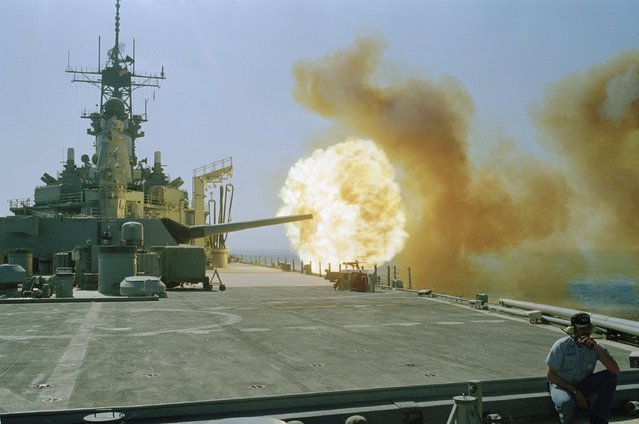
A fireball erupts from a 16-inch gun on the battleship USS Wisconsin during a live fire exercise in the Persian Gulf, October 13, 1990. The ship is in the Gulf as part of Operation Desert Shield. (Photo by John Gaps III/AP Photo)

A fireball erupts from a 16-inch gun on the battleship USS Wisconsin during a live fire exercise in the Persian Gulf, October 13, 1990. The ship is in the Gulf as part of Operation Desert Shield. (Photo by John Gaps III/AP Photo)
Details
15 Oct 2015 08:04:00