Loading...
Done
Devotees take a holy bath during the Swasthani Brata Katha festival in Kathmandu January 20, 2015. During the month-long festival, devotees recite one chapter of a Hindu tale daily from the 31-chapter sacred Swasthani Brata Katha book that is dedicated to God Madhavnarayan and Goddess Swasthani, alongside various other gods and goddesses and the miraculous feats performed by them. (Photo by Navesh Chitrakar/Reuters)

Devotees take a holy bath during the Swasthani Brata Katha festival in Kathmandu January 20, 2015. During the month-long festival, devotees recite one chapter of a Hindu tale daily from the 31-chapter sacred Swasthani Brata Katha book that is dedicated to God Madhavnarayan and Goddess Swasthani, alongside various other gods and goddesses and the miraculous feats performed by them. The devotees also go on pilgrimages to various temples, perform religious rituals, take a holy bath in the rivers and fast for a month, especially among women who believe fasting helps in their family's well-being or in getting them a good husband. (Photo by Navesh Chitrakar/Reuters)
Details
21 Jan 2015 13:50:00
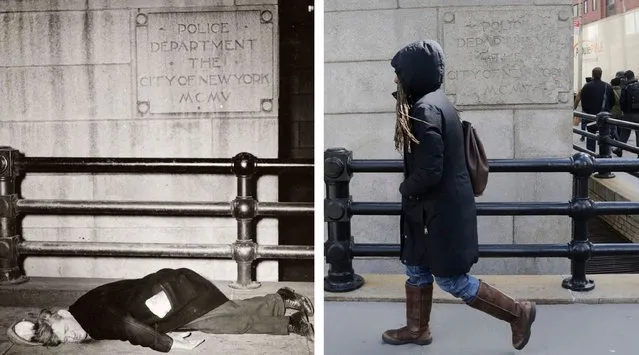
A new book of photos by legendary photographer Weegee shows what industrialized, pre-gentrified New York looked like in the mid-20th century, before the city was crammed with towers and billboards. (Photo by AP Photo/Copyright Weegee/The International Center of Photography, Mark Lennihan)

A new book of photos by legendary photographer Weegee shows what industrialized, pre-gentrified New York looked like in the mid-20th century, before the city was crammed with towers and billboards. Here: this combination shows the 1945 photo “Derelict sleeping on the sidewalk outside police headquarters” by Weegee, provided by the International Center of Photography in New York, and a woman walking on the same spot on Wednesday, March 18, 2015. (Photo by AP Photo/Copyright Weegee/The International Center of Photography, Mark Lennihan)


Details
27 Mar 2015 13:16:00
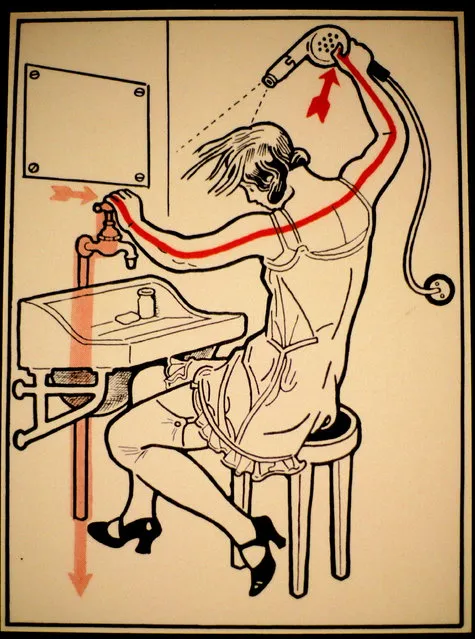
The book “Elektroschutz in 132 Bildern” (Electrical Protection in 132 Pictures) was published in Vienna in the early 1900s by a Viennese physician named Stefan Jellinek (1878-1968, a founder of the Electro-Pathological Museum). The pictures are nice and direct and unambiguous; they teach, graphically, that the surest way to kill yourself with electricity is to form a complete path from source (usually the bright red arrow) to ground (the screened back, pink arrow). Arrowheads provide the path for current flow. (Photo by The Vienna Technical Museum)

The book “Elektroschutz in 132 Bildern” (Electrical Protection in 132 Pictures) was published in Vienna in the early 1900s by a Viennese physician named Stefan Jellinek (1878-1968, a founder of the Electro-Pathological Museum). The pictures are nice and direct and unambiguous; they teach, graphically, that the surest way to kill yourself with electricity is to form a complete path from source (usually the bright red arrow) to ground (the screened back, pink arrow). Arrowheads provide the path for current flow. (Photo by The Vienna Technical Museum)
Details
11 Aug 2014 11:10:00
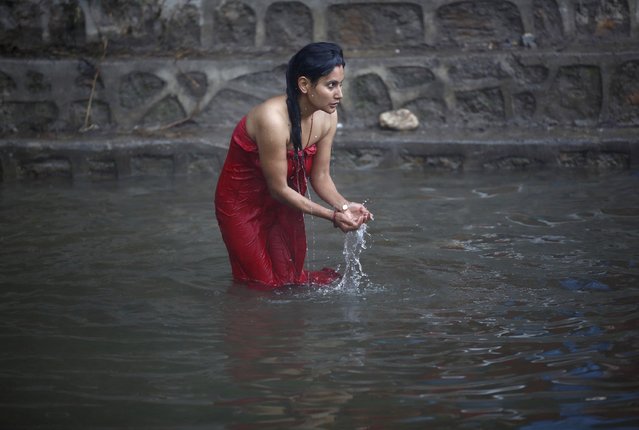
A devotee takes a holy bath in River Saali in Sankhu on the first day of Swasthani Brata Katha festival in Kathmandu January 5, 2015. During the month long festival, devotees recite one chapter of a Hindu tale daily from the 31-chapter sacred Swasthani Brata Katha book that is dedicated to God Madhavnarayan and Goddess Swasthani, alongside various other gods and goddess and the miraculous feats performed by them. (Photo by Navesh Chitrakar/Reuters)

A devotee takes a holy bath in River Saali in Sankhu on the first day of Swasthani Brata Katha festival in Kathmandu January 5, 2015. During the month long festival, devotees recite one chapter of a Hindu tale daily from the 31-chapter sacred Swasthani Brata Katha book that is dedicated to God Madhavnarayan and Goddess Swasthani, alongside various other gods and goddess and the miraculous feats performed by them. (Photo by Navesh Chitrakar/Reuters)
Details
06 Jan 2015 12:22:00
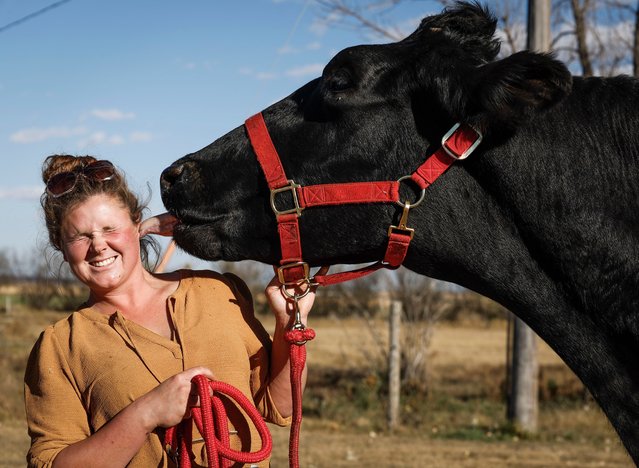
Jasmine Entz gets a kiss from her Guinness Book of World Record-breaking 8-year-old Holstein steer called “Beef”, who weighs 2,400 pounds and stands nearly two meters (6 feet) tall, on her ranch in Vulcan County, Alberta, Canada, on Friday, September 26, 2025. (Photo by Jeff McIntosh/The Canadian Press via AP Photo)

Jasmine Entz gets a kiss from her Guinness Book of World Record-breaking 8-year-old Holstein steer called “Beef”, who weighs 2,400 pounds and stands nearly two meters (6 feet) tall, on her ranch in Vulcan County, Alberta, Canada, on Friday, September 26, 2025. (Photo by Jeff McIntosh/The Canadian Press via AP Photo)
Details
12 Oct 2025 04:24:00
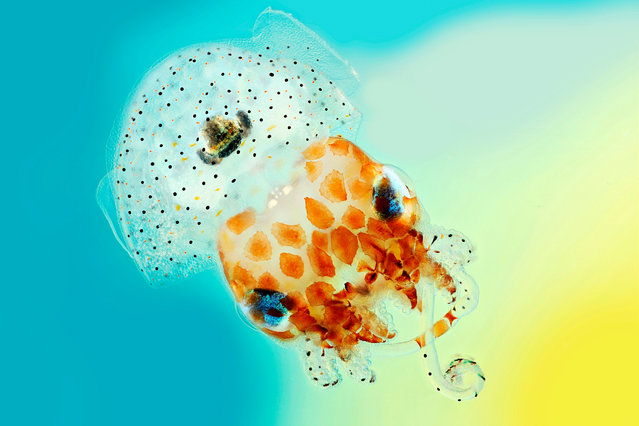
With its huge eyes, comical name and diminutive size, Mark R. Smith’s image of a baby Hawaiian bobtail squid can’t help but raise a smile. A curiously endearing creature, the cephalopod is just 1.5cm across, its mantle cavity bearing more than a passing resemblance to a rather natty shower cap. But it is also a beautiful example of symbiosis – nature’s version of “I’ll scratch your back if you scratch mine” – for on the underside of the squid is a light organ which houses bioluminescent bacteria. The squid offers the bacteria protection and food, while the bacteria emit a glow – a handy trait that the squid uses to offset its silhouette, helping it to evade predators in the depths below. Mark R. Smith’s entry combines several images of a Hawaiian bobtail squid with different focus lengths to create a final picture with greater depth of field than normal. (Photo by Mark R. Smith/Wellcome Images/Macroscopic Solutions)

With its huge eyes, comical name and diminutive size, Mark R. Smith’s image of a baby Hawaiian bobtail squid can’t help but raise a smile. A curiously endearing creature, the cephalopod is just 1.5cm across, its mantle cavity bearing more than a passing resemblance to a rather natty shower cap. But it is also a beautiful example of symbiosis – nature’s version of “I’ll scratch your back if you scratch mine” – for on the underside of the squid is a light organ which houses bioluminescent bacteria. The squid offers the bacteria protection and food, while the bacteria emit a glow – a handy trait that the squid uses to offset its silhouette, helping it to evade predators in the depths below. Mark R. Smith’s entry combines several images of a Hawaiian bobtail squid with different focus lengths to create a final picture with greater depth of field than normal. (Photo by Mark R. Smith/Wellcome Images/Macroscopic Solutions)
Details
08 Mar 2017 00:05:00
Impossible Animals By Jan Oliehoek. Part2

We’re showcasing photo-manipulation by Jan Oliehoek, a Dutch artist with a love for animals, photography and Photoshop. Oliehoek loves creating animal species that somehow never made it into our biology books, such as felines with rodent heads, lambs with the body of a squirrel, zebra rhinos and hippo-frogs! He’s currently having two of his pictures featured in Crazy Photography, an upcoming title from Vivays Publishing
Details
25 May 2013 11:56:00
Stone with Glass Layer By Ramon Todo

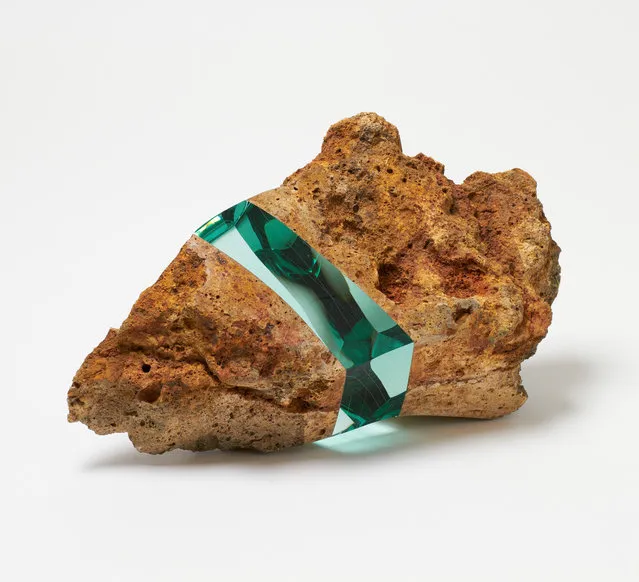
Born in Tokyo, Dusseldorf-based artist Ramon Todo creates beautiful textural juxtapositions using layers of glass in unexpected places. Starting with various stones, volcanic rock, fragments of the Berlin wall, and even books, the artist inserts perfectly cut glass fragments that seem to slice through the object resulting in segments of translucence where you would least expect it.
Details
07 Nov 2013 09:28:00