Loading...
Done
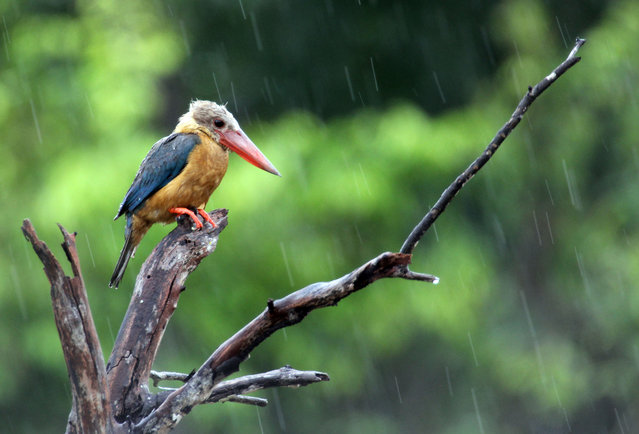
Stork-billed kingfisher during rain in Bintan, Indonesia. The tree species is sparsely distributed in the tropical Indian subcontinent and south-east Asia, from India to Indonesia. (Photo by Sijori Images/Barcroft Images)

A stork-billed kingfisher (Pelargopsis capensis) is seen perched on a tree during monsoon rain on July 25, 2016 in Bintan, Indonesia. The stork-billed kingfisher is a tree species which is widely but sparsely distributed in the tropical Indian subcontinent and Southeast Asia, from India to Indonesia. This kingfisher is resident throughout its range. It is very large, measuring 35 to 38 cm (14 to 15 in) in length. The adult has a green back, blue wings and tail, and grey head. (Photo by Sijori Images/Barcroft Images)
Details
27 May 2017 07:47:00
Ocean_Gravity_Guillaume_Nery_Julie_Gautier_(Video)

Elements of nature are too powerful for humans to subdue, yet it didn’t stop the most courageous individuals from trying. Conquering air, land, fire, water, and even the very fabric of reality – this is the ultimate goal of humanity. For now, we can only marvel at the beauty and tremble in awe before the Mother Nature. A short film “Ocean Gravity,” written and directed by Julie Gautier and Guillaume Nery, reminds us of how small and insignificant a human body is, as it is being swept away by an ocean current. Nevertheless, it never stopped people from attempting to subjugate these unstoppable forces, and someday, maybe the humanity will come out victorious.
Details
26 Feb 2015 15:49:00
Polar bears prepare to feast on the remains of a bowhead whale, harvested legally by whalers during their annual subsistence hunt, just outside the Inupiat village of Kaktovik, Alaska, USA, 10 September 2017. (Photo by Jim Lo Scalzo/EPA/EFE)

Polar bears prepare to feast on the remains of a bowhead whale, harvested legally by whalers during their annual subsistence hunt, just outside the Inupiat village of Kaktovik, Alaska, USA, 10 September 2017. As climate change shrinks their natural habitat, polar bears are turning Kaktovik into their very own sanctuary city. (Photo by Jim Lo Scalzo/EPA/EFE)
Details
28 Sep 2017 07:33:00
A jaguar ambushes a giant jacare caiman high up on the Three Brothers River in the Pantanal in Mato Grosso, Brazil. (Photo by Chris Brunskill Ltd/Getty Images)

A jaguar ambushes a giant jacare caiman high up on the Three Brothers River in the Pantanal in Mato Grosso, Brazil. The cat wrestled with the reptile for over twenty minutes in a death struggle witnessed by photographer Chris Brunskill just after ten o'clock in the morning on the 26th of September, 2017. Caimans form a large part of the jaguar's diet in the Pantanal but battles such as this are very rarely observed and seldom photographed. (Photo by Chris Brunskill Ltd/Getty Images)
Details
01 Oct 2017 06:37:00
The ice caves, taken in the Vatnajokull National Park in Iceland, on November 11, 2017. (Photo by Matej Kriz/Caters News Agency)

These frozen caves seem almost otherworldly as they daylight illuminates them. Matej Kriz’s shots reveal the beauty of the brilliant caves, but he’s also very aware of how deadly they can be. The photographer captured the amazing shots in the Vatnajokull National Park on the Breidamerkurjokull glacier tongue. Here: The ice caves, taken in the Vatnajokull National Park in Iceland, on November 11, 2017. (Photo by Matej Kriz/Caters News Agency)
Details
17 Jan 2018 07:45:00
Thornback Skate. (Photo by Ken Lucas/Caters News)

“They're some of the most intriguing and complex creatures on the planet but they really do have nothing to hide – because theyre totally see-through. Transparent animals – creatures with clear glass-like skin – can be found all over the world but their very existence is still shrouded in mystery. The fascinating organisms verge on the invisible and their translucent skin often helps them elude predators”. – Caters News. Photo: Thornback Skate. (Photo by Ken Lucas/Caters News)
Details
04 Sep 2014 08:37:00
Fishermen move a fishing boat to a safer place along the shore ahead of cyclone Hudhud at Ganjam district in Odisha October 11, 2014. (Photo by Reuters/Stringer)

Fishermen move a fishing boat to a safer place along the shore ahead of cyclone Hudhud at Ganjam district in Odisha October 11, 2014. The India Meteorological Department described Cyclone Hudhud as a “very severe” storm that could pack winds of 195 kilometers (120 miles) per hour and cause torrential rains when it makes landfall near the port city of Visakhapatnam around noon Sunday. (Photo by Reuters/Stringer)
Details
13 Oct 2014 10:43:00
Open Space Office By Tito Mouraz

The photos, created by Tito Mouraz in Portugal, look too surreal, and it takes a while to realize that these are actually not painting but reality. The way people can completely transform the terrain is very reminiscent of the way people tend to change themselves. Chip away the granite of their soul, turning it into something that fits their idea of perfection. However, in the end, most of them end up with an obscene parody of beauty, rather than something truly marvelous. The reason for it is probably that people are actually oblivious to the true image of beauty, making them stumble around in the dark, hoping to find something that might not exist at all. (Photo by Tito Mouraz)
Details
30 Oct 2014 13:13:00