Loading...
Done
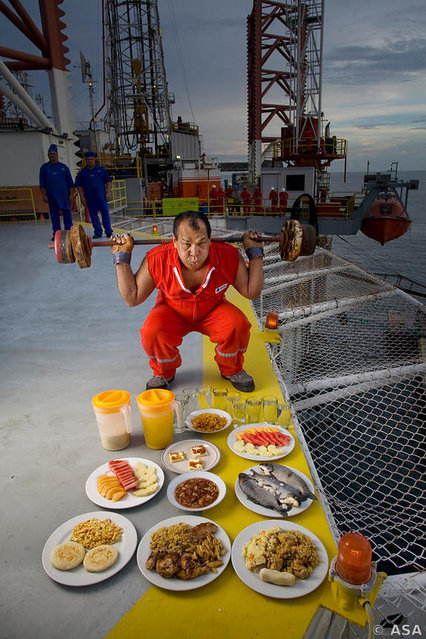
What the World Eats By Peter Menzel And Faith D'Aluisio Part 1

A stunning photographic collection featuring portraits of people from 30 countries and the food they eat in one day. In this fascinating study of people and their diets, 80 profiles are organized by the total number of calories each person puts away in a day. Featuring a Japanese sumo wrestler, a Massai herdswoman, world-renowned Spanish chef Ferran Adria, an American competitive eater, and more, these compulsively readable personal stories also include demographic particulars, including age, activity level, height, and weight. Essays from Harvard primatologist Richard Wrangham, journalist Michael Pollan, and others discuss the implications of our modern diets for our health and for the planet. This compelling blend of photography and investigative reportage expands our understanding of the complex relationships among individuals, culture, and food.
Details
23 Apr 2014 14:34:00
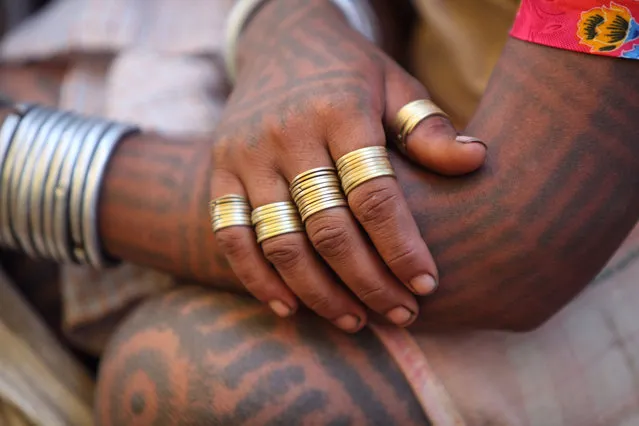
Once applied, the designs are washed using warm water and cow dung. Herbs are applied to promote faster healing. (Photo by Ronny Sen/WaterAid/The Guardian)

For more than 2,000 years, women from the Baiga tribe in the highland district of Dindori, in central India’s Madhya Pradesh state, have been tattooed. Sumintra, 25, from Bona village, has the markings across her forehead, legs and arms. The women who work as tattoo artists are knowledgable about the different types of designs and pigments preferred by various tribes, and their meanings are passed to them by their mothers. The tattooing ‘season’ begins with the approach of winter. (Photo by Ronny Sen/WaterAid/The Guardian)
Details
19 Aug 2017 08:48:00
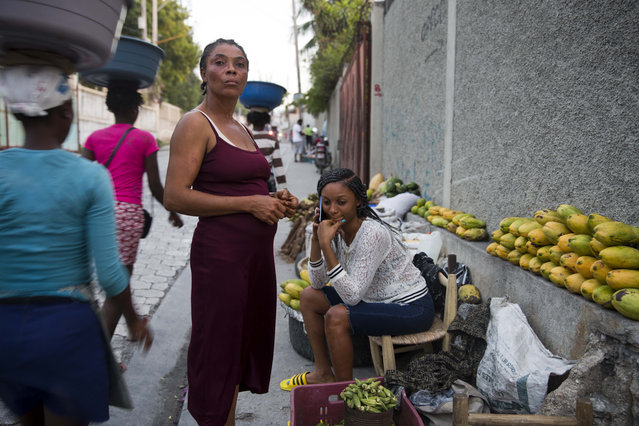
In this November 27, 2019 photo, Wadlande Pierre, right, talks on her mobile phone as she helps her mother, Vanlancia Julien, center, at their fruit and vegetable stand on a sidewalk in Delmas, a district of in Port-au-Prince, Haiti. Pierre, 23, said she temporarily moved in with her aunt in the southwest town of Les Cayes to escape the violent protests in Port-au-Prince. However, she had to move back to the capital because there was no gas, power or water in Les Cayes, and food was becoming scarce. (Photo by Dieu Nalio Chery/AP Photo)

In this November 27, 2019 photo, Wadlande Pierre, right, talks on her mobile phone as she helps her mother, Vanlancia Julien, center, at their fruit and vegetable stand on a sidewalk in Delmas, a district of in Port-au-Prince, Haiti. Pierre, 23, said she temporarily moved in with her aunt in the southwest town of Les Cayes to escape the violent protests in Port-au-Prince. However, she had to move back to the capital because there was no gas, power or water in Les Cayes, and food was becoming scarce. (Photo by Dieu Nalio Chery/AP Photo)
Details
01 Feb 2020 00:05:00
Zhao Deli waves as he pilots his self-made “flying scooter” in Dongguan, Guangdong Province, China, 12 August 2018 (issued 16 August 2018). Inspired by a cartoon he watched as a child, Zhao Deli sold off his apartment in pursuit of his dream of building a flying scooter. (Photo by Aleksandar Plavevski/EPA/EFE)

Zhao Deli waves as he pilots his self-made “flying scooter” in Dongguan, Guangdong Province, China, 12 August 2018 (issued 16 August 2018). Inspired by a cartoon he watched as a child, Zhao Deli sold off his apartment in pursuit of his dream of building a flying scooter. (Photo by Aleksandar Plavevski/EPA/EFE)
Details
06 Sep 2018 00:05:00
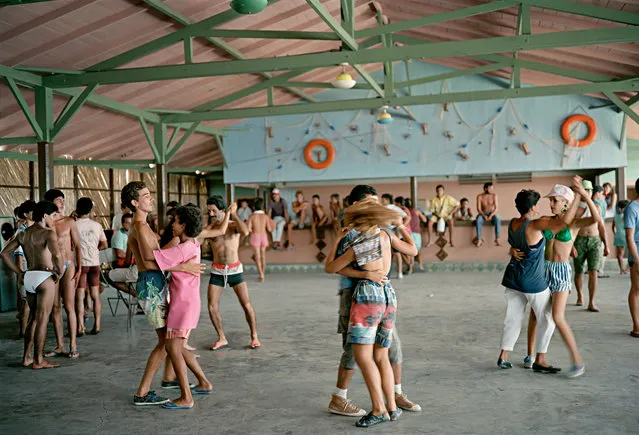
Giovan set out to capture the people’s resilience, during what Fidel Castro, with typical hyperbole, called the “special period”. (Photo by Tria Giovan/The Guardian)

As an American in 1990s Cuba, Tria Giovan risked being branded a traitor. But the photographer continued to visit and, from the dance hall to the hair salon, she captured the resilient spirit of the Cuban people. The 120 images in Tria Giovan’s “The Cuba Archive” are from the period in the 90s when, as an American, travel to Cuba could have seen her branded a traitor, as the country was subject to a US trade embargo. Her trip required lots of planning – and patience. (Photo by Tria Giovan/The Guardian)
Details
21 Sep 2017 09:04:00
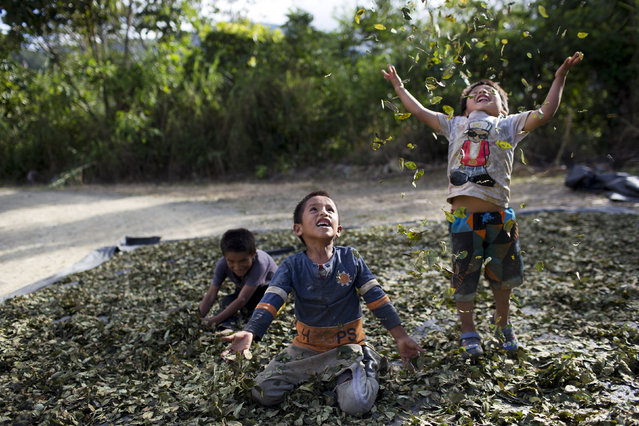
In this March 13, 2015 photo,  Yohan, 4, from left, Cristian, 7, and Angelo, 6, playfully toss coca leaves into the air, singing: “I have a lot of money, look at all the money I have”, in La Mar, province of Ayacucho, Peru. Hauling cocaine out of the remote valley is about the only way to earn decent cash in this region where a farmhand earns less than $10 a day. Beyond extinguishing young lives, the practice has packed Peru's highland prisons with cocaine backpackers while their bosses evade incarceration. (Photo by Rodrigo Abd/AP Photo)

In this March 13, 2015 photo, Yohan, 4, from left, Cristian, 7, and Angelo, 6, playfully toss coca leaves into the air, singing: “I have a lot of money, look at all the money I have”, in La Mar, province of Ayacucho, Peru. Hauling cocaine out of the remote valley is about the only way to earn decent cash in this region where a farmhand earns less than $10 a day. Beyond extinguishing young lives, the practice has packed Peru's highland prisons with cocaine backpackers while their bosses evade incarceration. (Photo by Rodrigo Abd/AP Photo)
Details
12 May 2015 12:40:00
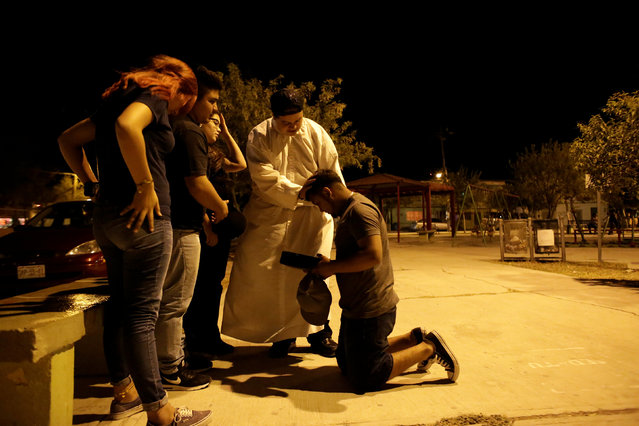
An aspiring Catholic priest Jose Luis Guerra, a member of Raza Nueva in Christ, a project of the archdiocese of Monterrey, and other missionaries hand out a Bible to Angel Castillo, who wants to become a missionary with Raza Nueva, in the municipality of Garcia, outskirts of Monterrey, Mexico, July 12, 2016. (Photo by Daniel Becerril/Reuters)

An aspiring Catholic priest Jose Luis Guerra, a member of Raza Nueva in Christ, a project of the archdiocese of Monterrey, and other missionaries hand out a Bible to Angel Castillo, who wants to become a missionary with Raza Nueva, in the municipality of Garcia, outskirts of Monterrey, Mexico, July 12, 2016. In the troubled fringes of the northern Mexican city of Monterrey, an aspiring priest is using his faith to reach out to young gang members and at-risk youth, and bring them into his “Gang of Christ”. (Photo by Daniel Becerril/Reuters)
Details
28 Jul 2016 13:22:00
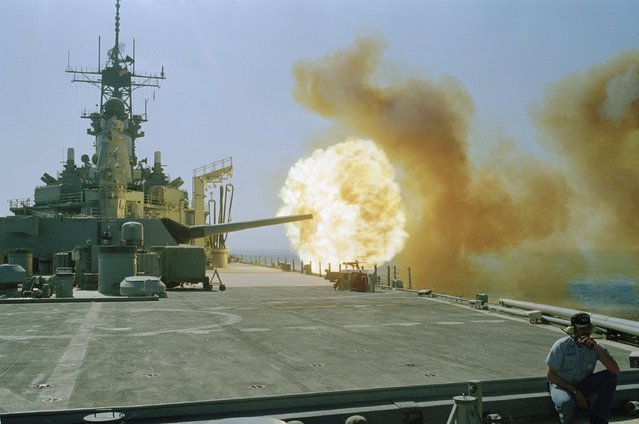
A fireball erupts from a 16-inch gun on the battleship USS Wisconsin during a live fire exercise in the Persian Gulf, October 13, 1990. The ship is in the Gulf as part of Operation Desert Shield. (Photo by John Gaps III/AP Photo)

A fireball erupts from a 16-inch gun on the battleship USS Wisconsin during a live fire exercise in the Persian Gulf, October 13, 1990. The ship is in the Gulf as part of Operation Desert Shield. (Photo by John Gaps III/AP Photo)
Details
15 Oct 2015 08:04:00