Loading...
Done
Interim Authority Forces Target Sirte

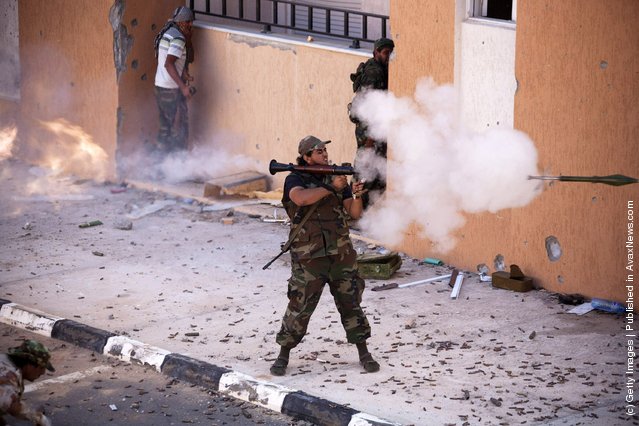
A National Transitional Council (NTC) fighter fires an RPG during a street battle in the 700 complex area of “Emarat” against Muammar Gaddafi's troops on October 8, 2011 in Sirte, Libya. NTC fighters say this is the final assault on Muammar Gaddafi's home town as they capture the main hospital, University and the Ouagadougou conference centre in the city. (Photo by Majid Saeedi/Getty Images)
Details
11 Oct 2011 07:41:00
Cat Bags By Pico

These cat hand bags are painstakingly crafted by Pico, a Japanese housewife who loves cats. The difficulty in making these bags means that they often aren’t available, and when they are, they’re only sold on Yahoo! Auction Japan. How much do bags like these go for? The three-color cat below ended up selling for about 700 USD!
Details
21 Oct 2015 09:02:00
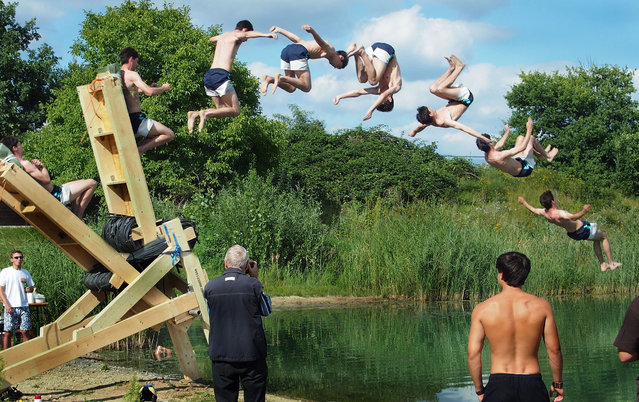
Two brothers have built a human catapult to fly into a lake. Johannes Schrieber, 26, and his brother Daniel, 28, from Frankfurt, Germany built the wooden contraption, which can fire people five metres into the sky and 12 metres away. The brothers raised more than £700 through crowdfunding to buy the materials, with every penny well spent as nobody has died yet! (Photo by Caters News)

Two brothers have built a human catapult to fly into a lake. Johannes Schrieber, 26, and his brother Daniel, 28, from Frankfurt, Germany built the wooden contraption, which can fire people five metres into the sky and 12 metres away. The brothers raised more than £700 through crowdfunding to buy the materials, with every penny well spent as nobody has died yet! (Photo by Caters News)
Details
31 Aug 2014 08:37:00
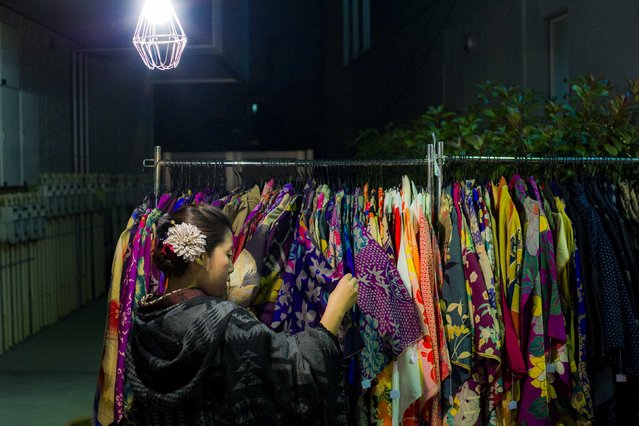
A woman browses through kimonos for sale at Boroichi flea market in Tokyo December 15, 2014. In the 16th century, Boroichi was a place for farmers to buy and sell rags, known as boro, for mending clothes and weaving sandals. Now in its 436th year, the original spirit lingers, with about 700 stands hawking fabric, used clothes and piles of rags. Others sell kitchen tools, pottery, seaweed and spices. (Photo by Thomas Peter/Reuters)

A woman browses through kimonos for sale at Boroichi flea market in Tokyo December 15, 2014. In the 16th century, Boroichi was a place for farmers to buy and sell rags, known as boro, for mending clothes and weaving sandals. Now in its 436th year, the original spirit lingers, with about 700 stands hawking fabric, used clothes and piles of rags. Others sell kitchen tools, pottery, seaweed and spices. About 200,000 people flock to the market, which is only open for four mid-winter days a year – two in December and two in January. (Photo by Thomas Peter/Reuters)
Details
19 Dec 2014 12:50:00
A woman reacts as she lays flowers outside the Perm State University following a campus shooting in Perm, about 1,100 kilometers (700 miles) east of Moscow, Russia, Tuesday, September 21, 2021. A student opened fire at the university, leaving a number of people dead and injured, before being shot in a crossfire with police and detained. Beyond saying that he was a student, authorities offered no further information on his identity or a possible motive. (Photo by Dmitri Lovetsky/AP Photo)

A woman reacts as she lays flowers outside the Perm State University following a campus shooting in Perm, about 1,100 kilometers (700 miles) east of Moscow, Russia, Tuesday, September 21, 2021. A student opened fire at the university, leaving a number of people dead and injured, before being shot in a crossfire with police and detained. Beyond saying that he was a student, authorities offered no further information on his identity or a possible motive. (Photo by Dmitri Lovetsky/AP Photo)
Details
21 Sep 2021 09:19:00
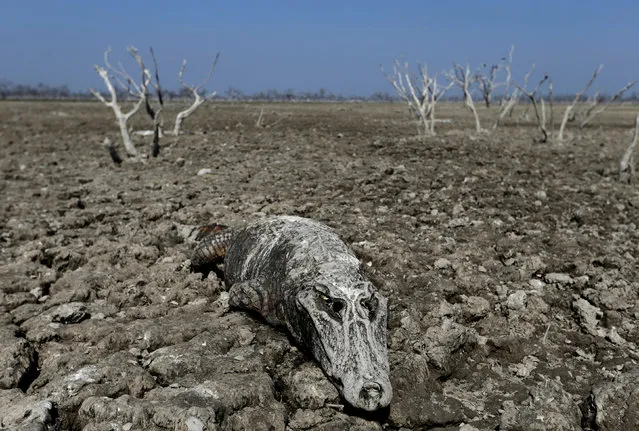
The carcass of a yacare caiman lies in the dried-up river bed of the Pilcomayo river in Boqueron, Paraguay, August 14, 2016. In Paraguay, alongside the Pilcomayo River, black vultures flew over a shrinking pond where a group of crocodilian reptiles known as yacare caimans sought refuge. Water from the river, which divides Paraguay and Argentina in the area of the Gran Chaco, was scarce. This is not an uncommon sight in the region of General Diaz, about 700 kilometres (435 miles) northwest of the country's capital Asuncion, where the Pilcomayo's waters form lakes and streams that give life to capybaras, birds and caimans. “The river's situation is critical. No water is forecast to enter the basin until December, as happens every year”, said Alcides Gonzalez, a resident of the area. (Photo by Jorge Adorno/Reuters)

The carcass of a yacare caiman lies in the dried-up river bed of the Pilcomayo river in Boqueron, Paraguay, August 14, 2016. In Paraguay, alongside the Pilcomayo River, black vultures flew over a shrinking pond where a group of crocodilian reptiles known as yacare caimans sought refuge. Water from the river, which divides Paraguay and Argentina in the area of the Gran Chaco, was scarce. This is not an uncommon sight in the region of General Diaz, about 700 kilometres (435 miles) northwest of the country's capital Asuncion, where the Pilcomayo's waters form lakes and streams that give life to capybaras, birds and caimans. (Photo by Jorge Adorno/Reuters)
Details
03 Nov 2016 12:40:00
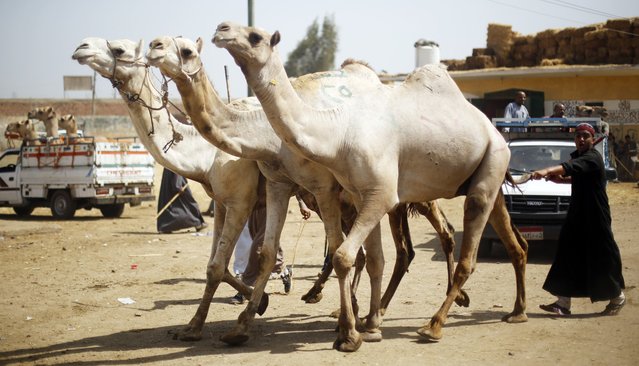
A man walks behind camels at the Birqash Camel Market, ahead of Eid al-Adha or Festival of Sacrifice, on the outskirts of Cairo September 29, 2014. (Photo by Amr Abdallah Dalsh/Reuters)

A man walks behind camels at the Birqash Camel Market, ahead of Eid al-Adha or Festival of Sacrifice, on the outskirts of Cairo September 29, 2014. Birqash Camel Market, one of the biggest markets for camel meat in Africa, draws sellers from Libya, Sudan, Somalia and other regions in Egypt. The camels sold at the market are also used in tourism. Traders say that the selling rate for a camel in 2014 is anywhere between 5,000 and 20,000 Egyptian pounds (700 – 2800 USD). (Photo by Amr Abdallah Dalsh/Reuters)
Details
02 Oct 2014 10:20:00
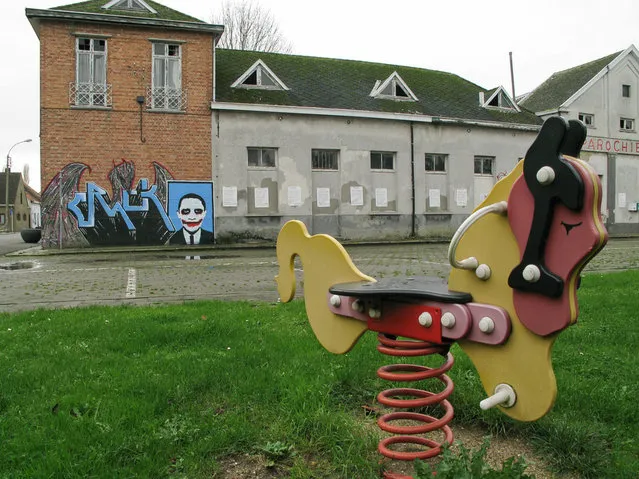
Abandon Village: Doel, Belgium

Doel is a 700 year old village on the river Scheldt in Belgium. Near to the local nuclear power plant, with its two giant cooling towers, it became the target for demolition not once but twice in order to make way for the ever expanding harbor. The successful protest groups of the seventies could not compete in the 90's and as residents began to leave, the government refused to rent out the properties again and instead let them fall into disrepair. On the 23rd of March 2007, the government decided that the village would be demolished by 2009 and in June 2008, residents received a letter informing them that they were to vacate their homes by the 1st of September 2009.
Details
20 Mar 2013 11:33:00