Loading...
Done
The Topography Of Tears By Rose-Lynn Fisher

Do tears of joy look the same as ones of woe—or ones from chopping onions? In “The Topography of Tears,” the Los Angeles-based photographer Rose-Lynn Fisher explores the physical terrain of one hundred tears emitted during a range of emotional states and physical reactions. Using a Zeiss microscope with an attached digital camera, she captures the composition of tears enclosed in glass slides, magnified between 10x and 40x. “There are many factors that determine the look of each tear image, including the viscosity of the tear, the chemistry of the weeper, the settings of the microscope, and the way I process the images afterwards,” she says.
Details
21 May 2014 17:46:00
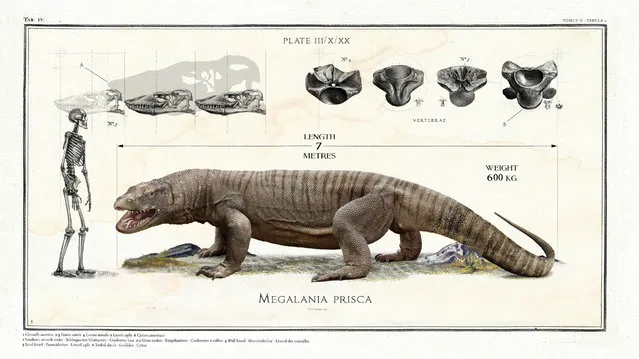
Fossil records indicate that this early lizard, Megalina prisca, was a whopping seven metres in length. (Photo by Sky TV/The Guardian)

Fossil records indicate that this early lizard, Megalania (Megalania prisca or Varanus priscus), was a whopping seven metres in length. They were part of a megafaunal assemblage that inhabited southern Australia during the Pleistocene. The youngest fossil remains date to around 50,000 years ago. The first aboriginal settlers of Australia might have encountered them and been a factor in their extinction. (Photo by Sky TV/The Guardian)
Details
12 Jun 2018 00:05:00
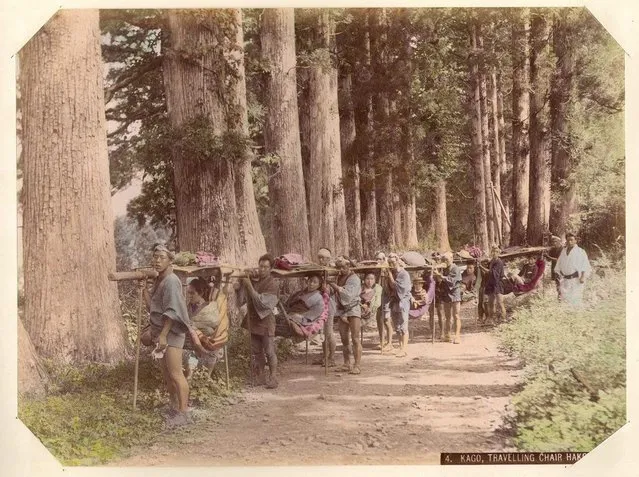
Traveling Chairso n Hakone Road

Traveling Chairso n Hakone Road. (Photo by Kusakabe Kimbei)
Details
02 May 2012 11:46:00
Isabel Schmalenbach, an environmental scientist with the Helgoland Biological Institute (Biologische Anstalt Helgoland), part of the Alfred Wegener Institute for Polar and Marine Research, holds a one-year old baby European lobster (Homarus gammarus) raised at the institute on August 3, 2013 on Helgoland Island, Germany. (Photo by Sean Gallup/Getty Images)

Isabel Schmalenbach, an environmental scientist with the Helgoland Biological Institute (Biologische Anstalt Helgoland), part of the Alfred Wegener Institute for Polar and Marine Research, holds a one-year old baby European lobster (Homarus gammarus) raised at the institute on August 3, 2013 on Helgoland Island, Germany. Later in the day Schmalenbach and her colleagues released a total of 415 one-year old lobsters into the North Sea as part of an effort to repopulate the lobster population around Helgoland (also called Heligoland). In the 19th century local fishermen caught up to 80,000 lobsters a year in the surrounding waters, combined with the heavy allied bombing of the island during and after World War II, as well as other environmental factors, decimated the lobster population. (Photo by Sean Gallup)
Details
05 Aug 2013 08:39:00
Tin and Naing win live on a small boat which they sail throughout the Delta region in Myanmar. The former gardeners once had a home on land but it was destroyed when a powerful cyclone ravaged the area in 2008. Since then, the couple have not been able to afford to rebuild their home, so they live on the boat from which they sell fish paste to make a living. (Photo by Muse Mohammed/IOM)

The ferocity of crises worldwide is forcing a record number of people to flee their homes, seeking some form of safety within their own country or across international borders. There are 65.3 million displaced people worldwide, including 21.3 million refugees. Most have lost their homes to armed conflict or natural disasters but other factors, such as extreme poverty and climate change, also drive displacement. The International Organisation for Migration commissioned photojournalist Muse Mohammed to document the plight of the displaced. (Photo by Muse Mohammed/IOM)
Details
02 Jan 2017 12:04:00
Nina Bahinskaya, 73, poses for a photo holding an old Belarusian national flag at an entrance of her apartment building in Minsk, Belarus, Thursday, September 10, 2020. The 73-year-old former geologist has become one of the most recognizable faces of Belarus protests, fearlessly waving a huge opposition's red-and-white flag in front of riot police. (Photo by AP Photo/Stringer)

Nina Bahinskaya, 73, poses for a photo holding an old Belarusian national flag at an entrance of her apartment building in Minsk, Belarus, Thursday, September 10, 2020. The 73-year-old former geologist has become one of the most recognizable faces of Belarus protests, fearlessly waving a huge opposition's red-and-white flag in front of riot police. (Photo by AP Photo/Stringer)
Details
22 Sep 2020 00:05:00
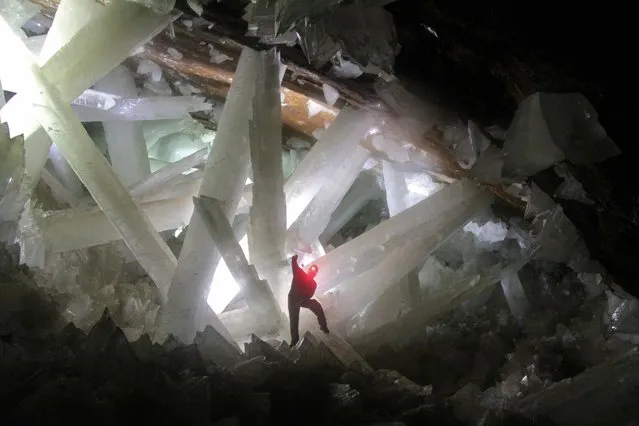
Giant Crystal Cave in Naica, Mexico

Cave of the Crystals or Giant Crystal Cave is a cave connected to the Naica Mine 300 metres (980 ft) below the surface in Naica, Chihuahua, Mexico. The main chamber contains giant selenite crystals (gypsum, CaSO4·2 H2O), some of the largest natural crystals ever found. The cave's largest crystal found to date is 12 m (39 ft) in length, 4 m (13 ft) in diameter and 55 tons in weight. The cave is extremely hot with air temperatures reaching up to 58 °C (136 °F) with 90 to 99 percent humidity. The cave is relatively unexplored due to these factors. Without proper protection people can only endure approximately ten minutes of exposure at a time.
Details
20 May 2014 07:56:00
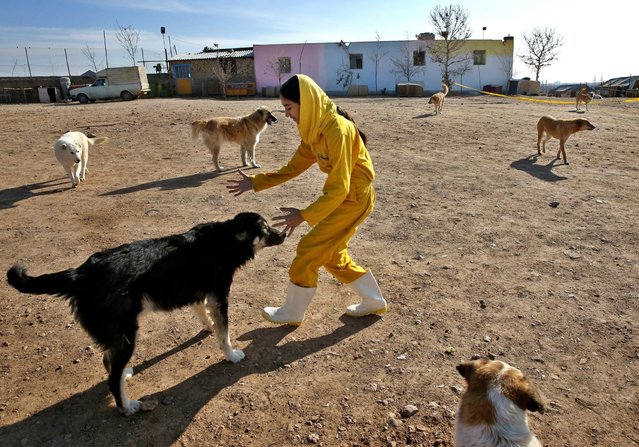
In this Friday, December 5, 2014 photo, Iranian volunteer Asal Moghaddam plays with dogs at the Vafa Animal Shelter in the city of Hashtgerd 43 miles (73 kilometers) west of the capital Tehran, Iran. (Photo by Vahid Salemi/AP Photo)

In this Friday, December 5, 2014 photo, Iranian volunteer Asal Moghaddam plays with dogs at the Vafa Animal Shelter in the city of Hashtgerd 43 miles (73 kilometers) west of the capital Tehran, Iran. More than 500 dogs find care and affection at the Vafa Animal Shelter, which was established through an endowment in 2004 and is the country’s only licensed animal refuge. (Photo by Vahid Salemi/AP Photo)
Details
16 Dec 2014 13:02:00