Loading...
Done
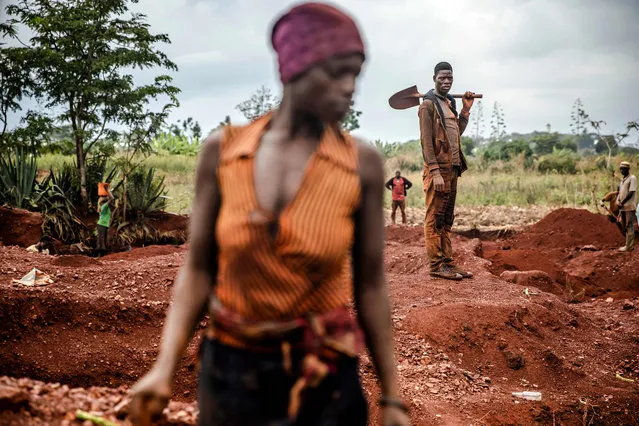
A gold miner observes from the distance how some women miners work at an open-pit gold mine in Nyarugusu, Geita Region, Tanzania on May 27, 2022. Tanzania is a land rich in minerals and one of the main gold producers in Africa, with gold representing more than 90% of the country's mineral exports. Artisanal and small-scale gold mining have culturally and historically relegated women's participation. The extractive sector in Tanzania has historically been a male-dominated industry with high levels of harassment, sеxual abuse, discrimination and misconceptions over women's involvement, and contributions following traditional beliefs. (Photo by Luis Tato/AFP Photo)

A gold miner observes from the distance how some women miners work at an open-pit gold mine in Nyarugusu, Geita Region, Tanzania on May 27, 2022. Tanzania is a land rich in minerals and one of the main gold producers in Africa, with gold representing more than 90% of the country's mineral exports. Artisanal and small-scale gold mining have culturally and historically relegated women's participation. The extractive sector in Tanzania has historically been a male-dominated industry with high levels of harassment, sеxual abuse, discrimination and misconceptions over women's involvement, and contributions following traditional beliefs. (Photo by Luis Tato/AFP Photo)
Details
13 Jun 2022 04:31:00
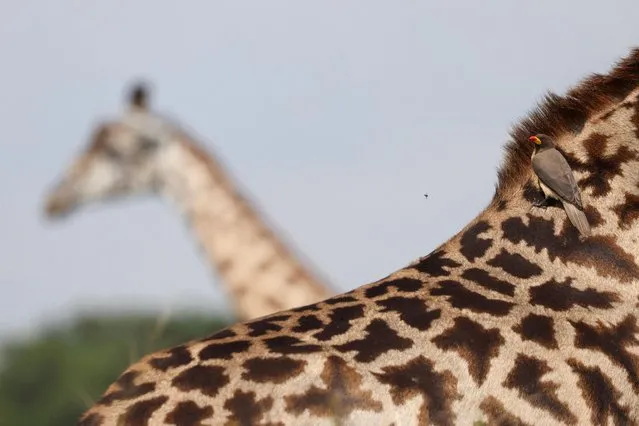
A yellow-billed oxpecker stands on a giraffe in the Masai Mara National Park, Kenya on September 3, 2022. (Photo by Baz Ratner/Reuters)

A yellow-billed oxpecker stands on a giraffe in the Masai Mara National Park, Kenya on September 3, 2022. (Photo by Baz Ratner/Reuters)
Details
09 Sep 2022 04:29:00
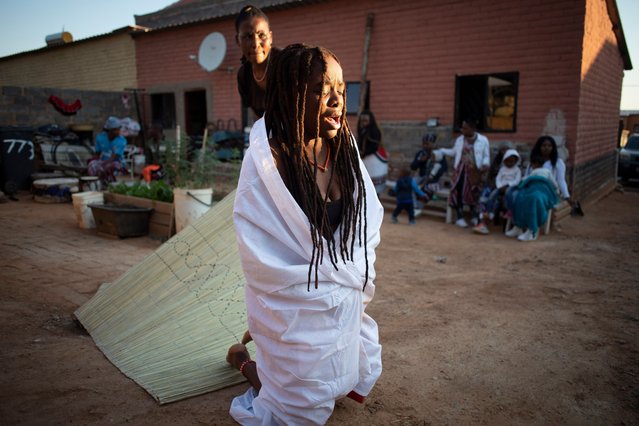
“Sangoma” initiate Dipuo Banda (C) is led out of her teachers shack while she remains in a trance like state prior to dancing during her 3 day initiation ceremony with her teacher, family, friends and students in the Alexandra Township in Johannesburg, South Africa, 14 May 2021. Sangomas, the Zulu term for Medicine Women or traditional healers, fulfill different social and political roles in the community, including divination, physical healing, emotional and spiritual illnesses, directing birth or death rituals and finding lost cattle. (Photo by Kim Ludbrook/EPA/EFE)

“Sangoma” initiate Dipuo Banda (C) is led out of her teachers shack while she remains in a trance like state prior to dancing during her 3 day initiation ceremony with her teacher, family, friends and students in the Alexandra Township in Johannesburg, South Africa, 14 May 2021. Sangomas, the Zulu term for Medicine Women or traditional healers, fulfill different social and political roles in the community, including divination, physical healing, emotional and spiritual illnesses, directing birth or death rituals and finding lost cattle. (Photo by Kim Ludbrook/EPA/EFE)
Details
28 May 2021 08:13:00
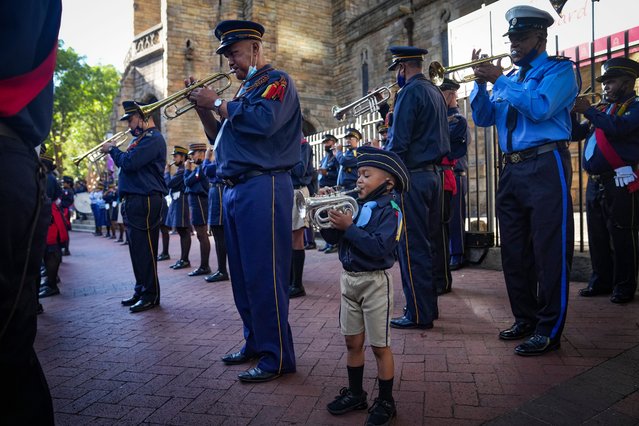
A young trumpeter joins the Anglican Church band as the coffin of late Archbishop Emeritus Desmond Tutu arrives outside the St. George's Cathedral in Cape Town, South Africa, 31 December 2021. The anti-apartheid leader and Nobel Peace Prize laureate, who was a key figure in the dismantling of apartheid, died on 26 December 2021 at the age of 90. A full state funeral will be held on 01 January 2022. (Photo by Nic Bothma/EPA/EFE)

A young trumpeter joins the Anglican Church band as the coffin of late Archbishop Emeritus Desmond Tutu arrives outside the St. George's Cathedral in Cape Town, South Africa, 31 December 2021. The anti-apartheid leader and Nobel Peace Prize laureate, who was a key figure in the dismantling of apartheid, died on 26 December 2021 at the age of 90. A full state funeral will be held on 01 January 2022. (Photo by Nic Bothma/EPA/EFE)
Details
07 Jan 2022 08:13:00
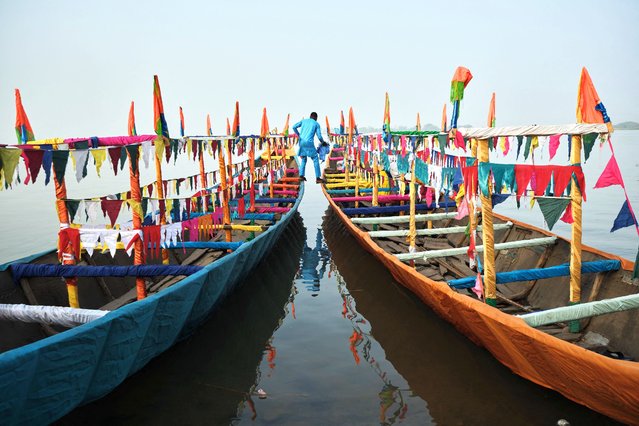
A man crosses from a pirogue to another pirogue during the annual boat regatta in Yauri, Kebbi State, on February 15, 2025. The regatta festival started about 200 years ago as a display of naval strength of the Gungu people, where the Gungu warriors annually attacked dangerous hippopotamus that were destroying farmlands. Warriors would board various sizes of canoes with different types of weapons to attack the animal on the River Niger. This required expertise in canoe paddling and naval warfare. It also served as training exercise for upcoming Gungu warriors. (Photo by Toyin Adedokun/AFP Photo)

A man crosses from a pirogue to another pirogue during the annual boat regatta in Yauri, Kebbi State, on February 15, 2025. The regatta festival started about 200 years ago as a display of naval strength of the Gungu people, where the Gungu warriors annually attacked dangerous hippopotamus that were destroying farmlands. Warriors would board various sizes of canoes with different types of weapons to attack the animal on the River Niger. This required expertise in canoe paddling and naval warfare. It also served as training exercise for upcoming Gungu warriors. (Photo by Toyin Adedokun/AFP Photo)
Details
25 Feb 2025 01:59:00
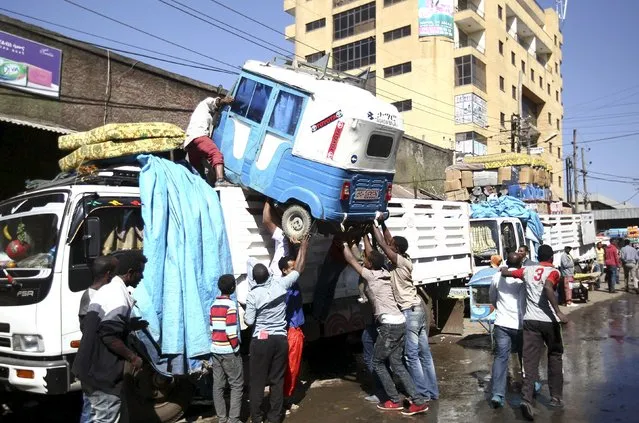
Labourers load a three-wheeled vehicle onto the back of a van at the Mercato market in Addis Ababa October 9, 2015. (Photo by Tiksa Negeri/Reuters)

Labourers load a three-wheeled vehicle onto the back of a van at the Mercato market in Addis Ababa October 9, 2015. Addis Ababa's “Mercato” – Italian for “market” – is reputedly the biggest open-air market in Africa, lying in the west of the capital. (Photo by Tiksa Negeri/Reuters)
Details
20 Dec 2015 08:06:00
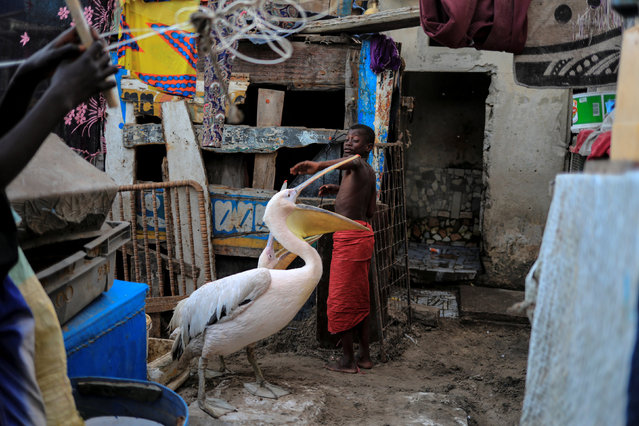
A boy plays with pelicans in Yoff, commune of Dakar, Senegal March 14, 2018. (Photo by Zohra Bensemra/Reuters)

A boy plays with pelicans in Yoff, commune of Dakar, Senegal March 14, 2018. (Photo by Zohra Bensemra/Reuters)
Details
28 Mar 2018 00:01:00
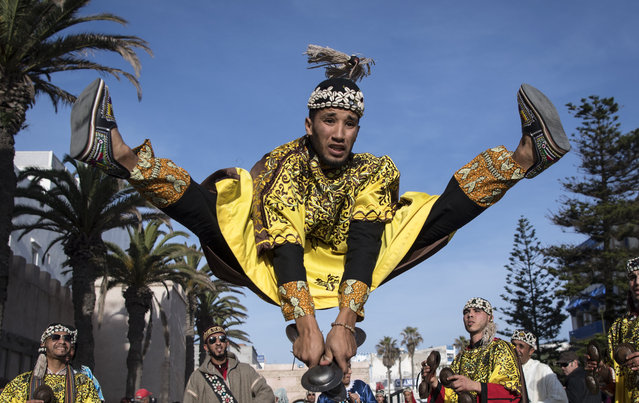
A Gnawa traditional group performs in the city of Essaouira on December 14, 2019, to celebrate the decision of adding the Gnawa culture to UNESCO's list of Intangible Cultural Heritage of Humanity. Gnawa culture, a centuries-old Moroccan practice rooted in music, African rituals and Sufi traditions, was added to UNESCO's list of Intangible Cultural Heritage of Humanity earlier in the week. Gnawa refers to a “set of musical productions, fraternal practices and therapeutic rituals where the secular mixes with the sacred”, according to the nomination submitted by Morocco. Often dressed in colourful outfits, Gnawa musicians play the guenbri, a type of lute with three strings, accompanied by steel castanets called krakebs. (Photo by Fadel Senna/AFP Photo)

A Gnawa traditional group performs in the city of Essaouira on December 14, 2019, to celebrate the decision of adding the Gnawa culture to UNESCO's list of Intangible Cultural Heritage of Humanity. Gnawa culture, a centuries-old Moroccan practice rooted in music, African rituals and Sufi traditions, was added to UNESCO's list of Intangible Cultural Heritage of Humanity earlier in the week. Gnawa refers to a “set of musical productions, fraternal practices and therapeutic rituals where the secular mixes with the sacred”, according to the nomination submitted by Morocco. Often dressed in colourful outfits, Gnawa musicians play the guenbri, a type of lute with three strings, accompanied by steel castanets called krakebs. (Photo by Fadel Senna/AFP Photo)
Details
18 Dec 2019 00:05:00