Loading...
Done
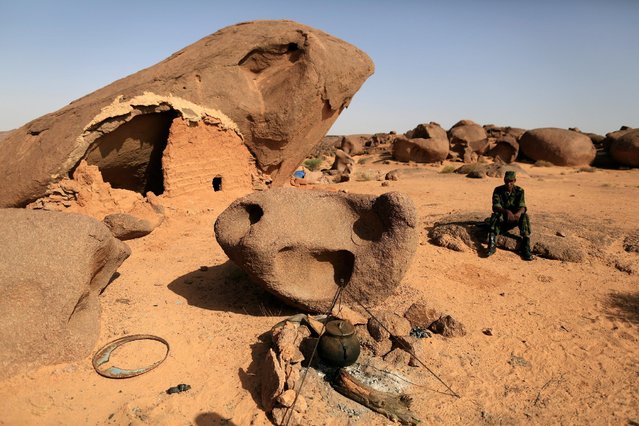
A Polisario fighter sits on a rock at a forward base on the outskirts of Tifariti, Western Sahara, September 9, 2016. At a rocky outpost in Western Sahara, a new generation of soldiers who have never known war are mobilising as tensions resurface in one of Africa's oldest disputes after a quarter century of uneasy peace. Young Sahrawi troops man new desert posts for the Polisario Front, which for more than 40 years has sought independence for the vast desert region - first in a guerrilla war against Morocco and then politically since a ceasefire deal in 1991. Now a standoff with Morocco, which controls the majority of Western Sahara, is renewing pressure for a diplomatic solution to ensure foot soldiers don't return to fighting as the last generation of commanders once did. The standoff since August has brought Moroccan and Polisario forces within 200 metres of each other in a narrow strip of land near the Mauritanian border. Rich in phosphate, Western Sahara has been contested since 1975 when Spanish colonial powers left. Morocco claimed the territory and fought the 16-year war with Polisario. (Photo by Zohra Bensemra/Reuters)

A Polisario fighter sits on a rock at a forward base on the outskirts of Tifariti, Western Sahara, September 9, 2016. At a rocky outpost in Western Sahara, a new generation of soldiers who have never known war are mobilising as tensions resurface in one of Africa's oldest disputes after a quarter century of uneasy peace. (Photo by Zohra Bensemra/Reuters)
Details
04 Nov 2016 12:09:00
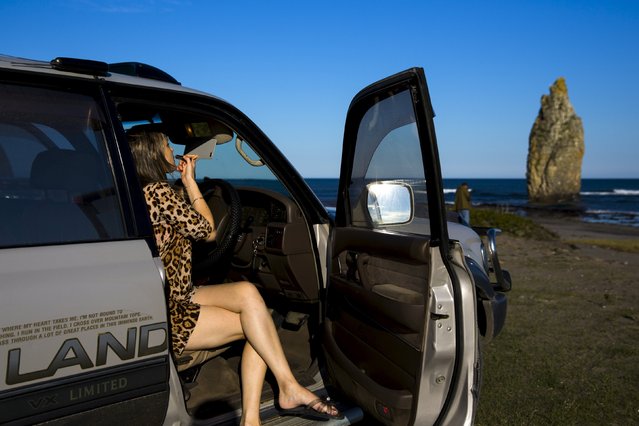
A woman applies lipstick in a car that is parked at a beach facing a volcanic rock called Devil's Finger outside Yuzhno-Kurilsk, the main settlement on the Southern Kurile island of Kunashir September 15, 2015. (Photo by Thomas Peter/Reuters)

A woman applies lipstick in a car that is parked at a beach facing a volcanic rock called Devil's Finger outside Yuzhno-Kurilsk, the main settlement on the Southern Kurile island of Kunashir September 15, 2015. Russian residents of the island chain at the centre of a dispute between Japan and Russia that has held up a treaty to formally end World War Two hope a diplomatic solution will lure tourists and investment to help refurbish rickety infrastructure. The Southern Kuriles are referred to in Japan as the Northern Territories. (Photo by Thomas Peter/Reuters)
Details
28 Sep 2015 08:03:00
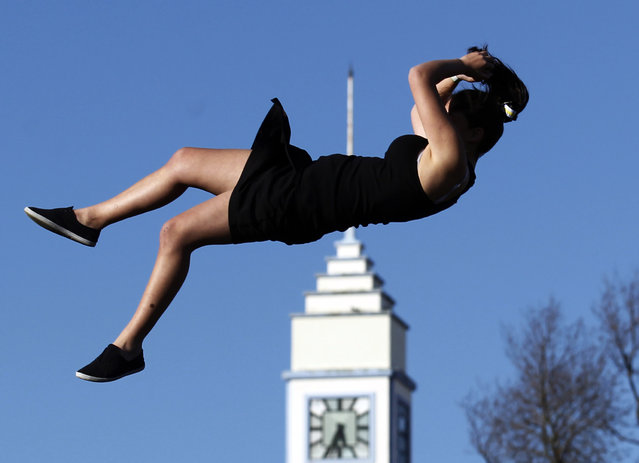
8. NEW ZEALAND: A woman dives from a platform into a giant air bed at a park in Palmerston North September 29, 2011. (Photo by Marcos Brindicci/Reuters)

The report, prepared by the Sustainable Development Solutions Network (SDSN) and the Earth Institute at Columbia University, showed Syria, Afghanistan and eight sub-Saharan countries as the 10 least happy places on earth to live. The top 10 this year were Denmark, Switzerland, Iceland, Norway, Finland, Canada, Netherlands, New Zealand, Australia, and Sweden. Denmark was in third place last year, behind Switzerland and Iceland. The bottom 10 were Madagascar, Tanzania, Liberia, Guinea, Rwanda, Benin, Afghanistan, Togo, Syria and Burundi. The United States came in at 13, the United Kingdom at 23, France at 32, and Italy at 50. Here: #8. NEW ZEALAND: A woman dives from a platform into a giant air bed at a park in Palmerston North September 29, 2011. (Photo by Marcos Brindicci/Reuters)
Details
26 Mar 2016 13:19:00
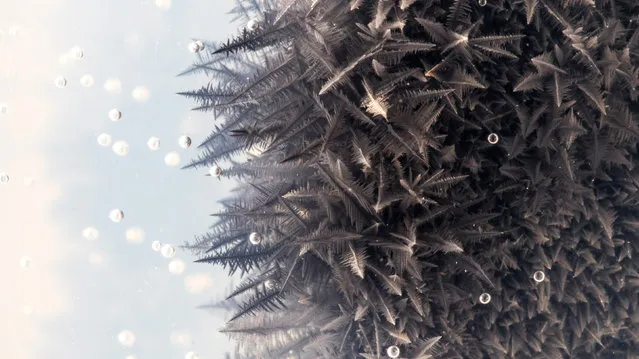
Zinc reacting with lead nitrate in a soft gel to form lead crystals. (Photo by Yan Liang/Caters News)

These beautiful shots may look like works of modern art – but they are actually close-ups of chemical reactions. The works were snapped with the help of a group of scientists from the University of Science and Technology of China (USTC) in Anhui, China. Here: Zinc reacting with lead nitrate in a soft gel to form lead crystals. (Photo by Yan Liang/Caters News)
Details
23 Oct 2014 11:33:00
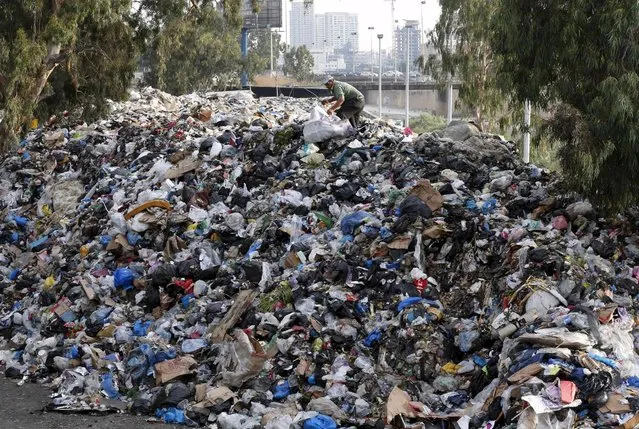
A scavenger sifts through garbage piled on the bank of Beirut river, Lebanon August 24, 2015. Lebanese protest organisers called for a fresh demonstration against the government on Saturday after two days of rallies that turned violent in central Beirut and wounded scores of people. (Photo by Mohamed Azakir/Reuters)

A scavenger sifts through garbage piled on the bank of Beirut river, Lebanon August 24, 2015. Lebanese protest organisers called for a fresh demonstration against the government on Saturday after two days of rallies that turned violent in central Beirut and wounded scores of people. The “You Stink” campaign has mobilised against the government's failure to solve a garbage disposal crisis, bringing thousands of people onto the streets in protests that have threatened the survival of the cabinet. (Photo by Mohamed Azakir/Reuters)
Details
25 Aug 2015 11:01:00
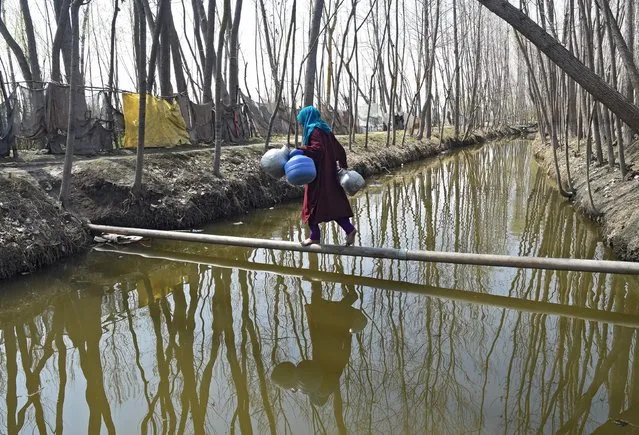
A Kashmiri Muslim woman balances on a water pipe before collecting water at Dasilpora village on March 22, 2018. World Water Day is held annually on 22 March as a means of focusing attention on the importance of freshwater and advocating for the sustainable management of freshwater resources. (Photo by Tauseef Mustafa/AFP Photo)

A Kashmiri Muslim woman balances on a water pipe before collecting water at Dasilpora village on March 22, 2018. World Water Day is held annually on 22 March as a means of focusing attention on the importance of freshwater and advocating for the sustainable management of freshwater resources. (Photo by Tauseef Mustafa/AFP Photo)
Details
24 Mar 2018 06:20:00
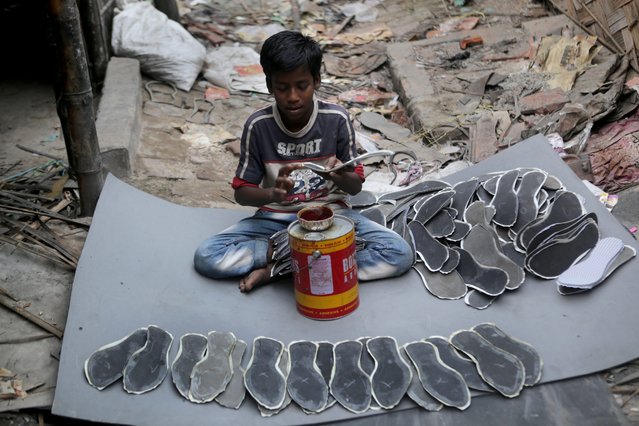
Indian boy Hassan Malik works in a leather shoe factory at Topsia in Calcutta, eastern India, 19 November 2013. (Photo by Piyal Adhikary/EPA)

Indian boy Hassan Malik works in a leather shoe factory at Topsia in Calcutta, eastern India, 19 November 2013. The leather industry occupies an important place in the Indian economy. It is an employment intensive sector with a vast potential for growth and exports but also a pollution intensive industry that relies on cheap labor. One of the major production centers for leather and leather products is located in Calcutta, West Bengal. Hundreds of tanneries are operated in the city’s Tiljala, Topsia and Tangra districts. They are mostly run by local families living and working under poor conditions. (Photo by Piyal Adhikary/EPA)
Details
20 Mar 2014 09:40:00
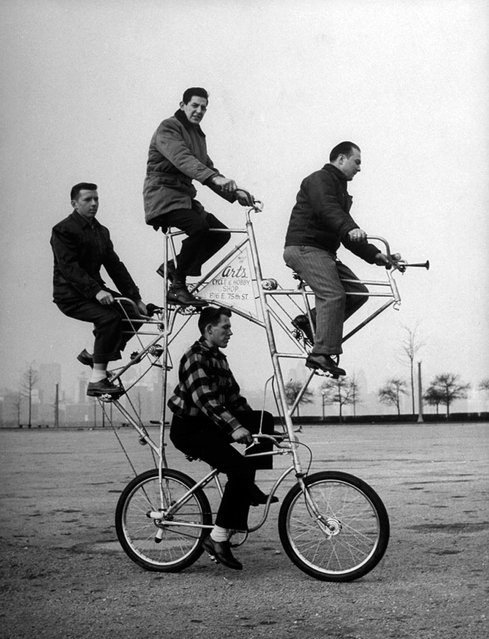
Four-man bicycle is powered by five chains and has brakes on both its wheels, 1948. The bike was built by Art Rothschild (top position) who broke three ribs while learning how to ride it. (Photo by Wallace Kirkland/Time & Life Pictures)

Four-man bicycle is powered by five chains and has brakes on both its wheels, 1948. The bike was built by Art Rothschild (top position) who broke three ribs while learning how to ride it. (Photo by Wallace Kirkland/Time & Life Pictures)
Details
05 May 2013 11:17:00