Loading...
Done
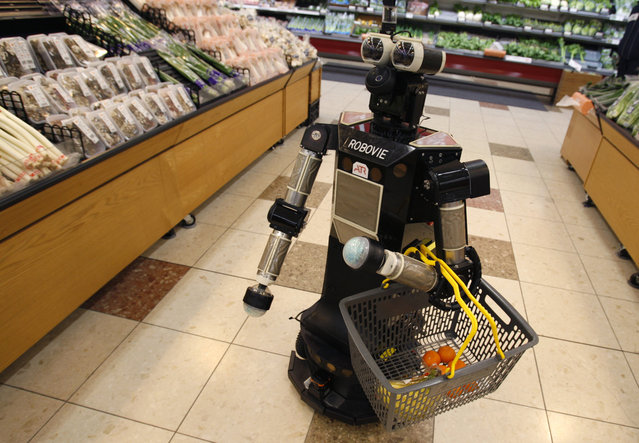
A robot named “Robovie-II”, developed by Japanese robotics research institution ATR, moves around at a grocery store during a shopping assisting experiment by utilizing the robot in an ubiquitous network technology platform in Kyoto, western Japan January 6, 2010. The robot greets the shopper at the entrance of the store, follows him to the shelves while holding a grocery basket and reminds him of the items on a shopping list, which the shopper would have entered beforehand in a specialized mobile device. The experiment is aimed to gather data in order to provide livelihood support for the elderly by using robots and network technologies, ATR's researcher Satoshi Koizumi said. (Photo by Yuriko Nakao/Reuters)

A robot named “Robovie-II”, developed by Japanese robotics research institution ATR, moves around at a grocery store during a shopping assisting experiment by utilizing the robot in an ubiquitous network technology platform in Kyoto, western Japan January 6, 2010. (Photo by Yuriko Nakao/Reuters)
Details
02 Feb 2018 06:54:00
A man walking his dog in a park made using chalk and keys. (Photo by Stanislav Aristov/Caters News)

“This quirky collection of photos proves that a little imagination is the key to a good a picture. By simply using a collection of keys and a strip of chalk, photographer, Stanislav Aristov, 32, is able to re-create everyday scenes and objects. Stanislav wanted to show that even the simplest of items can help change your view on the world. After acquiring a large selection of keys from friends and family as well as local charity shops, Stanislav then went about scrawling anything from a key shaped rain drops to a key-eyed crab”. – Caters News. Photo: A man walking his dog in a park made using chalk and keys. (Photo by Stanislav Aristov/Caters News)
Details
22 Aug 2014 12:11:00
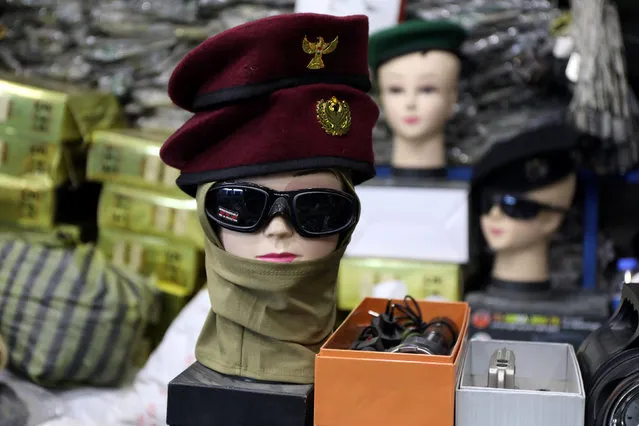
Military items for women are seen in a store in Erbil, Iraq January 24, 2017. (Photo by Marius Bosch/Reuters)

Military items for women are seen in a store in Erbil, Iraq January 24, 2017. (Photo by Marius Bosch/Reuters)
Details
28 Jan 2017 07:06:00
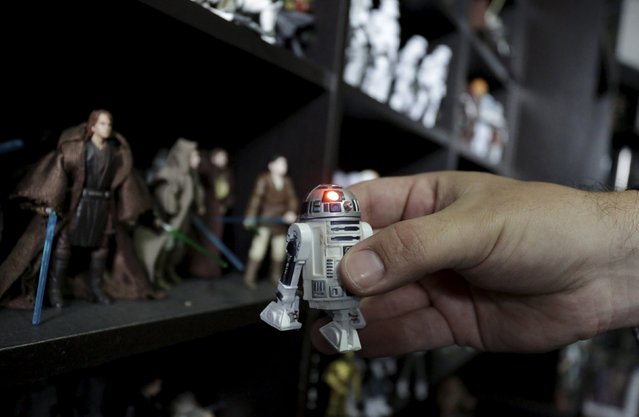
Mexican collector Pablo Perez, holds up a Star Wars R2-D2 toy while he displays a toy collection of Star Wars characters and items at his home in Monterrey, Mexico December 12, 2015. (Photo by Daniel Becerril/Reuters)

Mexican collector Pablo Perez, holds up a Star Wars R2-D2 toy while he displays a toy collection of Star Wars characters and items at his home in Monterrey, Mexico December 12, 2015. Perez has collected more than 3,000 toys and items from the Star Wars movie series over 10 years, local media reported. (Photo by Daniel Becerril/Reuters)
Details
15 Dec 2015 08:00:00
Carlos Cure holds packets of corn flour made in Colombia as he poses for a picture at a stall that sells food and staple items at a market in La Fria, Venezuela, June 2, 2016. (Photo by Carlos Garcia Rawlins/Reuters)

Carlos Cure holds packets of corn flour made in Colombia as he poses for a picture at a stall that sells food and staple items at a market in La Fria, Venezuela, June 2, 2016. (Photo by Carlos Garcia Rawlins/Reuters)
Details
09 Jun 2016 09:09:00
A Somali woman shows traditional items and food during an event to showcase traditional Somali culture in Hamarweyne district in the capital Mogadishu, December 3, 2015. (Photo by Feisal Omar/Reuters)

A Somali woman shows traditional items and food during an event to showcase traditional Somali culture in Hamarweyne district in the capital Mogadishu, December 3, 2015. (Photo by Feisal Omar/Reuters)
Details
05 Dec 2015 08:05:00
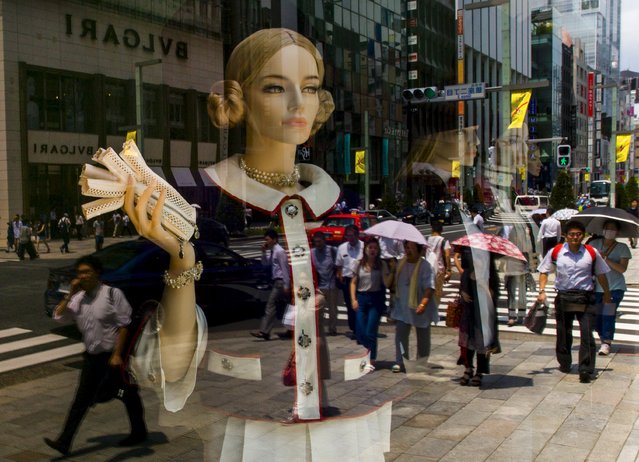
People are reflected in a shop window as they walk along a street in a shopping district in Tokyo, Japan June 25, 2015. (Photo by Thomas Peter/Reuters)

People are reflected in a shop window as they walk along a street in a shopping district in Tokyo, Japan June 25, 2015. (Photo by Thomas Peter/Reuters)
Details
19 Sep 2015 12:50:00
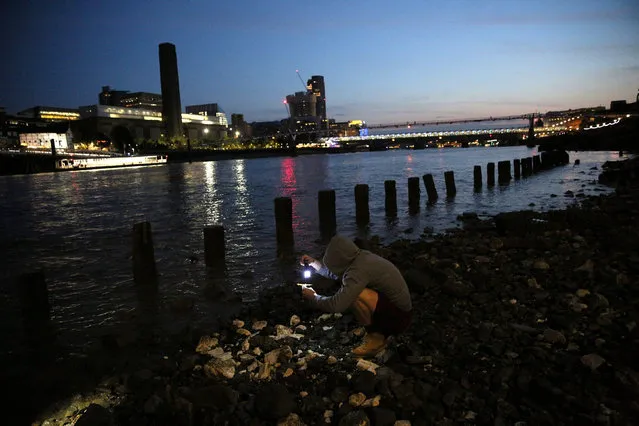
A mudlark uses a torch to look for items on the bank of the River Thames in London, Britain June 06, 2016. Mudlarking is believed to trace its origins to the 18th and 19th century, when scavengers searched the Thames' shores for items to sell. These days, history and archaeology fans are the ones hoping to find old relics such as coins, ceramics, artifacts or everyday items from across centuries. They wait for the low tide and then scour specific areas of exposed shores. "If you're in a field you could be out all day long, with the river you're restricted to about two or three hours," mudlark Nick Stevens said. While many just use the naked eye for their searches, others rely on metal detectors for which a permit from the Port of London Authority is needed. Digging also requires consent. (Photo by Neil Hall/Reuters)

A mudlark uses a torch to look for items on the bank of the River Thames in London, Britain June 06, 2016. Mudlarking is believed to trace its origins to the 18th and 19th century, when scavengers searched the Thames' shores for items to sell. These days, history and archaeology fans are the ones hoping to find old relics such as coins, ceramics, artifacts or everyday items from across centuries. their finds with the Portable Antiquities Scheme. Any item over 300 years old must be recorded. (Photo by Neil Hall/Reuters)
Details
27 Aug 2016 10:43:00