Loading...
Done
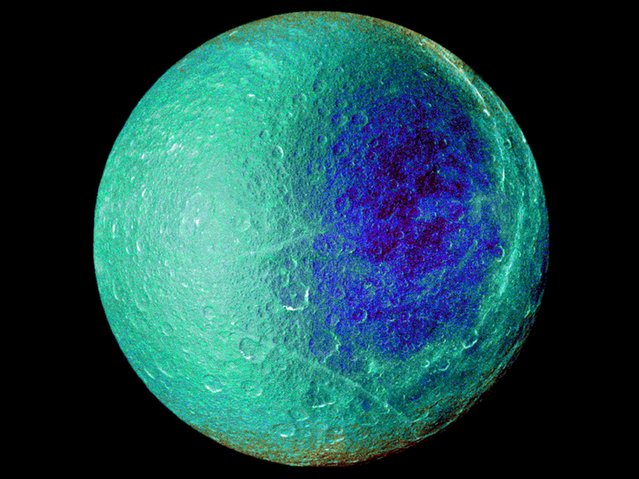
Hemispheric color differences on Saturn's moon Rhea are apparent in this false-color view from NASA's Cassini spacecraft in this March 2, 2010 file photo. (Photo by Reuters/NASA/JPL/SSI)

Hemispheric color differences on Saturn's moon Rhea are apparent in this false-color view from NASA's Cassini spacecraft in this March 2, 2010 file photo. (Photo by Reuters/NASA/JPL/SSI)
Details
16 Nov 2015 08:14:00
Handout grab taken from YouTube of Commander Chris Hadfield who has said goodbye to life on the International Space Station by making a cover version of David Bowie's Space Oddity. Issue date: Monday May 13, 2013. (Photo by Commander Chris Hadfield/YouTube/PA Wire)

Handout grab taken from YouTube of Commander Chris Hadfield who has said goodbye to life on the International Space Station by making a cover version of David Bowie's Space Oddity. Issue date: Monday May 13, 2013. (Photo by Commander Chris Hadfield/YouTube/PA Wire)
Details
14 May 2013 12:37:00
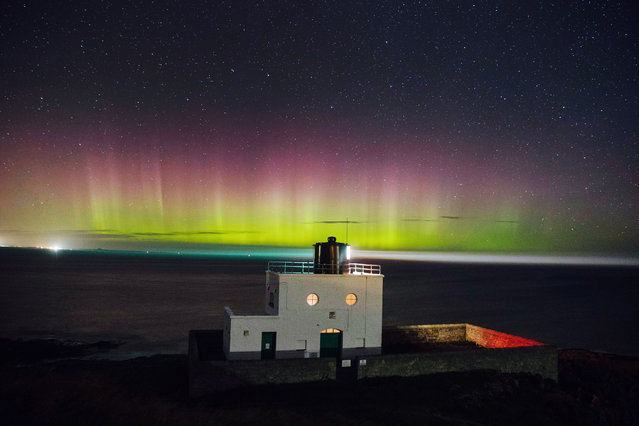
The northern lights, or aurora borealis, appear in the sky over the Bamburgh lighthouse at Stag Rock in Northumberland, England on September 28, 2016. (Photo by Owen Humphreys/PA Wire via ZUMA Press)

The northern lights, or aurora borealis, appear in the sky over the Bamburgh lighthouse at Stag Rock in Northumberland, England on September 28, 2016. (Photo by Owen Humphreys/PA Wire via ZUMA Press)
Details
30 Sep 2016 09:25:00
Urban explorer Vad Him of Rudex team jumps whilst on a rooftop in Moscow, Russia, August 14, 2017. (Photo by Maxim Shemetov/Reuters)

To an outsider, their passion is at times illegal and often on the verge of life and death. But climbing rooftops of high-rise buildings and exploring abandoned facilities is in the blood of these young Muscovites. The small group calls itself “Rudex”, which stands for “roof and decay exploration”, and is akin a Western youth craze known as urbex or “urban exploration” of man-made structures. Here: Urban explorer Vad Him of Rudex team jumps whilst on a rooftop in Moscow, Russia, August 14, 2017. (Photo by Maxim Shemetov/Reuters)
Details
25 Sep 2017 06:36:00


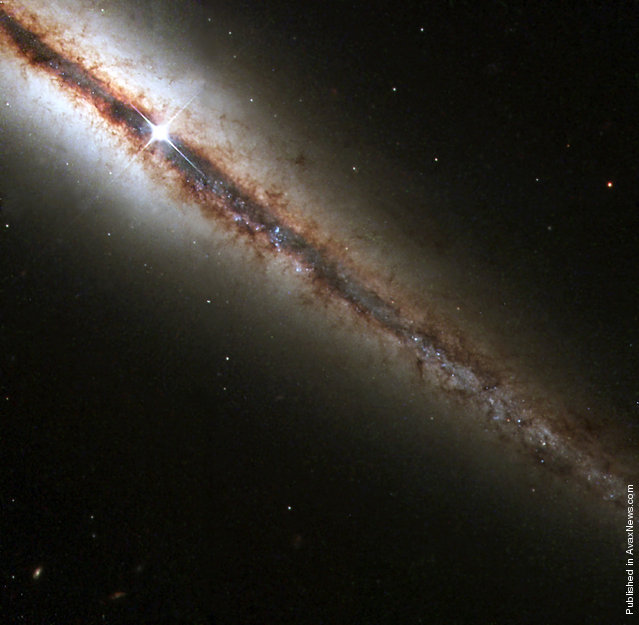
An image produced by the Hubble telescope of the perfectly “edge-on” galaxy, or NGC 4013, March 1, 2001. This new Hubble picture reveals, with great detail, huge clouds of dust and gas extending along, as well as far above, the galaxy's main disk. NGC 4013 is a spiral galaxy, similar to the Milky Way, lying some 55 million light-years from Earth in the direction of the constellation Ursa Major. Viewed face-on, it would look like a nearly circular pinwheel, but NGC 4013 happens to be seen edge-on from our vantage point. Even at 55 million light-years, the galaxy is larger than Hubble's field of view, and the image shows only a little more than half of the object, albeit with unprecedented detail. (Photo Courtesy of NASA/Newsmakers)
Details
28 Feb 2015 22:33:00
A NASA Engineer Builds A Better Halloween Costume

Two years ago, Mark Rober was an engineer at NASA’s Jet Propulsion Laboratory in Pasadena, California, part of a team that worked on the Curiosity rover. For Halloween, he strapped an iPad to his chest and another to his back. Then he turned them on and used the devices’ cameras and screens to make it appear as if he had a gaping hole in the middle of his torso. (Photo By Mark Rober)
Details
15 Oct 2014 17:16:00
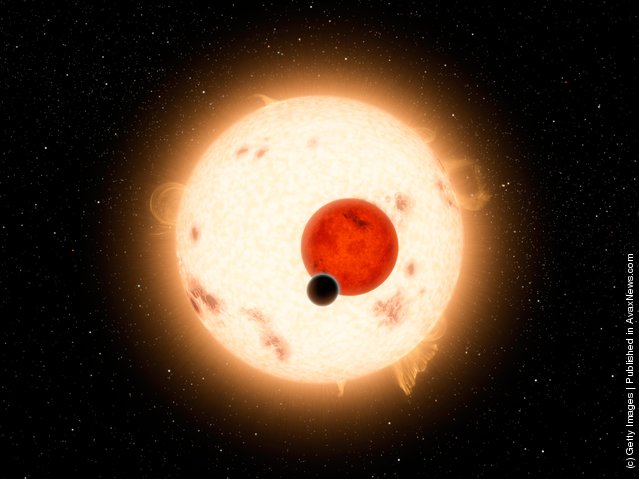
The newly-discovered gaseous planet Kepler-16b orbits it's two stars

The newly-discovered gaseous planet Kepler-16b orbits it's two stars. NASA's Kepler Mission discoverd the world orbiting two Stars, the larger a K dwarf and the smaller a red dwarf. (Photo by NASA/JPL-Caltech/T. Pyle via Getty Images)
Details
07 Dec 2011 12:28:00
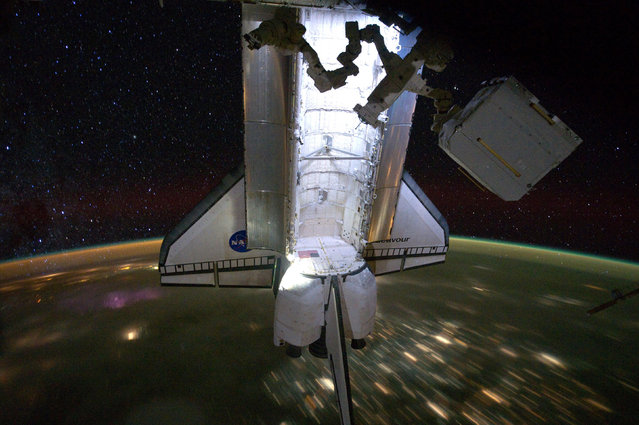
Backdropped by a night time view of the Earth and the starry sky, the Space Shuttle Endeavour is seen docked to the International Space Station on May 28, 2011. (Photo by Reuters/NASA)

Backdropped by a night time view of the Earth and the starry sky, the Space Shuttle Endeavour is seen docked to the International Space Station on May 28, 2011. (Photo by Reuters/NASA)
Details
21 Sep 2014 10:50:00