Loading...
Done
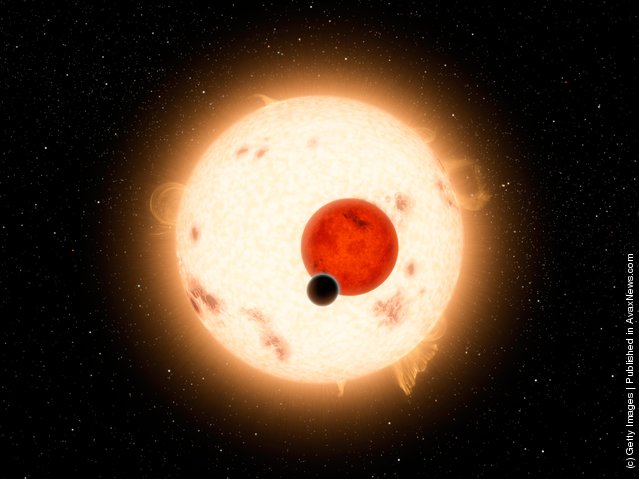
The newly-discovered gaseous planet Kepler-16b orbits it's two stars

The newly-discovered gaseous planet Kepler-16b orbits it's two stars. NASA's Kepler Mission discoverd the world orbiting two Stars, the larger a K dwarf and the smaller a red dwarf. (Photo by NASA/JPL-Caltech/T. Pyle via Getty Images)
Details
07 Dec 2011 12:28:00
A NASA Engineer Builds A Better Halloween Costume

Two years ago, Mark Rober was an engineer at NASA’s Jet Propulsion Laboratory in Pasadena, California, part of a team that worked on the Curiosity rover. For Halloween, he strapped an iPad to his chest and another to his back. Then he turned them on and used the devices’ cameras and screens to make it appear as if he had a gaping hole in the middle of his torso. (Photo By Mark Rober)
Details
15 Oct 2014 17:16:00
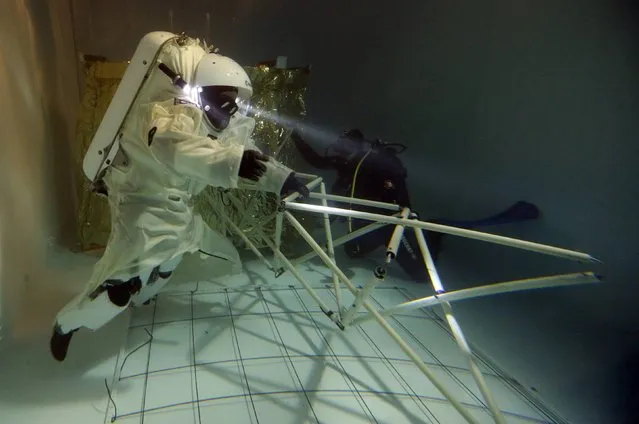
National Diving School director Jerome Vincent, wearing a Gandolfi space suit, executes training procedures in a swimming pool in Marseille October 22, 2014. (Photo by Jean-Paul Pelissier/Reuters)

National Diving School director Jerome Vincent, wearing a Gandolfi space suit, executes training procedures in a swimming pool in Marseille October 22, 2014. The underwater test session develops European expertise in spacewalk simulations under partial gravity for exploring the Moon, asteroids and Mars.The training is organised by Comex, a French company specializing in engineering and deep sea diving operations, in collaboration with the European Space Agency (ESA) and with Apollo XI “Under the sea”. (Photo by Jean-Paul Pelissier/Reuters)
Details
26 Oct 2014 12:47:00
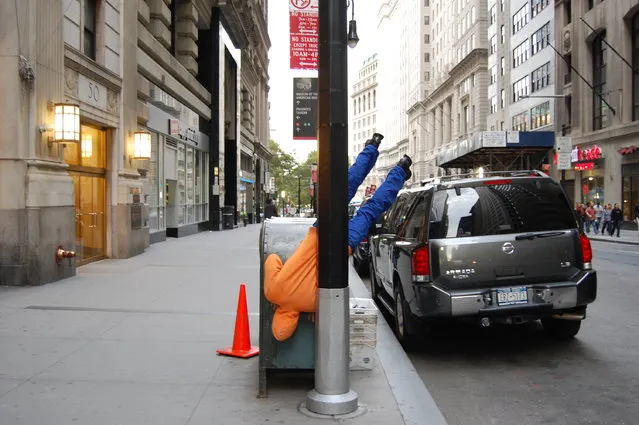
Willi Dorner, Bodies in Urban Spaces, September 26, 2010

“Bodies in urban spaces” is a temporarily intervention in diversified urban architectonical environment. The intention of “bodies in urban spaces” is to point out the urban functional structure and to uncover the restricted movement possibilities and behavior as well as rules and limitations. Photo: “Bodies in Urban Spaces”, September 26, 2010. (Photos by Andrew Russeth)
Details
16 Sep 2013 09:32:00
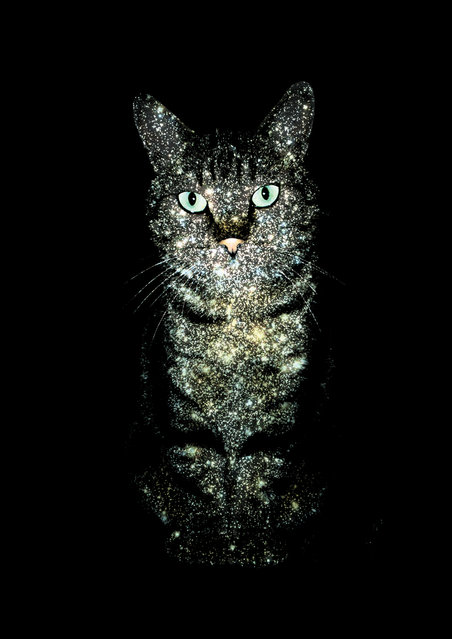
Space Cats By Zippora Lux

Boya Latumahina, alter ego, Zippora Lux is a Design student studying at Central St Martins in London. She has created these space age cats by combining two of her favourite things, cats and telescopic photographs.
Details
01 Dec 2013 10:34:00
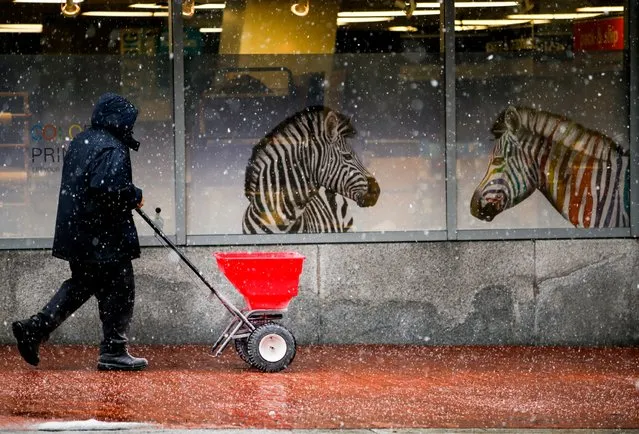
A man salts a downtown sidewalk in Washington, Thursday, March 5, 2015, as snow begins to fall. The U.S. federal government said its offices in the Washington area will be closed Thursday because of a new round of winter weather expected in the region. The Office of Personnel Management said non-emergency personnel in and around Washington were granted excused absences for the day. Emergency employees and telework-ready employees were expected to work. (AP Photo/Andrew Harnik)

A man salts a downtown sidewalk in Washington, Thursday, March 5, 2015, as snow begins to fall. The U.S. federal government said its offices in the Washington area will be closed Thursday because of a new round of winter weather expected in the region. The Office of Personnel Management said non-emergency personnel in and around Washington were granted excused absences for the day. Emergency employees and telework-ready employees were expected to work. (AP Photo/Andrew Harnik)
Details
07 Mar 2015 13:00:00


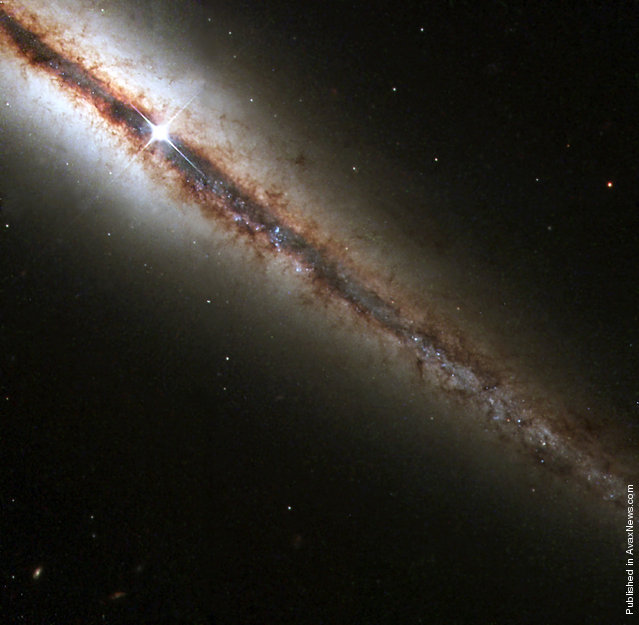
An image produced by the Hubble telescope of the perfectly “edge-on” galaxy, or NGC 4013, March 1, 2001. This new Hubble picture reveals, with great detail, huge clouds of dust and gas extending along, as well as far above, the galaxy's main disk. NGC 4013 is a spiral galaxy, similar to the Milky Way, lying some 55 million light-years from Earth in the direction of the constellation Ursa Major. Viewed face-on, it would look like a nearly circular pinwheel, but NGC 4013 happens to be seen edge-on from our vantage point. Even at 55 million light-years, the galaxy is larger than Hubble's field of view, and the image shows only a little more than half of the object, albeit with unprecedented detail. (Photo Courtesy of NASA/Newsmakers)

Details
28 Feb 2015 22:33:00
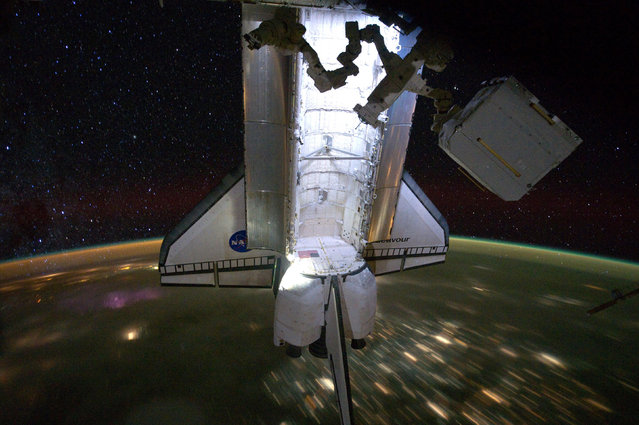
Backdropped by a night time view of the Earth and the starry sky, the Space Shuttle Endeavour is seen docked to the International Space Station on May 28, 2011. (Photo by Reuters/NASA)

Backdropped by a night time view of the Earth and the starry sky, the Space Shuttle Endeavour is seen docked to the International Space Station on May 28, 2011. (Photo by Reuters/NASA)
Details
21 Sep 2014 10:50:00